Results by title
3 books match the query 'Meléndez, A. Gabriel'
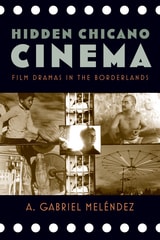
Hidden Chicano Cinema
Film Dramas in the BorderlandsMeléndez, A. Gabriel
Rutgers University Press, 2013
The book highlights “film moments” in this region’s history including the “filmic turn” ushered in by Chicano/a filmmakers who created new ways to represent their community and region. A. Gabriel Meléndez narrates the drama, intrigue, and politics of these moments and accounts for the specific cinematic practices and the sociocultural detail that explains how the camera itself brought filmmakers and their subjects to unexpected encounters on and off the screen. Such films as Adventures in Kit Carson Land, The Rattlesnake, and Red Sky at Morning, among others, provide examples of movies that have both educated and misinformed us about a place that remains a “distant locale” in the mind of most film audiences.
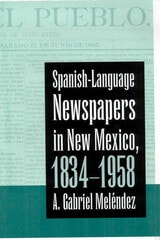
Spanish-Language Newspapers in New Mexico, 1834-1958
A. Gabriel Meléndez
University of Arizona Press, 2005
Gabriel Meléndez details the education and formation of a generation of Spanish-language journalists who were instrumental in creating a culture of print in nativo communities. He then offers in-depth cultural and literary analyses of the texts produced by los periodiqueros, establishing them thematically as precursors of the Chicano literary and political movements of the 1960s and ’70s.
Moving beyond a simple effort to reinscribe Nuevomexicanos into history, Meléndez views these newspapers as cultural productions and the work of the editors as an organized movement against cultural erasure amid the massive influx of easterners to the Southwest. Readers will find a wealth of information in this book. But more important, they will come away with the sense that the survival of Nuevomexicanos as a culturally and politically viable group is owed to the labor of this brilliant generation of newspapermen who also were statesmen, scholars, and creative writers.
The Multicultural Southwest
A ReaderEdited by A. Gabriel Meléndez, M. Jane Young, Patricia Moore, and Patrick Pynes
University of Arizona Press, 2001
As Americans debate what it means to be a multicultural society, one need only turn for lessons to the Southwest, where distinct peoples have coexisted over centuries. Here difference has not only survived but thrived in a melting pot of races and customs.
This book presents a montage of differing perspectives demonstrating that there is no single, definitive description of the Southwest. It brings together a host of writers, from early travelers and historians to contemporary commentators, who explore a region diverse in its people and ecology and show it to be not just a segment of the nation, but rather a border contact zone.
The editors have assembled an interdisciplinary composite, drawing on history, sociology, anthropology, and geography. Fiction, essays, poetry, newspaper articles, and interviews with local inhabitants add a colorful dimension to the coverage. All of the contributions reveal the tremendous impact that everyday occurrences can have and show how life in the Southwest is affected by the interweaving of social, cultural, and ecological forces. Together they demonstrate the role played by personal and cultural memory in creating alternative views of environment, landscape, human social interaction, conquest, dispossession, technological change, and the survival of cultures.
The Multicultural Southwest is a multifaceted work that shows the many ways in which the past continues to affect the present. It will create in readers an awareness of the phenomena that fuel human imagination and creativity as it opens their eyes to the possibilities of the future.