Results by title
6 books match the query 'Membership'
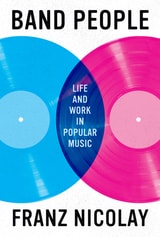
Band People
Life and Work in Popular MusicFranz Nicolay
University of Texas Press, 2024
A close look at the lives of working musicians who aren’t the center of their stage.
Secret (and not-so-secret) weapons, side-of-the-stagers, rhythm and horn sections, backup singers, accompanists—these and other “band people” are the anonymous but irreplaceable character actors of popular music. Through interviews and incisive cultural critique, writer and musician Franz Nicolay provides a portrait of the musical middle class. Artists talk frankly about their careers and attitudes toward their craft, work environment, and group dynamics, and shed light on how support musicians make sense of the weird combination of friend group, gang, small business consortium, long-term creative collaboration, and chosen family that constitutes a band. Is it more important to be a good hang or a virtuoso player? Do bands work best as democracies or autocracies? How do musicians with children balance their personal and professional lives? How much money is too little? And how does it feel to play on hundreds of records, with none released under your name? In exploring these and other questions, Band People gives voice to those who collaborate to create and dissects what it means to be a laborer in the culture industry.
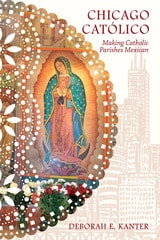
Chicago Católico
Making Catholic Parishes MexicanDeborah E. Kanter
University of Illinois Press, 2020
Deborah E. Kanter tells the story of neighborhood change and rebirth in Chicago's Mexican American communities. She unveils a vibrant history of Mexican American and Mexican immigrant relations as remembered by laity and clergy, schoolchildren and their female religious teachers, parish athletes and coaches, European American neighbors, and from the immigrant women who organized as guadalupanas and their husbands who took part in the Holy Name Society. Kanter shows how the newly arrived mixed memories of home into learning the ways of Chicago to create new identities. In an ever-evolving city, Mexican immigrants and Mexican Americans’ fierce devotion to their churches transformed neighborhoods such as Pilsen.
The first-ever study of Mexican-descent Catholicism in the city, Chicago Católico illuminates a previously unexplored facet of the urban past and provides present-day lessons for American communities undergoing ethnic integration and succession.
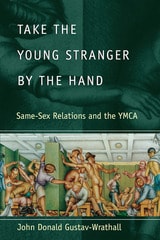
Take the Young Stranger by the Hand
Same-Sex Relations and the YMCAJohn Donald Gustav-Wrathall
University of Chicago Press, 1998
"Gustav-Wrathall's book offers an in-depth history of the origins and purposes of the Young Men's Christian Association and how it evolved into—and out of—a gay playland."—Arnie Kantrowitz, Lambda Book Report
"The book's absorbing exploration of the sometimes schismatic, sometimes synergistic relationship between spirituality and sexuality is a fascinating addition to the growing body of social history."—Jim Van Buskirk, San Francisco Bay Guardian
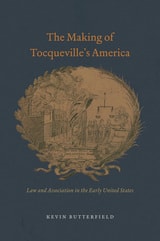
The Making of Tocqueville's America
Law and Association in the Early United StatesKevin Butterfield
University of Chicago Press, 2015
Butterfield explains that the first generations of American citizens found in the concept of membership—in churches, fraternities, reform societies, labor unions, and private business corporations—a mechanism to balance the tension between collective action and personal autonomy, something they accomplished by emphasizing law and procedural fairness. As this post-Revolutionary procedural culture developed, so too did the legal substructure of American civil society. Tocqueville, then, was wrong to see associations as the training ground for democracy, where people learned to honor one another’s voices and perspectives. Rather, they were the training ground for something no less valuable to the success of the American democratic experiment: increasingly formal and legalistic relations among people.
Transforming Citizenship
Democracy, Membership, and Belonging in Latino CommunitiesRaymond A. Rocco
Michigan State University Press, 2014
Why I Stay 2
The Challenges of Discipleship for Contemporary Latter-day SaintsRobert A. Rees
Signature Books, 2021
Twenty-one women and men discuss what it is about Mormonism that keeps them part of the fold. Their deep, unique experiences make their individual travels even more compelling. Kimberly Applewhite Teitter, growing up in the South as a Black Latter-day Saint, often encountered well-meaning Latter-day Saints whose words messaged the idea that she was at some level an outsider or perhaps not as authentically Mormon as others in her congregation. Thus, she writes, “At the end of the day I’m still Black—still have felt the weight of proving that I represent the church I’ve fought so hard for my entire life.” Yet the very episodes that could have driven her from the church became lessons on the meaning of discipleship.
For Carol Lynn Pearson, staying boiled down to two reasons: “I find a great deal of love in this church,” and “where I do not find love, I have an opportunity to help create love.” The stories she shares illuminate that mantra. Mitch Mayne, an openly gay man, has faced many challenges by his decision to stay. “Most days, it seems I can’t be Mormon enough for my LDS community, and I can’t be gay enough for my LGBT fellows.” In his essay, he answers the question many have asked: “Why don’t you just leave the church?”