Results by title
10 books match the query 'Mendes-Flohr, Paul'
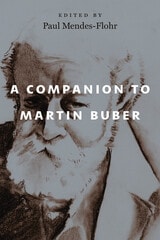
A Companion to Martin Buber
Edited by Paul Mendes-Flohr
University of Chicago Press, 2025
In his 1923 essay, I and Thou, the philosopher, theologian, and activist Martin Buber introduced a philosophy of dialogue that achieved a global, interdisciplinary resonance. For Buber, dialogue was more than a conversation; dialogue discloses something essential about our orientation and our lives with one another. This companion assembles twenty-six scholars from a dozen countries to explore Buber’s international reputation and legacy in education, interfaith relations, Judaism, philosophy, politics, and psychology. The result is an essential guide to one of the most influential Jewish thinkers of the twentieth century.
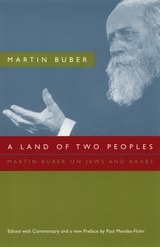
A Land of Two Peoples
Martin Buber on Jews and ArabsMartin Buber
University of Chicago Press, 2005
Collected in ALand of Two Peoples are the private and open letters, addresses, and essays in which Buber advocated binationalism as a solution to the conflict in the Middle East. A committed Zionist, Buber steadfastly articulated the moral necessity for reconciliation and accommodation between the Arabs and Jews. From the Balfour Declaration of November 1917 to his death in 1965, he campaigned passionately for a "one state solution.
With the Middle East embroiled in religious and ethnic chaos, A Land of Two Peoples remains as relevant today as it was when it was first published more than twenty years ago. This timely reprint, which includes a new preface by Paul Mendes-Flohr, offers context and depth to current affairs and will be welcomed by those interested in Middle Eastern studies and political theory.
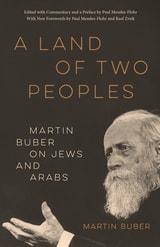
A Land of Two Peoples
Martin Buber on Jews and ArabsMartin Buber
University of Chicago Press, 2025
The theologian and philosopher Martin Buber (1878–1965) was committed to radical socioeconomic reconstruction in pursuit of international peace. His voluminous writings on Arab-Jewish relations in Palestine interweave his religious and philosophical teachings with his politics, each essential to Buber’s vision of democratic and religious life.
A Land of Two Peoples collects the letters, talks, and essays in which Buber advocated for a binationalism that reconciled Arabs and Jews as a solution to the conflict in the Middle East. As relevant today as when it was first published nearly fifty years ago, this edition of A Land of Two Peoples includes two forewords from the preeminent Jewish and Palestinian scholars Paul Mendes-Flohr and Raef Zreik.
Cultural Disjunctions
Post-Traditional Jewish IdentitiesPaul Mendes-Flohr
University of Chicago Press, 2021
Judaism Despite Christianity
The 1916 Wartime Correspondence Between Eugen Rosenstock-Huessy and Franz RosenzweigEdited by Eugen Rosenstock-Huessy
University of Chicago Press, 2011
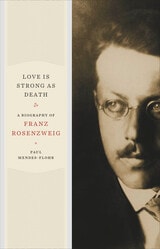
Love Is Strong as Death
A Biography of Franz RosenzweigPaul Mendes-Flohr
University of Chicago Press, 2026
Franz Rosenzweig (1886–1929) was one of the central figures of the Jewish cultural and intellectual renaissance in Weimar Germany. His masterwork, The Star of Redemption (1921), is a classic of existential thought and Jewish philosophy, and his considerable legacy also includes his collaboration with Martin Buber on a key translation of the Hebrew Bible into German and the establishment of an education center in Frankfurt that brought together the most important young German-Jewish intellectuals of its time.
Rosenzweig’s personal biography is no less fascinating than his ideas and accomplishments. Drawing on unprecedented access to Rosenzweig’s unpublished personal correspondence, Paul Mendes-Flohr skillfully weaves together the threads of Rosenzweig’s life to give us a moving portrait of this towering figure—from his near-conversion to Christianity to his tragic diagnosis with ALS. Mendes-Flohr also closely explores Rosenzweig’s relationship with Margrit Huessy, who was a vital intellectual partner for Rosenzweig, as well as a muse and lover. He worked out many of his ideas about love both in conversation and consort with her, and Mendes-Flohr shows the importance of intimacy—both romantic and platonic—in the development of Rosenzweig’s thought.
Love Is Strong as Death provides a unique and insightful look at one of the most important modern Jewish thinkers.
On Faith
Nathan Rotenstreich
University of Chicago Press, 1998
Rotenstreich's phenomenological study will be of great importance for religious scholars as well as for philosophers.
Nathan Rotenstreich (1913-93) was professor of philosophy at the Hebrew University of Jerusalem. He was elected to the Israel Academy of Sciences and Humanities, and his works include Jews and German Philosophy and Reason and Its Manifestations: A Study of Kant and Hegel.
The Essential Hayim Greenberg
Essays and Addresses on Jewish Culture, Socialism, and ZionismHayim Greenberg, Edited and introduced by Mark Raider, Foreword by Paul Mendes-Flohr
University of Alabama Press, 2016
This collection of thoroughly annotated essays, spanning the 1920s to the early 1950s, includes Greenberg’s meditations on socialism and ethics, profiles of polarizing twentieth-century figures (among them Trotsky, Lenin, and Gandhi), and several essays investigating the compatibility of socialism and communism. Greenberg always circles back, however, to the recurring question of how Jews might situate themselves in modernity, both before and after the Holocaust, and how Labor Zionist ideology might reshape the imbalances of Jewish economic life.
Alongside his role as an American Zionist leader, Greenberg maintained a lifelong commitment to the vitality of the Jewish diaspora. Rather than promoting Jewish autonomy and statehood, he argued for fidelity to the Jewish spirit. This volume not only seeks to restore Greenberg to his previous stature in the field of Judaic studies but also to return a vital and authentic voice, long quieted, to the continuing debate over what it means to be Jewish.
The Essential Hayim Greenberg provides an accessible text for scholars, historians, and students of Jewish studies, religion, and theology.

The Philosophy of Franz Rosenzweig
Edited by Paul Mendes-Flohr
University Press of New England, 2002
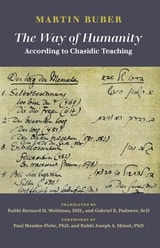
The Way of Humanity
According to Chasidic TeachingMartin Buber, translated by Rabbi Bernard H. Mehlman, DHL and GabrielE. Padawer, ScD
Central Conference of American Rabbis, 2023
Martin Buber (1878–1965) was one of the most influential Jewish thinkers of the twentieth century. A philosopher, seeker, and nurturer of dialogue, he responded to the complexities of his times by affirming the fullness of interpersonal encounter and the spiritual everyday. In 1947, Buber delivered lectures interpreting six traditional Chasidic stories to a German-speaking audience, published as The Way of Humanity. In the first new English translation in over half a century, Rabbi Bernard H. Mehlman, DHL, and Gabriel E. Padawer, ScD, z"l, bring the work to contemporary readers in a clear, accessible voice. The teachings within highlight the subversion and innovation of the early Chasidic masters of the eighteenth and nineteenth centuries, while providing meaningful spiritual guidance and insight for any seeker today. Scholarly forewords by Paul Mendes-Flohr, PhD, and Rabbi Joseph A. Skloot, PhD, as well as an introduction, epilogue, and notes from the translators, place Buber’s work in historical context. Timeless and enlightening, The Way of Humanity guides us to inner meaning and highlights our human wholeness.