Results by title
39 books match the query 'Method'
A Fan Studies Primer
Method, Research, EthicsPaul Booth
University of Iowa Press, 2021
Advanced Theoretical and Numerical Electromagnetics
Field representations and the Method of Moments, Volume 2Vito Lancellotti
The Institution of Engineering and Technology, 2022
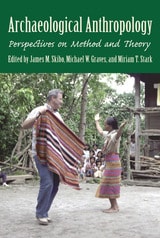
Archaeological Anthropology
Perspectives on Method and TheoryEdited by James M. Skibo, Michael W. Graves, and Miriam T. Stark
University of Arizona Press, 2014
In this collection of twelve new chapters, four generations of Longacre protégés show how they are building upon and developing but also modifying the theoretical paradigm that remains at the core of Americanist archaeology. The contributions focus on six themes prominent in Longacre’s career: the intellectual history of the field in the late twentieth century, archaeological methodology, analogical inference, ethnoarchaeology, cultural evolution, and reconstructing ancient society.
More than a comprehensive overview of the ideas developed by one of the most influential scholars in the field, however, Archaeological Anthropology makes stimulating contributions to contemporary research. The contributors do not unequivocally endorse Longacre’s ideas; they challenge them and expand beyond them, making this volume a fitting tribute to a man whose robust research and teaching career continues to resonate.
Asia as Method
Toward DeimperializationKuan-Hsing Chen
Duke University Press, 2010
Chen is one of the most important intellectuals working in East Asia today; his writing has been influential in Taiwan, South Korea, Hong Kong, Japan, Singapore, and mainland China for the past fifteen years. As a founding member of the Inter-Asia Cultural Studies Society and its journal, he has helped to initiate change in the dynamics and intellectual orientation of the region, building a network that has facilitated inter-Asian connections. Asia as Method encapsulates Chen’s vision and activities within the increasingly “inter-referencing” East Asian intellectual community and charts necessary new directions for cultural studies.
Border as Method, or, the Multiplication of Labor
Sandro Mezzadra and Brett Neilson
Duke University Press, 2013
Cartesian Questions
Method and MetaphysicsJean-Luc Marion
University of Chicago Press, 1999
"Besides the impact of their content, the clarity and reach of these essays force one to consider foundational questions concerning philosophy and its history."—Richard Watson, Journal of the History of Philosophy
Cinemachines
An Essay on Media and MethodGarrett Stewart
University of Chicago Press, 2020
Engaging in fresh ways with revelatory special effects in the history of cinematic storytelling—from Buster Keaton’s breaching of the film screen in Sherlock Jr. to the pixel disintegration of a remotely projected hologram in Blade Runner 2049—Stewart’s book puts unprecedented emphasis on technique in moving image narrative. Complicating and revising the discourse on historical screen processes, Cinemachines will be crucial reading for anyone interested in the evolution of the movies from a celluloid to a digital medium.
Comparing Public Bureaucracies
Problems of Theory and MethodB. Guy Peters
University of Alabama Press, 1988
A foundational guide to understanding how bureaucracies differ—and why those differences matter.
The comparative study of public policy once promised to make major contributions to our understanding of government. Much of that promise now appears unfulfilled. What accounts for this decline in intellectual fortunes and change in intellectual fashion? Comparing Public Bureaucracies seeks to understand why. One of the principal answers is that there is no readily accepted and dependent variable that would allow comparative public administration to conform to the usual canons of social research. In contrast, comparative public policy has a ready-made dependent variable in public expenditure.
Peters discusses four possible dependent variables for comparative public administration. The first is personnel—the number and type of people who work for government. Second, the number and type of organizations that form government can suggest a great deal about the structure of government. Third, the behavior of members is obviously important for understanding what actually happens in government—such as the extents to which bureaucracies approximate the budget-maximizing behavior posited by economists. Ginally, the relative power of civil servants in the policymaking process is a major factor in institutional politics in contemporary industrial societies.
Consequences of Hermeneutics
Fifty Years After Gadamer's Truth and MethodJeff Malpas
Northwestern University Press, 2010
The publication of Hans-Georg Gadamer’s magnum opus Truth and Method in 1960 marked the arrival of philosophical hermeneutics as a dominant force in philosophy and the humanities as a whole. Consequences of Hermeneutics celebrates the fiftieth anniversary of the publication of one of the most important philosophical works of the twentieth century with essays by most of the leading figures in contemporary hermeneutic theory, including Gianni Vattimo and Jean Grondin.
These essays examine the achievements of hermeneutics as well as its current status and prospects for the future. Gadamer’s text provides an important focus, but the ambition of these critical reappraisals extends to hermeneutics more broadly and to a range of other thinkers, such as Heidegger, Ricoeur, Derrida, and Rorty. Forcefully demonstrating the continuing relevance and power of hermeneutics, Consequences of Hermeneutics is a fitting tribute to Gadamer and the legacy of his thought.

Critical Paths
Blake and the Argument of MethodDan Miller, Mark Bracher and Donald Ault, eds.
Duke University Press, 1987
The contributors assembled here, leading exponents of contemporary critical methods as well as close students of Blake, argue the grounds, purposes, and validity of each approach and then apply its method in detailed readings of Blake's works. We see deconstruction, psychoanalytic interpretation, feminist critique, semiotic analysis, Marxist criticism, revisionism, and other methods brought to bear on Blake's texts and into confrontation with one another by those best able to do so.
Through the essays themselves and in the reaction they will certainly provoke, Critical Paths will bring increased theoretical awareness to the study of Blake and will further the ongoing redefinition of Blake's art. At the same time, the collection investigates the general problem of methodology in literary studies by means of a casebook examination of modern critical approaches. Blake criticism and current literary theory here come together; the encounter illuminates and enriches both.
Criticism and Truth
On Method in Literary StudiesJonathan Kramnick
University of Chicago Press, 2023
Does literary criticism offer truths about the world? In Criticism and Truth, Jonathan Kramnick offers a new and surprising account of criticism’s power by zeroing in on its singular method: close reading. Long recognized as the distinctive technique of literary studies, close reading is the critic’s way of pursuing arguments and advancing knowledge, as well as the primary skill taught in the English major. But it is also more than that—a creative, immersive, and transformative writing practice that fosters a unique kind of engagement with the world. Drawing on the rich and varied landscape of contemporary criticism, Kramnick changes how we think about the basic tools of literary analysis, including the art of in-text quotation, summary, and other reading methods, helping us to see them as an invaluable form of humanistic expertise. Criticism and Truth is a call to arms, making a powerful case for the necessity of both literature and criticism within a multidisciplinary university.
As the humanities fight for survival in contemporary higher education, the study of literature doesn’t need more plans for reform. Rather, it needs a defense of the work already being done and an account of why it should flourish. This is what Criticism and Truth offers, in vivid and portable form.
Digital Pedagogy in Early Modern Studies
Method and PraxisEdited by Andie Silva and Scott Schofield
Iter Press, 2023
This collection of essays focuses on teaching at the intersection of early modern literature, book history, and digital media. It considers how teaching different fields and methods of study can be enhanced and facilitated by digital technologies. The volume provides a snapshot of current thinking on digital pedagogy as practiced by leading scholars in the field and offers a series of models that may be adapted, personalized, and repurposed by future teachers seeking to bring digital methodologies to their classrooms. Supplementary materials for this title are available on the Iter Press website (iterpress.org): see under Books/Supplementary Materials.
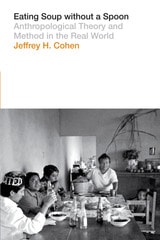
Eating Soup without a Spoon
Anthropological Theory and Method in the Real WorldBy Jeffrey H. Cohen
University of Texas Press, 2015
Significant scholarship exists on anthropological fieldwork and methodologies. Some anthropologists have also published memoirs of their research experiences. Renowned anthropologist Jeffrey Cohen’s Eating Soup without a Spoon is a first-of-its-kind hybrid of the two, expertly melding story with methodology to create a compelling narrative of fieldwork that is deeply grounded in anthropological theory.
Cohen’s first foray into fieldwork was in 1992, when he lived in Santa Anna del Valle in rural Oaxaca, Mexico. While recounting his experiences studying how rural folks adapted to far-reaching economic changes, Cohen is candid about the mistakes he made and the struggles in the village. From the pressures of gaining the trust of a population to the fear of making errors in data collection, Cohen explores the intellectual processes behind ethnographic research. He offers tips for collecting data, avoiding pitfalls, and embracing the chaos and shocks that come with working in an unfamiliar environment. Cohen’s own photographs enrich his vivid portrayals of daily life.
In this groundbreaking work, Cohen discusses the adventure, wonder, community, and friendships he encountered during his first year of work, but, first and foremost, he writes in service to the field as a place to do research: to test ideas, develop theories, and model how humans cope and react to the world.
Hearing Things
Voice and Method in the Writing of Stanley CavellTimothy Gould
University of Chicago Press, 1998
Gould argues that a tension between voice and method unites Cavell's broad and often perplexing range of interests. From Wittgenstein to Thoreau, from Shakespeare to the movies, and from opera to Freud, Gould reveals the connection between the voice within Cavell's writing and the voices Cavell appeals to through the methods of ordinary language philosophy. Within Cavell's extraordinary productivity lies a new sense of philosophical method based on elements of the act of reading. Hearing Things is both an important study of Cavell's work and a major contribution to the construction of American philosophy.
History 4° Celsius
Search for a Method in the Age of the AnthropoceneIan Baucom
Duke University Press, 2020
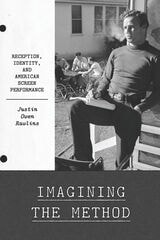
Imagining the Method
Reception, Identity, and American Screen PerformanceJustin Owen Rawlins
University of Texas Press, 2024
A revisionist history of Method acting that connects the popular reception of “methodness” to entrenched understandings of screen performance still dominating American film discourse today.
Only one performance style has dominated the lexicon of the casual moviegoer: “Method acting.” The first reception-based analysis of film acting, Imagining the Method investigates how popular understandings of the so-called Method—what its author Justin Rawlins calls "methodness"—created an exclusive brand for white, male actors while associating such actors with rebellion and marginalization. Drawing on extensive archival research, the book maps the forces giving shape to methodness and policing its boundaries.
Imagining the Method traces the primordial conditions under which the Method was conceived. It explores John Garfield's tenuous relationship with methodness due to his identity. It considers the links between John Wayne's reliance on "anti-Method" stardom and Marlon Brando and James Dean's ascribed embodiment of Method features. It dissects contemporary emphases on transformation and considers the implications of methodness in the encoding of AI performers. Altogether, Justin Rawlins offers a revisionist history of the Method that shines a light on the cultural politics of methodness and the still-dominant assumptions about race, gender, and screen actors and acting that inform how we talk about performance and performers.
Looking Past the Screen
Case Studies in American Film History and MethodJon Lewis and Eric Smoodin, eds.
Duke University Press, 2007
Focusing on Hollywood cinema from the teens to the 1970s, these case studies show the value of this extraordinary range of historical materials in developing interdisciplinary approaches to film stardom, regulation, reception, and production. The contributors examine State Department negotiations over the content of American films shown abroad; analyze the star image of Clara Smith Hamon, who was notorious for having murdered her lover; and consider film journalists’ understanding of the arrival of auteurist cinema in Hollywood as it was happening during the early 1970s. One contributor chronicles the development of film studies as a scholarly discipline; another offers a sociopolitical interpretation of the origins of film noir. Still another brings to light Depression-era film reviews and Production Code memos so sophisticated in their readings of representations of sexuality that they undermine the perception that queer interpretations of film are a recent development. Looking Past the Screen suggests methods of historical research, and it encourages further thought about the modes of inquiry that structure the discipline of film studies.
Contributors. Mark Lynn Anderson, Janet Bergstrom, Richard deCordova, Kathryn Fuller-Seeley, Sumiko Higashi, Jon Lewis, David M. Lugowski, Dana Polan, Eric Schaefer, Andrea Slane, Eric Smoodin, Shelley Stamp

Method and Perspective in Anthropology
Papers in Honor of Wilson D. WallisRobert F. Spencer
University of Minnesota Press, 1954
Method and Perspective in Anthropology was first published in 1954. Minnesota Archive Editions uses digital technology to make long-unavailable books once again accessible, and are published unaltered from the original University of Minnesota Press editions.
The boundaries and goals of anthropology are changing and expanding as scholars recognize and pursue wider opportunities for achieving an understanding of the cultural development of man. The range of interests of the discipline as shown in this book embodies such varied fields as archaeology, human geography, linguistics, and the organization of society. With the broadening and deepening of these concerns, those working and studying in the various areas of anthropology have sought more concise methods and more adequate techniques with which to meet increasingly complex problems.
This volume of papers, published in honor of a scholar who has himself devoted much effort to the refinement of anthropological methods, represents a long step forward toward the solution of some of the problems of methodology. The contributors are outstanding scholars in cultural anthropology, ethnology, and related fields.
The first twelve papers, by as many different authors, present discussions of specific aspects of ethnography, cultural anthropology, prehistory, linguistics, ethnogeography, and sociology. The final paper, by Alfred L. Kroeber, provides a critical summary of the preceding papers. All twelve of the writers answer, in their own way, the questions of how they derive their data, and how they establish their theoretical frame of reference.
The contributors are, in addition to Professor Kroeber, Melville J. Herskovits, Sister M. Inez Hilger, Elizabeth Colson, David G. Mandelbaum, Allan R. Holmberg, Robert F. Spencer, Ralph Linton, Erwin H. Ackerknecht, Lloyd A. Wilford, Joseph H. Greenberg, Omer C. Stewart, and Raymond V. Bowers.
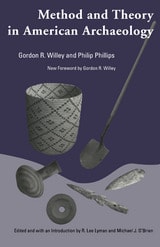
Method and Theory in American Archaeology
Gordon R. Willey
University of Alabama Press, 2001
A Dan Josselyn Memorial Publication
This invaluable classic provides the framework for the development of American archaeology during the last half of the 20th century.
In 1958 Gordon R. Willey and Philip Phillips first published Method and Theory in American Archaeology—a volume that went through five printings, the last in 1967 at the height of what became known as the new, or processual, archaeology. The advent of processual archaeology, according to Willey and Phillips, represented a "theoretical debate . . . a question of whether archaeology should be the study of cultural history or the study of cultural process."
Willey and Phillips suggested that little interpretation had taken place in American archaeology, and their book offered an analytical perspective; the methods they described and the structural framework they used for synthesizing American prehistory were all geared toward interpretation. Method and Theory served as the catalyst and primary reader on the topic for over a decade.
This facsimile reprint edition of the original University of Chicago Press volume includes a new foreword by Gordon R. Willey, which outlines the state of American archaeology at the time of the original publication, and a new introduction by the editors to place the book in historical context. The bibliography is exhaustive. Academic libraries, students, professionals, and knowledgeable amateurs will welcome this new edition of a standard-maker among texts on American archaeology.
Method and Theory in Paleoethnobotany
John M. Marston
University Press of Colorado, 2014
A diverse and highly regarded group of scholars reference a broad array of literature from around the world as they cover their areas of expertise in the practice and theory of paleoethnobotany—starch grain analysis, stable isotope analysis, ancient DNA, digital data management, and ecological and postprocessual theory.
The only comprehensive edited volume focusing on method and theory to appear in the last twenty-five years, Method and Theory in Paleoethnobotany addresses the new areas of inquiry that have become central to contemporary archaeological debates, as well as the current state of theoretical, methodological, and empirical work in paleoethnobotany.
Method as Method
Carlos Rojas, special issue editor
Duke University Press, 2020
Contributors. Yomi Braester, Hsiao-hung Chang, Margaret Hillenbrand, Chun-kit Ko, Belinda Kong, Petrus Liu, Laikwan Pang, Christopher Rea, Carlos Rojas, Shuang Shen, Robin Visser, Lorraine Wong
Mind, Matter, and Method
Essays in Philosophy and Science in Honor of Herbert FeiglPaul K. Feyerabend and Grover Maxwell, Editors
University of Minnesota Press, 1966
Mind, Matter, and Method was first published in 1966. Minnesota Archive Editions uses digital technology to make long-unavailable books once again accessible, and are published unaltered from the original University of Minnesota Press editions.
This volume of twenty-six essays by as many contributors is published in honor of Herbert Feigl, professor of philosophy at the University of Minnesota and director of the Minnesota Center for the Philosophy of Science. Though the majority of the contributors are philosophers, there are also -- as benefits Mr. Feigl's varied intellectual interests -- representatives of psychology, psychoanalysis, and physics.
The first group of ten essays deals with the philosophy of mind, particularly with the mind-body problem, to which Mr. Feigl has devoted much attention. The eleven essays in the second part are concerned with problems of philosophical method, especially with induction and confirmation. The third part is comprised of five essays on the philosophy of the physical sciences. A biographical sketch of Mr. Feigl and a bibliography of his writings are also provided.
Minor China
Method, Materialisms, and the AestheticHentyle Yapp
Duke University Press, 2021
Paradise and Method
Poetry and PraxisBruce Andrews
Northwestern University Press, 1996
Addressing poetics from a poet's perspective, Andrews focuses on the ways in which meaning is produced and challenged. His essays aim "to map out opportunities for making sense (or making noise)--both in reading and writing contemporary literature. At the center has been a desire to explore language, as up close as possible, as a material and social medium for restagings of meaning and power." Andrews analyzes poetics and the production of meaning; alternative traditions and canons; and innovative contemporary poetry, particularly its break with many of the premises and constraints of even the most forward-looking modernisms.
Personology
Method and Content in Personality Assessment and PsychobiographyIrving E. Alexander
Duke University Press, 1990
This work by a highly respected senior psychologist is an effort to answer these questions. Irving E. Alexander presents a case for considering the personal narrative of a human life as the most compelling aspect of that life to be decoded and understood. In part a critique of an exclusive reliance on general theories about the development of personality and ways of knowing based primarily on comparison with others, Personology is illustrated with material drawn from the lives, personal writings, and theories of Freud, Jung, and Sullivan. Alexander develops new insights into the lives of these men and offers methods and guidelines for investigating and teaching personology and psychobiography.
Ramus, Method, and the Decay of Dialogue
From the Art of Discourse to the Art of ReasonWalter J. Ong, S.J.
University of Chicago Press, 2004
Considered the most important work of Walter Ong's career, Ramus, Method, and the Decay of Dialogue is an elegant review of the history of Ramist scholarship and Ramus's quarrels with Aristotle. A key influence on Marshall McLuhan, with whom Ong enjoys the status of honorary guru among technophiles, this challenging study remains the most detailed account of Ramus's method ever published. Out of print for more than a decade, this book—with a new foreword by Adrian Johns—is a canonical text for enthusiasts of media, Renaissance literature, and intellectual history.
Reading the Dead Sea Scrolls
Essays in MethodGeorge J. Brooke
SBL Press, 2013
Rhetorical Criticism
A Study In MethodEdwin Black
University of Wisconsin Press, 1978
This is a book that, almost singlehandedly, freed scholars from the narrow constraints of a single critical paradigm and created a new era in the study of public discourse. Its original publication in 1965 created a spirited controversy. Here Edwin Black examines the assumptions and principles underlying neo-Aristotelian theory and suggests an alternative approach to criticism, centering around the concept of the "rhetorical transaction." This new edition, containing Black's new introduction, will enable students and scholars to secure a copy of one of the most influential books ever written in the field.
Rio as Method
Collective Resistance for a New GenerationPaul Amar, editor
Duke University Press, 2024
Contributors. Rosiane Rodrigues de Almeida, José Claudio Souza Alves, Tamires Maria Alves, Paul Amar, Marcelo Caetano Andreoli, Beatriz Bissio, Thaddeus Gregory Blanchette, Fernando Brancoli, Thayane Brêtas, Victoria Broadus, Fatima Cecchetto, Leonard Cortana, Marcos Coutinho, Monica Cunha, Luiz Henrique Eloy Amado, Marielle Franco, Cristiane Gomes Julião, Benjamin Lessing, Roberto Kant de Lima, Amanda De Lisio, Bryan McCann, Flávia Medeiros, Ana Paula Mendes de Miranda, Sean T. Mitchell, Rodrigo Monteiro, Vitória Moreira, Jacqueline de Oliveira Muniz, Laura Rebecca Murray, Cesar Pinheiro Teixeira, Osmundo Pinho, Paulo Pinto, María Victoria Pita, João Gabriel Rabello Sodré, Luciane Rocha, Marcos Alexandre dos Santos Albuquerque, Ana Paula da Silva, Denise Ferreira da Silva, Soraya Simões, Indianare Siqueira, Antonio Carlos de Souza Lima, Leonardo Vieira Silva
The Autonomy of History
Truth and Method from Erasmus to GibbonJoseph M. Levine
University of Chicago Press, 1999
Levine's first three essays discuss Thomas More's preoccupation with the distinction between history and fiction; Erasmus's biblical criticism and the contribution of Renaissance philology to critical method; and the way in which Renaissance rhetoric, as in Thomas Elyot's Book of the Governor, continued to inhibit the autonomy of history. He then shows how these issues persisted into the eighteenth century, even as critical method developed. He concludes with a close description of the great controversy that culminated in Edward Gibbon's day over the authenticity of a biblical text that had been used for centuries to defend the Trinity but which turned out to be a forgery. Levine shows how by then all sides were ready to concede the autonomy of history.
The Causes of Human Behavior
Implications for Theory and Method in the Social SciencesLawrence B. Mohr
University of Michigan Press, 1996
The Comity and Grace of Method
Essays in Honor of Edmund F. PerryThomas Ryba
Northwestern University Press, 2004
The essays in the first section—"Theory and Method in the History and Study of Religion"—clarify the role of scientific, phenomenological, and comparative approaches within the history of the study of religion; collectively, they represent a multifaceted statement about recurring and subtle problems in the field. In the second section—"Theories and Methods in Application"—the authors move from overarching theoretical concerns to the application of these methods in specific religious traditions, Western and Eastern. The third section demonstrates the effectiveness of these theories and methods as guidelines for promoting global inter-religious comity.
More than a fitting tribute to a revered and highly influential scholar, this book gives even those who knew nothing of Perry and his work much to learn from and ponder about the study of religion.

The Method of Metaphor
Stanley Raffel
Intellect Books, 2013
The Politics of Method in the Human Sciences
Positivism and Its Epistemological OthersGeorge Steinmetz, ed.
Duke University Press, 2005
Contributors explore and contrast some of the major alternatives to positivist epistemologies, including Marxism, psychoanalysis, poststructuralism, narrative theory, and actor-network theory. Almost all the essays are written by well-known practitioners of the fields discussed. Some essayists approach positivism and anti-positivism via close readings of texts influential in their respective disciplines. Some engage in ethnographies of the present-day human sciences; others are more historical in method. All of them critique contemporary social scientific practice. Together, they trace a trajectory of thought and method running from the past through the present and pointing toward possible futures.
Contributors. Andrew Abbott, Daniel Breslau, Michael Burawoy, Andrew Collier , Michael Dutton, Geoff Eley, Anthony Elliott, Stephen Engelmann, Sandra Harding, Emily Hauptmann, Webb Keane, Tony Lawson, Sophia Mihic, Philip Mirowski, Timothy Mitchell, William H. Sewell Jr., Margaret R. Somers, George Steinmetz, Elizabeth Wingrove
Theory and Method in the Social Sciences
Arnold M. Rose
University of Minnesota Press, 1954
Theory and Method in the Social Sciences was first published in 1954. Minnesota Archive Editions uses digital technology to make long-unavailable books once again accessible, and are published unaltered from the original University of Minnesota Press editions.
A series of essays dealing with some previously neglected areas of theory and research in the social sciences make up this volume. The problems considered fall into the general categories of social theory, values in social research, the contributions of sociological theory to the other social sciences, methodological issues in sociology, and some specific techniques of sociological research. The chapter entitled "A Theory of Social Organization and Disorganization," published here for the first time, won for Dr. Rose the 1952 prize of the American Association for the Advancement of Science for essays in social science. Although addressed primarily to sociologists, the book offers material of interest and value to other social scientists, particularly economists, psychologists, political scientists, and students of law.
Time Matters
On Theory and MethodAndrew Abbott
University of Chicago Press, 2001
Time Matters focuses particularly on questions of time, events, and causality. Abbott grounds each essay in straightforward examinations of actual social scientific analyses. Throughout, he demonstrates the crucial assumptions we make about causes and events, about actors and interaction and about time and meaning every time we employ methods of social analysis, whether in academic disciplines, market research, public opinion polling, or even evaluation research. Turning current assumptions on their heads, Abbott not only outlines the theoretical orthodoxies of empirical social science, he sketches new alternatives, laying down foundations for a new body of social theory.
Tolstoy's Phoenix
From Method to Meaning in War and PeaceGeorge R. Clay
Northwestern University Press, 1998
Volksgeist as Method and Ethic
Essays on Boasian Ethnography and the German Anthropological TraditionEdited by George W. Stocking, Jr.
University of Wisconsin Press, 1998
Walking in Cities
Quotidian Mobility as Urban Theory, Method, and PracticeEvrick Brown
Temple University Press, 2015
Walking connects the rhythms of urban life to the configuration of urban spaces. As the contributors and editors show in Walking in Cities, walking also reflects the systematic inequalities that order contemporary urban life. Walking has different meanings because it can be a way of temporarily “taking possession” of urban space, or it can make the relatively powerless more vulnerable to crime. The essays in Walking in Cities explore how walking intersects with sociological dimensions such as gender, race and ethnicity, social class, and power.
Various chapters explorethe flâneuse, or female urban drifter, in Tehran’s shopping malls; Hispanic neighborhoods in New York, San Diego, and El Paso; and the intra-neighborhood and inter-class dynamics of gentrification in Greenpoint, Brooklyn.The essays in Walking in Cities provide important lessons about urban life.