Results by title
188 books match the query 'Middle Eastern' and 18 start with a
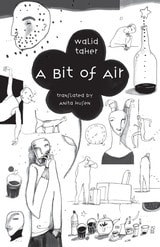
A Bit of Air
By Walid Taher
University of Texas Press, 2012
Award-winning Egyptian children’s author and illustrator Walid Taher targets a wider audience with A Bit of Air. Inspired by the long tradition of Egyptian colloquial poetry and its relation to social and political movements in Egypt, Taher creates a unique blend of visual art, poetry, and architecture. These darkly humorous poems and their accompanying images are snapshots of a state of mind and a space of fantasy that convey the absurd, the comical, the profound, and the idiosyncratic.
This illustrated, bilingual edition comes at a time of political and literary upheaval. An unprecedented number of Arab authors are producing new and noteworthy works by appropriating the language of blogs, poetry, comic strips, and film, to name a few. This mixing of media gives shape to new experiences emerging from and redefining a rapidly changing social and political reality. A new generation is ushering in a new language, a new literature, and a new Arab world.
A Map of Signs and Scents
New and Selected Poems, 1979–2014Amjad Nasser / Translated from the Arabic by Fady Joudah and Khaled Mattawa
Northwestern University Press, 2016
Featuring poems from earlier collections of Amjad Nasser’s work and many newer uncollected poems never made available in English, A Map of Signs and Scents introduces the work of an important Arabic poet to a broader contemporary Anglophone readership. This special annotation edition helps readers view the multifaceted contexts within which Nasser has created his award-winning poems.
A New Divan
A Lyrical Dialogue between East and WestEdited by Barbara Schwepcke and Bill Swainson
Gingko, 2019
Reaching through time, language, and poetic history, A New Divan offers a lyrical conversation and opens paths of connection across cultures.
A Poetic Genealogy of North African Literature
Thomas C. Connolly
Northwestern University Press, 2025
Engaging the poetic to expand our imagination of Maghrebi literature in French
Poetry, as the Moroccan writer Abdelkébir Khatibi describes it, is a form of dissymmetry that exposes readers to the unexpected, and to the possibility of a transformative encounter with the text. Drawing on literary, philosophical, theoretical, and theological texts in multiple languages and scripts, as well as on the visual arts, Thomas C. Connolly delves into the poetic works of Khatibi and six other major Maghrebi authors—Jean Amrouche, Tahar Djaout, Nabile Farès, Mohammed Khaïr-Eddine, Abdelwahab Meddeb, and Jean Sénac—as well as the French poet Arthur Rimbaud, to think anew about the origins and legacy of Francophone poetry in the Maghreb. Instead of turning away from the poetic when it becomes indecipherable, A Poetic Genealogy of North African Literature engages poetic texts on their own terms, allowing them to dictate the search for meaning, thereby expanding our understanding of what Maghrebi literature in French was, is, and might become.
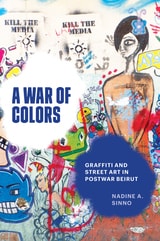
A War of Colors
Graffiti and Street Art in Postwar BeirutNadine A. Sinno
University of Texas Press, 2024
Demonstrates the role of Beirut’s postwar graffiti and street art in transforming the cityscape and animating resistance.
Over the last two decades in Beirut, graffiti makers have engaged in a fierce “war of colors,” seeking to disrupt and transform the city’s physical and social spaces. In A War of Colors, Nadine Sinno examines how graffiti and street art have been used in postwar Beirut to comment on the rapidly changing social dynamics of the country and region. Analyzing how graffiti makers can reclaim and transform cityscapes that were damaged or monopolized by militias during the war, Sinno explores graffiti’s other roles, including forging civic engagement, commemorating cultural icons, protesting political corruption and environmental violence, and animating resistance. In addition, she argues that graffiti making can offer voices to those who are often marginalized, especially women and LGBTQ people. Copiously illustrated with images of graffiti and street art, A War of Colors is a visually captivating and thought-provoking journey through Beirut, where local and global discourses intersect on both scarred and polished walls in the city.
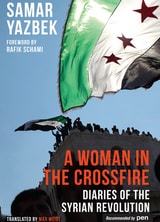
A Woman in the Crossfire
Diaries of the Syrian RevolutionSamar Yazbek
Haus Publishing, 2012
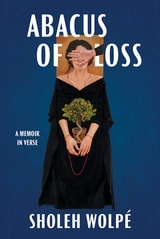
Abacus of Loss
A Memoir in VerseSholeh Wolpé
University of Arkansas Press, 2022
lbert Einstein said, “Not everything that can be counted counts, and not everything that counts can be counted.” It is in this vein that Sholeh Wolpé’s mesmerizing memoir in verse unfolds. In this lyrical and candid work, her fifth collection of poems, Wolpé invokes the abacus as an instrument of remembering. Through different countries and cultures, she carries us bead by bead on a journey of loss and triumph, love and exile. In the end, the tally is insight, not numbers, and we arrive at a place where nothing is too small for gratitude.
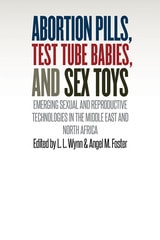
Abortion Pills, Test Tube Babies, and Sex Toys
Emerging Sexual and Reproductive Technologies in the Middle East and North AfricaL. L. Wynn
Vanderbilt University Press, 2017

Absinthe
World Literature in Translation: The Islamicate in TranslationJaideep Pandey
Michigan Publishing Services, 2025
Guest-edited by Razieh Araghi and Jaideep Pandey, this special issue explores the rich, multilingual, and transregional literary worlds shaped by and within the Islamicate sphere.
From the Mughal court to Metro Detroit, from Malayalam ghazals to Kurdish-inflected Persian prison poetry, this issue brings together literary translations and critical reflections that unsettle assumptions about language, identity, and belonging. Rather than framing the Islamicate as a fixed geography or religious category, Absinthe 31 approaches it as a set of fluid crossings—linguistic, cultural, historical, and affective.
The issue features work in and from an expansive range of languages, including Persian, Arabic, Malayalam, Kurdish, Assamese, Amazigh, Armeno-Turkish, Dari, and Urdu—foregrounding both canonical and marginalized voices. It includes new English translations of ghazals, sīrahs, biographies, and poems originally written by poets and thinkers working across sectarian, linguistic, and national boundaries, and often negotiating minority or diasporic positionalities.
In addition to the translated works, many contributions are accompanied by translator commentaries that reflect on the ethics, politics, and poetics of translating from within the Islamicate literary landscape. Together, they suggest that translation is not just a means of access, but a mode of thinking—a method native to the Islamicate tradition itself. Spanning from the premodern courts of empire to contemporary diasporic communities, Absinthe 31 offers readers a vibrant and pluralistic vision of the Islamicate as a dynamic literary terrain shaped by continual movement, negotiation, and transformation.
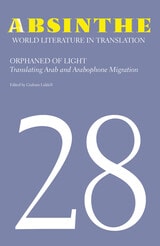
Absinthe
World Literature in Translation: Volume 28: Orphaned of Light: Translating Arab and Arabophone MigrationGraham Liddell
Michigan Publishing Services, 2022
Absinthe 28: Orphaned of Light features contemporary literature of migration translated from and to Arabic. In short stories, creative nonfiction essays, poetry, and selections from novels, a multiplicity of migration experiences is brought to the fore: life in diaspora, undocumented labor, refugeehood, human trafficking, internal displacement, exile.
This issue brings together names familiar to readers of Arabic literature in translation, such as Ghassan Kanafani and Saadi Youssef, with writers making their English-language debuts, such as Dearborn, MI-based Kurdish Iraqi poet Gulala Nouri and Libyan novelist Mohamad Alasfar. Likewise, the issue includes veteran translators Marilyn Booth, Nancy Roberts, and Khaled Mattawa alongside newcomers, several of them graduate students at the University of Michigan.
Each piece is accompanied by a translator’s reflection that meditates on the work’s themes as well as the creative process of translation, and the issue’s poetry is presented in a side-by-side Arabic-English format.
Absinthe 28 comes to us at a time when, according to the UN, one in every 78 people on earth is displaced. This collection serves as a reminder that translation and migration are inextricably linked.
All Politics Are God’s Politics
Moroccan Islamism and the Sacralization of DemocracyAhmed Khanani
Rutgers University Press, 2021
Amazigh Politics in the Wake of the Arab Spring
Bruce Maddy-Weitzman
University of Texas Press, 2022
On television, the Arab Spring took place in Cairo, Tunis, and the city-states of the Persian Gulf. Yet the drama of 2010, and the decade of subsequent activism, extended beyond the cities—indeed, beyond Arabs. Bruce Maddy-Weitzman brings to light the sustained post–Arab Spring political movement of North Africa’s Amazigh people.
The Amazigh movement did not begin with the Arab Spring, but it has changed significantly since then. Amazigh Politics in the Wake of the Arab Spring details the increasingly material goals of Amazigh activism, as protest has shifted from the arena of ethnocultural recognition to that of legal and socioeconomic equality. Amazigh communities responded to the struggles for freedom around them by pressing territorial and constitutional claims while rejecting official discrimination and neglect. Arab activists, steeped in postcolonial nationalism and protective of their hegemonic position, largely refused their support, yet flailing regimes were forced to respond to sharpening Amazigh demands or else jeopardize their threadbare legitimacy. Today the Amazigh question looms larger than ever, as North African governments find they can no longer ignore the movement’s interests.
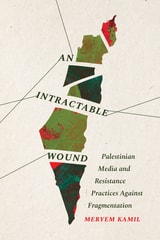
An Intractable Wound
Palestinian Media and Resistance Practices Against FragmentationMeryem Kamil
Rutgers University Press, 2027
An Intractable Wound explores Palestinian resistance to colonial fragmentation that originated as territorial fracture, as proposed through the United Nations partition plan that split the land between the state of Israel and Arab territories. The resulting fragmentation of geography, sovereignty, and populations spurred multiple other schisms that manifest culturally, politically, and developmentally across the West Bank, Gaza, refugee camps, exiled and diasporic Palestinians, and Arab citizens of Israel.
An Intractable Wound considers the various tactics Palestinians deploy to combat these multiple, intersecting iterations of fracture. In particular, this text considers Palestinian media technologies and practices that manage, subvert, and overcome fragmentation. Each chapter centers projects that elaborate on these fractures and combat them, including virtual reality representations, online archives, digital mapping platforms, and video games that imagine and construct an intact Palestinian community. Together, these case studies provide a capacious reading of the Palestinian condition as structured by fragmentation, and Palestinian resistance as struggling in opposition to that geographic, sociopolitical, and cultural disillusion.
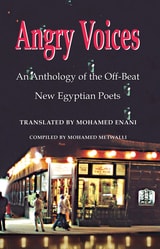
Angry Voices
An Anthology of the Off-Beat New Egyptian PoetsMohamed Enani
University of Arkansas Press, 2003
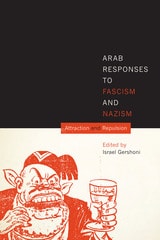
Arab Responses to Fascism and Nazism
Attraction and RepulsionBy Israel Gershoni
University of Texas Press, 2014
The first book to present an analysis of Arab response to fascism and Nazism from the perspectives of both individual countries and the Arab world at large, this collection problematizes and ultimately deconstructs the established narratives that assume most Arabs supported fascism and Nazism leading up to and during World War II. Using new source materials taken largely from Arab memoirs, archives, and print media, the articles reexamine Egyptian, Syrian, Lebanese, Palestinian, and Iraqi responses in the 1930s and throughout the war.
While acknowledging the individuals, forces, and organizations that did support and collaborate with Nazi Germany and fascist Italy, Arab Responses to Fascism and Nazism focuses on the many other Arab voices that identified with Britain and France and with the Allied cause during the war. The authors argue that many groups within Arab societies—elites and non-elites, governing forces, and civilians—rejected Nazism and fascism as totalitarian, racist, and, most important, as new, more oppressive forms of European imperialism. The essays in this volume argue that, in contrast to prevailing beliefs that Arabs were de facto supporters of Italy and Germany—since “the enemy of my enemy is my friend”—mainstream Arab forces and currents opposed the Axis powers and supported the Allies during the war. They played a significant role in the battles for control over the Middle East.
Arabs in the Mirror
Images and Self-Images from Pre-Islamic to Modern TimesBy Nissim Rejwan
University of Texas Press, 2008
What is an Arab? Though many in the West would answer that question with simplistic stereotypes, the reality is far more complex and interesting. Arabs themselves have been debating Arab identity since pre-Islamic times, coming to a variety of conclusions about the nature and extent of their “Arabness.” Likewise, Westerners and others have attempted to analyze Arab identity, reaching mostly negative conclusions about Arab culture and capacity for self-government.
To bring new perspectives to the question of Arab identity, Iraqi-born scholar Nissim Rejwan has assembled this fascinating collection of writings by Arab and Western intellectuals, who try to define what it means to be Arab. He begins with pre-Islamic times and continues to the last decades of the twentieth century, quoting thinkers ranging from Ibn Khaldun to modern writers such as al-Ansari, Haykal, Ahmad Amin, al-'Azm, and Said. Through their works, Rejwan shows how Arabs have grappled with such significant issues as the influence of Islam, the rise of nationalism, the quest for democracy, women's status, the younger generation, Egypt's place in the Arab world, Israel's role in Middle Eastern conflict, and the West's "cultural invasion."
By letting Arabs speak for themselves, Arabs in the Mirror refutes a prominent Western stereotype—that Arabs are incapable of self-reflection or self-government. On the contrary, it reveals a rich tradition of self-criticism and self-knowledge in the Arab world.
Aspects of Islamic Civilization
As Depicted in the Original TextsA. J. Arberry
University of Michigan Press, 1967
Islamic literature is rich, varied, and abundant, as befits the literature of a civilization which once controlled an empire as great as that of the Romans. In Aspects of Islamic Civilization, A. J. Arberry has chosen and translated passages from the most highly regarded works of Islamic literature in order to illustrate the development of Islamic civilization from its origins in the sixth century to the present.
This anthology is made up of selections from Arabic and Persian writers who have given world renown to Islamic literature—such as Hafiz, Sa'di, Jalal al-Din Rumi, Omar Khayyam, Ibn al-Farid, Avicenna, Ibn Hazm—and from such works as the Koran, the Masnavi, and the Moorish Anthology. It is an invaluable collection of sources for anyone interested in the Moslem world and a fascinating volume to browse in.
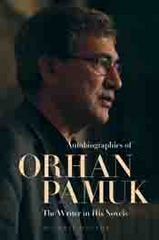
Autobiographies of Orhan Pamuk
The Writer in His NovelsMichael McGaha
University of Utah Press, 2008
"Pamuk is a writer who shares my reverence for the great art of the novel. He takes the novel seriously in a way that is perhaps no longer possible for Western writers, boldly describing it as European civilization’s greatest invention."—Michael McGaha
Turkish novelist Orhan Pamuk is a prominent voice in Turkish literature, speaking to the country’s history, culture, and politics. In 2006, he became the first Turkish writer to receive the Nobel Prize for Literature.
Autobiographies of Orhan Pamuk is the first book-length study of the life and writings of Pamuk. It provides both a historical and cultural context that will help readers better understand and appreciate both the man and his work. It begins with a brief biography, outlines Pamuk’s contributions to Turkish literature and history, examines how his art has evolved over the past thirty years, and discusses some of the writers who provided inspiration. Though his books deal with specifically Turkish issues, like all great literature the themes they explore are universal. In addition to a thorough analysis of his seven published novels, including Snow and My Name is Red, an entire chapter is devoted to his first two novels, Cevdet Bey and Sons and The Silent House, which have yet to be translated into English.
This is a comprehensive examination of the Nobel laureate’s work, free of jargon and of interest to anyone who enjoys good literature.