Results by title
60 books match the query 'Middle Eastern Studies' and 7 start with a
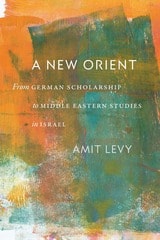
A New Orient
From German Scholarship to Middle Eastern Studies in IsraelAmit Levy
Brandeis University Press, 2024
This study examines the history of Zionist academic Orientalism—referred to throughout as Oriental studies, the term contemporary English speakers would have used—in light of its German-Jewish background, as a history of knowledge transfer stretching along an axis from Germany to Palestine. The transfer, which took place primarily during the 1920s and 1930s, involved questions about the re-establishment, far from Germany, of a field of knowledge with deep German roots. Like other German-Jewish scholars arriving in Palestine at the time, some of the Orientalist agents of transfer did so out of Zionist conviction as olim (immigrants making aliyah, or literally “ascending” to the homeland), while others joined them later as refugees from Nazi Germany; both groups were integrated into the institutional apparatus of the Hebrew University. Unlike other fields of knowledge or professions, however, the transfer of Orientalist knowledge was unique in that the axis involved an essential change in the nature of its encounter with the Orient: from a textual-scientific encounter at German universities, largely disconnected from contemporary issues to a living, substantive, and unmediated encounter with an essentially Arab region—and the escalating Jewish-Arab conflict in the background. Within the new context, German-Jewish Orientalist expertise was charged with political and cultural significance it had not previously faced, fundamentally influencing the course of the discipline’s development in Palestine and Israel.
All Politics Are God’s Politics
Moroccan Islamism and the Sacralization of DemocracyAhmed Khanani
Rutgers University Press, 2021
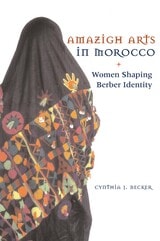
Amazigh Arts in Morocco
Women Shaping Berber IdentityBy Cynthia Becker
University of Texas Press, 2006
In southeastern Morocco, around the oasis of Tafilalet, the Ait Khabbash people weave brightly colored carpets, embroider indigo head coverings, paint their faces with saffron, and wear ornate jewelry. Their extraordinarily detailed arts are rich in cultural symbolism; they are always breathtakingly beautiful—and they are typically made by women. Like other Amazigh (Berber) groups (but in contrast to the Arab societies of North Africa), the Ait Khabbash have entrusted their artistic responsibilities to women. Cynthia Becker spent years in Morocco living among these women and, through family connections and female fellowship, achieved unprecedented access to the artistic rituals of the Ait Khabbash. The result is more than a stunning examination of the arts themselves, it is also an illumination of women's roles in Islamic North Africa and the many ways in which women negotiate complex social and religious issues.
One of the reasons Amazigh women are artists is that the arts are expressions of ethnic identity, and it follows that the guardians of Amazigh identity ought to be those who literally ensure its continuation from generation to generation, the Amazigh women. Not surprisingly, the arts are visual expressions of womanhood, and fertility symbols are prevalent. Controlling the visual symbols of Amazigh identity has given these women power and prestige. Their clothing, tattoos, and jewelry are public identity statements; such public artistic expressions contrast with the stereotype that women in the Islamic world are secluded and veiled. But their role as public identity symbols can also be restrictive, and history (French colonialism, the subsequent rise of an Arab-dominated government in Morocco, and the recent emergence of a transnational Berber movement) has forced Ait Khabbash women to adapt their arts as their people adapt to the contemporary world. By framing Amazigh arts with historical and cultural context, Cynthia Becker allows the reader to see the full measure of these fascinating artworks.
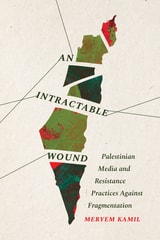
An Intractable Wound
Palestinian Media and Resistance Practices Against FragmentationMeryem Kamil
Rutgers University Press, 2027
An Intractable Wound explores Palestinian resistance to colonial fragmentation that originated as territorial fracture, as proposed through the United Nations partition plan that split the land between the state of Israel and Arab territories. The resulting fragmentation of geography, sovereignty, and populations spurred multiple other schisms that manifest culturally, politically, and developmentally across the West Bank, Gaza, refugee camps, exiled and diasporic Palestinians, and Arab citizens of Israel.
An Intractable Wound considers the various tactics Palestinians deploy to combat these multiple, intersecting iterations of fracture. In particular, this text considers Palestinian media technologies and practices that manage, subvert, and overcome fragmentation. Each chapter centers projects that elaborate on these fractures and combat them, including virtual reality representations, online archives, digital mapping platforms, and video games that imagine and construct an intact Palestinian community. Together, these case studies provide a capacious reading of the Palestinian condition as structured by fragmentation, and Palestinian resistance as struggling in opposition to that geographic, sociopolitical, and cultural disillusion.
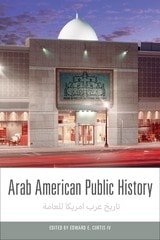
Arab American Public History
Edited by Edward E. Curtis IV
Temple University Press, 2026
Arab American Public History is an invitation to engage more deeply with Arab American communities. Chapters examine Arab Americans’ origins, ethnic identities, and efforts to belong in America through case studies of the community’s food cultures, genealogy research, cultural production, and neighborhood enclaves.
The first formal study of Arab American public history, this exciting volume charts various ways Arab Americans have interpreted their past as a source of defiant humanity, cultural enfranchisement, social solidarity, and political power.
Contributors: Reem Awad-Rashmawi, Chloe Bordewich, Richard M. Breaux, Maria F. Curtis, Lydia Harrington, Randa A. Kayyali, Matthew Jaber Stiffler, Rebecca K. Shrum, and the editor
In the series History and the Public
Architecture and the Right to Heal
Resettler Nationalism in the Aftermath of Conflict and DisasterEsra Akcan
Duke University Press, 2025
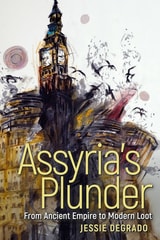
Assyria’s Plunder
From Ancient Empire to Modern LootJessie DeGrado
University Press of Colorado, 2026
Assyria’s Plunder offers a new history of ancient Assyria and its interactions with its client states of Israel and Judah. Considering the entanglement of modern imperialism with the historiography of ancient empire, Jessie DeGrado reassesses the conventional understanding of the Neo-Assyrian Empire using textual analysis, art history, and archaeology.
Engaging texts from Israel and Judah, DeGrado refuses the usual framings of Biblical resistance to Assyrian despotism and asks instead why subject populations may have capitulated to Assyrian rule. Paired chapters consider specific Assyrian imperial practices and biblical texts that engage them. As the study moves from the awe-filled spectacle of Assyrian throne rooms to the Assyrian policy of deporting divine statues, Assyria’s Plunder centers the embodied experiences of those subjected to Assyrian hegemony. DeGrado also explores how the empire’s violence still holds sway in the popular imagination while Euro-American imperialism goes largely unacknowledged.
Drawing on decolonial studies alongside epigraphic and textual analysis, Assyria’s Plunder shows how critical historiography and theory can enrich historical analysis and provide a fuller portrait of Assyrian interaction with its client states.