Results by title
2 books match the query 'Mier-Cruz, Benjamin'

A Burnt Child
A NovelStig Dagerman
University of Minnesota Press, 2013
After the international success of his collection of World War II newspaper articles, German Autumn—a book that solidified his status as the most promising and exciting writer in Sweden—Stig Dagerman was sent to France with an assignment to produce more in this journalistic style. But he could not write the much-awaited follow-up. Instead, he holed up in a small French village and in the summer of 1948 created what would be his most personal, poignant, and shocking novel: A Burnt Child.
Set in a working-class neighborhood in Stockholm, the story revolves around a young man named Bengt who falls into deep, private turmoil with the unexpected death of his mother. As he struggles to cope with her loss, his despair slowly transforms to rage when he discovers his father had a mistress. But as Bengt swears revenge on behalf of his mother’s memory, he also finds himself drawn into a fevered and conflicted relationship with this woman—a turn that causes him to question his previous faith in morality, virtue, and fidelity.
Written in a taut and beautifully naturalistic tone, Dagerman illuminates the rich atmospheres of Bengt’s life, both internal and eternal: from his heartache and fury to the moody streets of Stockholm and the Hitchcockian shadows of tension and threat in the woods and waters of Sweden’s remote islands. A Burnt Child remains Dagerman’s most widely read novel, both in Sweden and worldwide, and is one of the crowning works of his short but celebrated career.
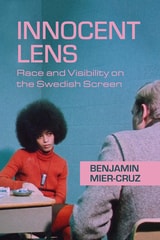
Innocent Lens
Race and Visibility on the Swedish ScreenBenjamin Mier-Cruz
University of Wisconsin Press, 2027
Sweden, like other Nordic countries, prides itself on being “colorblind” or immune to the kinds of racism found in, most dramatically, the United States. In the 1960s and 1970s, white Swedish documentarians, in the fashion of early anthropologists, recorded racial tensions amid the US civil rights movement. More recently, in the twenty-first century, short films produced by Swedes of color have tackled racism and bigotry within Sweden.
Benjamin Mier-Cruz offers a comparative study of these two periods of Swedish documentary filmmaking. “Racially innocent” white documentarians of the mid-twentieth century developed an “aesthetics of altruism” predicated on Sweden’s assumed racial equalitarianism—a notion that their documentaries in turn helped create and maintain. In contemporary films, on the other hand, Swedes of color reimagine the same filmic format to challenge not only their predecessors’ reductionist, pseudo-anthropological presentations but also Sweden’s purportedly colorblind ideology. Mier-Cruz’s close readings of films from both eras demonstrate the possibilities and limitations of the documentary form and the ways in which it is motivated by politics and activism.