Results by title
13 books match the query 'Military History'
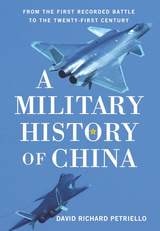
A Military History of China
From the First Recorded Battles to the Twenty-First CenturyDavid Richard Petriello
Westholme Publishing, 2018
The twenty-first century has been labeled the “Pacific Century,” both in terms of economics as well as military affairs. While South Korea and Japan have stagnated in these aspects, the growth of China since 1980 is unprecedented in modern history. While its economic achievements are both well known and studied, the rapid development of its military is not. In A Military History of China: From the First Recorded Battle to the Twenty-First Century, historian David Richard Petriello provides the first English language account of China’s martial history. China’s military prowess extends across the centuries, and includes the invention or first use of gunpowder, landmines, rocket launchers, armored cavalry, repeating crossbows, multistage rockets, and chemical weapons—in many cases, long before the West.
Illustrated with more than one hundred maps and figures, the book traces the general military history of China from the Neolithic Age to the present day. Particular attention is paid to specific battles, military thinkers, the impact of geography on warfare in China, and the role played by technology. Likewise, the work examines the underlying philosophy of why China goes to war. Because China’s military weakness over the past two centuries compared to the West has given a false sense of China’s potential, a thorough knowledge of the men, battles, tactics, geography, strategies, philosophy, and experiences of war throughout Chinese history are vital to prepare students, scholars, soldiers, and politicians for the return of China as a major innovative and global military power.

A Military History of Texas
Loyd Uglow
University of North Texas Press, 2022

A World in Flames
A Concise Military History of World War IIMartha Byrd
University of Alabama Press, 2008
An essential, accessible guide to the greatest conflict in human history.
A World in Flames by Martha Byrd offers a clear, compelling, and comprehensive chronicle of World War II, guiding readers through the defining battles, strategies, and turning points that reshaped the modern world. Emphasizing the military history of the conflict, Byrd structures the narrative as a battle‑by‑battle survey, covering major campaigns including Stalingrad, Omaha Beach, and the Battle of the Atlantic, each presented with clarity and precision.
Beginning with the prelude to war and the rising tensions across Europe and Asia, the book traces Germany’s swift subjugation of Holland, Belgium, and France before shifting to Britain’s determined resistance. As the conflict expands, Byrd explores Japan’s entry into the war, the rapid advances across the Pacific, and the United States’ pivotal role in reversing Axis momentum.
Byrd’s accessible style makes complex military operations understandable without sacrificing depth, offering readers both a broad overview and meaningful detail. Maps, campaign analyses, and vivid summaries of naval, air, and ground operations provide context for the global scale of the conflict. From the brutal Eastern Front to the island‑hopping campaigns of the Pacific, the book highlights the strategic decisions and human costs that defined the war’s progression.
Concluding with the collapse of Axis power and the war’s final climactic battles in Europe and the Pacific, A World in Flames stands as an excellent introduction for readers seeking a concise but thorough account of World War II—one praised for its balance of readability, accuracy, and narrative drive.
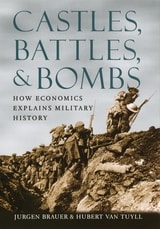
Castles, Battles, and Bombs
How Economics Explains Military HistoryJurgen Brauer and Hubert van Tuyll
University of Chicago Press, 2008
Castles, Battles, and Bombs reconsiders key episodes of military history from the point of view of economics—with dramatically insightful results. For example, when looked at as a question of sheer cost, the building of castles in the High Middle Ages seems almost inevitable: though stunningly expensive, a strong castle was far cheaper to maintain than a standing army. The authors also reexamine the strategic bombing of Germany in World War II and provide new insights into France’s decision to develop nuclear weapons. Drawing on these examples and more, Brauer and Van Tuyll suggest lessons for today’s military, from counterterrorist strategy and military manpower planning to the use of private military companies in Afghanistan and Iraq.
"In bringing economics into assessments of military history, [the authors] also bring illumination. . . . [The authors] turn their interdisciplinary lens on the mercenary arrangements of Renaissance Italy; the wars of Marlborough, Frederick the Great, and Napoleon; Grant's campaigns in the Civil War; and the strategic bombings of World War II. The results are invariably stimulating."—Martin Walker, Wilson Quarterly
"This study is serious, creative, important. As an economist I am happy to see economics so professionally applied to illuminate major decisions in the history of warfare."—Thomas C. Schelling, Winner of the 2005 Nobel Prize in Economics
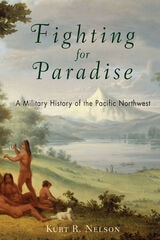
Fighting for Paradise
A Military History of the Pacific NorthwestKurt R. Nelson
Westholme Publishing, 2007
One of the Most Important Battlegrounds in the History of America
While it is in the eastern United States where most Americans identify our military history, the vast, resource-rich Pacific Northwest, stretching from Northern California through British Columbia, endured a series of battles and wars over the course of the nineteenth century that were of regional and national importance. It was here where Great Britain and the United States had their final confrontation in the Americas, where Chief Joseph attempted to secure independence for the Nez Perce, and where the Oregon Trail marked the first great migration to the West of settlers bent on carving out new lives in the wilderness. The Pacific Northwest also saw some of the only attacks on the mainland by Japan during World War II.
Beginning with the earliest known accounts of wars among the American Indians of the region, Fighting for Paradise: A Military History of the Pacific Northwest describes early European contact, including British trappers of the Hudson's Bay Company, the Lewis and Clark Expedition, Jedediah Smith, and John Jacob Astor's trading post. The competition over the lucrative fur trade led to the "Pig War," which almost resulted in another armed conflict between Great Britain and the United States, but it was the influx of settlers from the Oregon Trail that touched off the long bitter battles between whites and American Indians. Starting with the 1847 Whitman Massacre and the ensuing war it touched off, the book covers the next three decades of violence, ending with the Sheepeater's War in 1879. Kurt R. Nelson then relates the Pacific Northwest's contributions to the Spanish-American and Philippine-American Wars, the Mexican Punitive Expedition, World War I, and finally World War II, where the region fought Japanese submarine attacks and was harassed by balloon bombs. Throughout, the author provides current information about the state of preservation of various battle sites and other points of historical interest. Accompanied by maps and photographs, Fighting for Paradise provides insight into an area of American military history, rich in drama, that is not generally known.

How the North Won
A MILITARY HISTORY OF THE CIVIL WARHerman Hattaway and Archer Jones
University of Illinois Press, 1983
“To those unacquainted with military history, [this book] provides an elementary, instructive, and readable military account of the American Civil War. The basic concepts of war, its conduct, management, and support, are thoroughly explained and explicitly applied throughout in order to make clear what many authors often incorrectly take for granted that readers already know. . . .
We have tried to tell the military history of the war from the viewpoint of the higher commanders on both sides. We therefore emphasize strategy and logistics rather than tactics. . . .Strategy, management, and execution weigh more than superior numbers and resources in dictating the outcomes of wars, and the Civil War is no exception. The weaker side can win; the South almost did.”
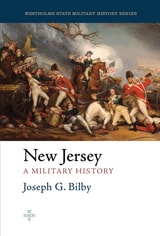
New Jersey
A Military HistoryJoseph G. Bilby
Westholme Publishing, 2017
New Jersey: A Military History by military historian Joseph G. Bilby tells the long, diverse, and sometimes complicated story of New Jersey’s citizens and their significant and continuing role in America’s defense. Over more than 350 years as a colony and state, hundreds of thousands of New Jersey residents have served in regular armed forces, militia, and National Guard units or in direct support of those organizations. New Jerseyans in the military include General “Scotch Willie” Maxwell of Sussex County, an unappreciated Revolutionary War master tactician; First Sergeant George Ashby of Allentown, of Company H, 45th United States Colored Infantry, the state’s last surviving Civil War veteran; Clara Maas of Newark, a nurse who sacrificed her life in the effort to eradicate Yellow Fever; Captain William J. Reddan, who led his company into hell during the Meuse-Argonne offensive in 1918; and Medal of Honor winner John Basilone, whose sense of duty and honor led him to return to combat and death in World War II.
Complete with maps, an annotated list of historical sites in the state, and further reading, New Jersey: A Military History is an important reference for those interested in the role of the Garden State in our nation’s wars.
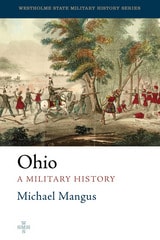
Ohio
A Military HistoryMichael Mangus
Westholme Publishing, 2016
Complete with a list of historical sites and a comprehensive bibliography, Ohio: A Military History is an important reference for those interested in the role of the Buckeye State in our nation’s history.
Westholme State Military History Series
Each state in the United States of America has a unique military history. The volumes in this series seek to provide a portrait of the richness of each state’s military experience, primarily defined by its borders, as well as the important contributions the state has made to the nation’s military history. Written by historians for the general reader, the volumes trace the history of conflict from the original native populations to today. The volumes are well illustrated and include specially commissioned maps, extensive bibliographies, lists of national and state historical sites, and a detailed index.
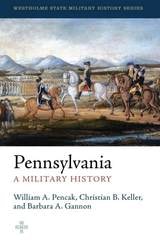
Pennsylvania
A Military HistoryWilliam A. Pencak
Westholme Publishing, 2016
Westholme State Military History Series
Each state in the United States of America has a unique military history. The volumes in this series seek to provide a portrait of the richness of each state’s military experience, primarily defined by its borders, as well as the important contributions the state has made to the nation’s military history. Written by historians for the general reader, the volumes trace the history of conflict from the original native populations to today. The volumes are well illustrated and include specially commissioned maps, extensive bibliographies, lists of national and state historical sites, and a detailed index.

Texian Iliad
A Military History of the Texas Revolution, 1835-1836By Stephen L. Hardin
University of Texas Press, 1996
Winner, T. R. Fehrenbach Book Award, Texas Historical Commission
Summerfield G. Roberts Award, Sons of the Republic of Texas
Honorable Mention, Certificate of Commendation, American Association for State and Local History
Hardly were the last shots fired at the Alamo before the Texas Revolution entered the realm of myth and controversy. French visitor Frederic Gaillardet called it a "Texian Iliad" in 1839, while American Theodore Sedgwick pronounced the war and its resulting legends "almost burlesque."
In this highly readable history, Stephen L. Hardin discovers more than a little truth in both of those views. Drawing on many original Texan and Mexican sources and on-site inspections of almost every battlefield, he offers the first complete military history of the Revolution. From the war's opening in the "Come and Take It" incident at Gonzales to the capture of General Santa Anna at San Jacinto, Hardin clearly describes the strategy and tactics of each side. His research yields new knowledge of the actions of famous Texan and Mexican leaders, as well as fascinating descriptions of battle and camp life from the ordinary soldier's point of view.
This award-winning book belongs on the bookshelf of everyone interested in Texas or military history.
The Art of War in Western World
Archer Jones
University of Illinois Press, 1987
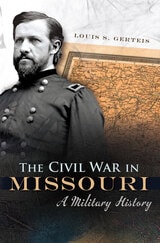
The Civil War in Missouri
A Military HistoryLouis S. Gerteis
University of Missouri Press, 2012
Both the Union and the Confederacy had a vested interest in Missouri throughout the war. The state offered control of both the lower Mississippi valley and the Missouri River, strategic areas that could greatly factor into either side’s success or failure. Control of St. Louis and mid-Missouri were vital for controlling the West, and rail lines leading across the state offered an important connection between eastern states and the communities out west. The Confederacy sought to maintain the Ozark Mountains as a northern border, which allowed concentrations of rebel troops to build in the Mississippi valley. With such valuable stock at risk, Lincoln registered the importance of keeping rebel troops out of Missouri, and so began the conventional battles investigated by Gerteis.
The first book-length examination of its kind, The Civil War in Missouri: A Military History dares to challenge the prevailing opinion that Missouri battles made only minor contributions to the war. Gerteis specifically focuses not only on the principal conventional battles in the state but also on the effects these battles had on both sides’ national aspirations. This work broadens the scope of traditional Civil War studies to include the losses and wins of Missouri, in turn creating a more accurate and encompassing narrative of the nation’s history.
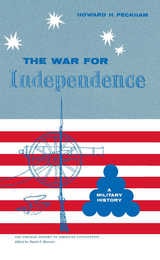
War for Independence
A Military HistoryHoward H. Peckham
University of Chicago Press, 1958
This book is an effort to explain how and why that upset was accomplished. Alternating with scene and summary, the narrative has pace and proportion. Battles fall into campaigns, and campaigns interpret strategy. Commanders are deftly characterized, and flashes of insight illuminate victories and defeats. There emerges a picture of American soldiers as tougher and more deeply motivated fighters than the uncommitted British and German professionals. The book also demonstrates how highly prized were the rights that the revolutionists sought to confirm or establish, and serves as a reminder today that some ideas are worth risking life for.
"What is most amazing about this excellent history is Prof. Peckham's ability to retell these . . . legendary events . . . in a way which enriches and absorbs the reader."—Robert Kirsch, Los Angeles Times