Results by title
8 books match the query 'Millennialism'

A Woman to Deliver Her People
Joanna Southcott and English Millenarianism in an Era of RevolutionBy James K. Hopkins
University of Texas Press, 1982
The Second Coming of Christ has been prophesied many times through the centuries but seldom by a figure so fascinating as Joanna Southcott (1750–1814), the domestic servant who at the age of forty-two declared that God had chosen her to announce His return. A Woman to Deliver Her People is the most comprehensive study of this remarkable woman and her movement yet written.
Dramatic social and political changes of the late eighteenth century—among them the revolutions in America and France—had a profound effect on the attitudes of English men and women at all levels of society. With events so far outside the range of ordinary experience, both the educated and the uneducated turned to the prophetic books of the Bible, seeking solace and explanation. A number of prophets and prophetesses appeared, claiming to have a special understanding of the biblical texts and offering startling new revelations which had been disclosed to them by God. The greatest and most influential of these was Joanna Southcott, who attracted tens of thousands of followers from the West Country, London, the Midlands, and the industrial North. Her "spiritual communications" filled some sixty-five books and pamphlets from 1801 until her death.
Most contemporary observers dismissed Southcott as a fanatic, and she was frequently the subject of caricature and ridicule. James Hopkins attempts to remedy this distortion by examining Southcott's life and the millenarian movement she led within the context of the social, political, and economic crises of the period. By tracing the psychological and popular roots of Southcott's piety, and casting her appeal against the backdrop of a revolutionary age, Hopkins not only vividly portrays the life of this fascinating woman but also offers a new perspective on the mentality of ordinary English men and women during the years of their transformation into a working class.
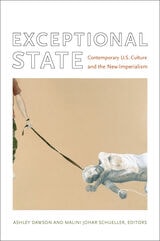
Exceptional State
Contemporary U.S. Culture and the New ImperialismAshley Dawson and Malini Johar Schueller, eds.
Duke University Press, 2007
The contributors address a range of topics, paying particular attention to the dynamics of gender and race. Their essays include a surprising reading of the ostensibly liberal movies Wag the Dog and Three Kings, an exploration of the rhetoric surrounding the plan to remake the military into a high-tech force less dependent on human bodies, a look at the significance of the popular Left Behind series of novels, and an interpretation of the Abu Ghraib prison photos. They scrutinize the national narrative created to justify the US invasions of Afghanistan and Iraq, the ways that women in those countries have responded to the invasions, the contradictions underlying calls for US humanitarian interventions, and the role of Africa in the US imperial imagination. The volume concludes on a hopeful note, with a look at an emerging anti-imperialist public sphere.
Contributors. Omar Dahbour, Ashley Dawson, Cynthia Enloe, Melani McAlister, Christian Parenti, Donald E. Pease, John Carlos Rowe, Malini Johar Schueller, Harilaos Stecopoulos
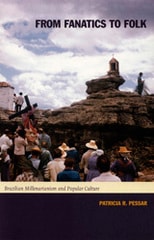
From Fanatics to Folk
Brazilian Millenarianism and Popular CulturePatricia R. Pessar
Duke University Press, 2004
Pessar combines cultural history spanning the colonial period to the present; comparative case studies of the Canudos, Contestado, Juazeiro, and Santa Brígida movements; and three decades of ethnographic research in the Brazilian Northeast. Highlighting the involvement of a broad range of individuals and institutions, the cross-fertilization between movements, contestation and accommodation vis-à-vis the church and state, and matters of spirituality and faith, From Fanatics to Folk reveals Brazilian millenarianism as long-enduring and constantly in flux.
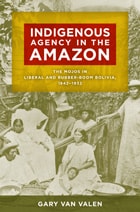
Indigenous Agency in the Amazon
The Mojos in Liberal and Rubber-Boom Bolivia, 1842–1932Gary Van Valen
University of Arizona Press, 2013
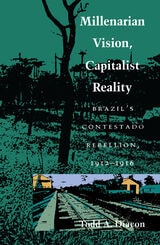
Millenarian Vision, Capitalist Reality
Brazil’s Contestado Rebellion, 1912–1916Todd A. Diacon
Duke University Press, 1991
Combining oral history with detailed archival research, Millenarian Vision, Capitalist Reality depicts a peasant community whose security in economic, social, and religious relations was suddenly disrupted by the intrusion of international capital. Diacon shows how a “deadly triumvirate” comprised to foreign capital, state power, and local bosses engineered a land tenure revolution that threatened smallholders’ subsistence, sparking rebellion among the Contestado peasants.
Unlike most analysis of millenarian movements, Diacon combines a material analysis with a careful exploration of the movement’s millenarian ideology to demonstrate how a particular combination of external and internal forces produced a crisis of values in the Contestado society. Such a crisis, Diacon concludes, gave a special power to the millenarian vision that promised not only outward reform, but inner salvation as well. This work offers a significant contribution to the literature of millenarian movements, popular religion, peasant rebellions, and the transition to capitalism in Brazil.

Nearest East
American Millenialism and Mission to the Middle EastAuthored by Hans-Lukas Kieser
Temple University Press, 2012
Long before oil interests shaped American interaction with the Middle East, the U.S. had a strong influence on the late Ottoman and post-Ottoman region. Covering the period from approximately 1800 to the 1970s, Hans-Lukas Kieser’s compelling Nearest East tells the story of this intimate, identity-building relationship between the U.S. and the Near East.
Kieser chronicles how American missionaries worked to implement their belief in Biblical millennialism, enlightened modernity, and a modern Zion-Israel. Millennialism was part of an American identity that constituted itself religiously in the interaction with and the representation of the “cradle of Zion.” As such, "going Near East" was—at least to American evangelical Protestants—in some ways more important than colonizing the American West. However, many Ottoman Muslims felt threatened by the American missionaries perceiving their successful institutions as an estranging challenge from the outside.
Measuring the long twisted road from the missionary Zion-builders of the early 19th century to the privileged US-Israeli partnership in the late 20th century, Nearest East looks carefully on both sides of the relationship. Kieser uses a wide range of Ottoman, Turkish, French, German and other sources, unfamiliar to most Anglophone readers, to tell this story that will appeal to historians of all stripes.

The Millenarian World of Early Mormonism
Grant Underwood
University of Illinois Press, 1994
"A model of first-rate scholarship and balanced interpretation; it has much to say not only to those interested in Mormon history but also to anyone seeking to understand the role of millenarian ideas in the American experience." -- Michael Barkun, Journal of American History
"No serious student of early Mormon history should fail to read this book." -- L. B. Tipson, Choice
"A signal contribution to Mormon studies. Anyone who wishes to explore the core of the Mormon identity in the nineteenth century will have to come to terms with this book." -- Richard T. Hughes, author of Reviving the Ancient Faith: The Story of Churches of Christ in America
The Roots of Fundamentalism
British and American Millenarianism, 1800-1930Ernest R. Sandeen
University of Chicago Press, 1970