Results by title
13 books match the query 'Millennium'
Approaching the Millennium
Essays on Angels in AmericaDeborah R. Geis and Steven F. Kruger, Editors
University of Michigan Press, 1997
Buckminster Fuller
Anthology for the MillenniumEdited by Thomas T. K. Zung
Southern Illinois University Press, 2014

DR. FAUSTUS
ARCHETYPAL SUBTEXT AT THE MILLENNIUMPETER WERRES
West Virginia University Press, 1999
Ethnobiology at the Millennium
Past Promise and Future ProspectsEdited by Richard I. Ford
University of Michigan Press, 2001
Feminisms at a Millennium
Edited by Judith A. Howard and Carolyn Allen
University of Chicago Press, 2001
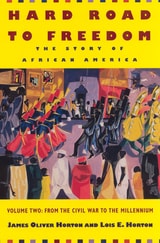
Hard Road to Freedom
The Story of African America, The Civil War to the MillenniumHorton, Lois E
Rutgers University Press, 2002
Latin American Literature at the Millennium
Local Lives, Global SpacesCecily Raynor
Bucknell University Press, 2021
Literary Luxuries
American Writing at the End of the MillenniumJoe David Bellamy
University of Missouri Press, 1995
From the Iowa Writers Workshop to the halls of Congress and the National Endowment for the Arts, from the world of literary magazines and writers' conferences to the bizarre realm of the late-twentieth-century American English department, Literary Luxuries takes the reader on a guided tour of American literary life in our time--and the forces threatening its existence.
Joe David Bellamy has been a significant figure on the literary scene during the last three decades; as a "literary Everyman," he offers in Literary Luxuries a distinctive and valuable perspective on the culture wars, on education and the imagination, on particular writers and major literary and aesthetic movements, on the role of government in fostering cultural development, and on the day-to-day strife of the writer's life in the United States.
As director of the literature program of the National Endowment for the Arts, Bellamy had the unenviable task of trying to persuade Congress and ordinary citizens that American literature is worthy of support, and in Literary Luxuries he continues that debate and helps us to understand its implications: "Literature is our national treasury of language and style and our best reckoning about human life, as it is lived in this time and place."
Part memoir, part critique, part impassioned defense of American literary culture and the values it espouses and struggles to uphold, Literary Luxuries offers unforgettable commentary on the literary life in the United States during the last decades of the twentieth century as described from the perspective of one of its key participants.
Michigan at the Millennium
A Benchmark and Analysis of Its Fiscal and Economic StructureCharles L. Ballard
Michigan State University Press, 2003
Michigan at the Millennium provides objective background and analysis on a wide variety of key economic and fiscal issues. The chapters are written by economists and policy analysts at leading universities and other institutions in Michigan. Written in clear, non-technical language, the articles are aimed at an audience that includes members of the legislative and executive branches of state government, members of the judicial system, local government officials, policy analysts, and informed citizens.
This volume follows in the tradition of the landmark 1982 study, Michigan’s Fiscal and Economic Structure, edited by Harvey E. Brazer. The first section of the volume focuses on broad aspects of the economy, people, and land of Michigan, including chapters on demographics, the labor force, land use, the manufacturing sector, high-technology industries, and health care. Section two focuses on public expenditures and public services, and includes chapters on economic-development efforts, K–12 education, the transportation system, the welfare system, policies for low-wage workers and displaced workers, and pensions. The third section is concerned with taxes and other government revenues. It includes chapters on the Headlee Amendment, income taxes, sales and use taxes, property taxes, the Single Business Tax, intergovernmental fiscal relations, and other sources of revenue.

Sex for the Millennium
Extreme TalesHarold Jaffe
University of Alabama Press, 2026
An innovative work of experimental prose examining the entanglements of media, authority, and embodied experience.
Sex for the Millennium: Extreme Tales by Harold Jaffe is a provocative collection of experimental narratives that push the boundaries of form, language, and subject matter. Blending fiction, satire, and cultural commentary, the book presents a series of fragmented “extreme” episodes that explore the intersections of desire, power, and media in contemporary society.
Jaffe uses the concept of sex as a central metaphor rather than a literal focus, exploring how desire can be shaped, controlled, and commodified within larger social and political systems. Rather than following a traditional plot, Jaffe constructs a shifting landscape populated by characters caught in systems of control shaped by institutions, technology, and consumer culture. The stories examine how identity and intimacy are mediated by external forces.
Jaffe's work reflects postmodern literary traditions, using disjointed narratives and abrupt tonal shifts to unsettle the reader. His writing challenges social norms and exposes the underlying mechanisms of authority and manipulation at work in everyday life. With dark humor and intentional provocation, Sex for the Millennium: Extreme Tales offers a critique of modern culture, inviting readers to confront questions about autonomy, authenticity, and the influence of media in shaping human experience.
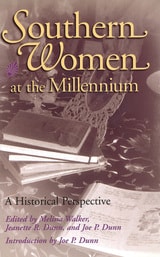
Southern Women at the Millennium
A Historical PerspectiveEdited by Melissa Walker, Jeanette R. Dunn, & Joe P. Dunn, & Intro by Joe P. Dunn
University of Missouri Press, 2003
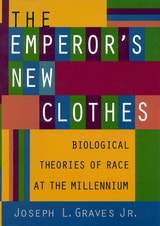
The Emperor's New Clothes
Biological Theories of Race at the MillenniumGraves Jr., Joseph L.
Rutgers University Press, 2003
In this groundbreaking book, Joseph Graves traces the development of biological thought about human genetic diversity. Greek philosophy, social Darwinism, New World colonialism, the eugenics movement, intelligence testing biases, and racial health fallacies are just a few of the topics he addresses. Graves argues that racism has persisted in our society because adequate scientific reasoning has not entered into the equation. He champions the scientific method and explains how we may properly ask scientific questions about the nature of population differentiation and how (if at all) we may correlate that diversity to observed human behavior. He also cautions us to think critically about scientific findings that have historically been misused in controversies over racial differences in intelligence heritability, criminal behavior, disease predisposition, and other traits. According to Graves, this country cannot truly address its racial problems until people understand the empirical evidence behind this truth that separate human races do not exist. With the biological basis for race removed, racism becomes an ideology, one that can and must be deleted.
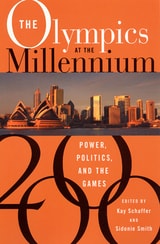
The Olympics at the Millennium
Power, Politics, and the GamesEdited by Kay Schaffer
Rutgers University Press, 2000
The Olympics thrill the world with spectacle and drama. They also carry a cultural and social significance that goes beyond the stadium, athletes, and fans. The Games are arenas in which individual and team athletic achievement intersect with the politics of national identity in a global context.
The Olympics at the Millennium offers groundbreaking essays that explore the cultural politics of the Games. The contributors investigate such topics as the emergence of women athletes as cultural commodities, the orchestrated spectacles of the opening and closing ceremonies, and the alternative sport culture offered via the Gay Games. Unforgettable events and decisions are discussed: Native American athlete Jim Thorpe winning—and losing—his two gold medals in 1912. Why America was one of the few countries to actually send Jewish athletes to the “Nazi Olympics.” The disqualification of champion Ewa Klobukowska from competing as a woman, due to chromosomal testing in 1967.
With the 2000 Sydney Games imminent, several essays address concerns with which every host country must contend, such as the threat of terrorism. Highlighting the difficult issues of racism and nationalism, another article explores the efforts of this country’s aboriginal people to define a role for themselves in the 2000 Games, as they struggle with ongoing discrimination. And with the world watching, Sydney faces profound pressure to implement a successful Olympics, as a matter of national pride.