Results by title
25 books match the query 'Milwaukee (Wis.)'
A City At War
Milwaukee Labor During World War IIRichard L. Pifer
Wisconsin Historical Society Press, 2003

A Milwaukee Inheritance
David Milofsky
University of Wisconsin Press, 2019
Moira is becoming obsessed with starting a family; Andy is becoming obsessed by thoughts of her friend Patsy. An unwinnable domestic dispute involving his shady tenant (and former classmate) Frankie “The Pin” Pignatano takes over more and more of his life. As tensions rise at home, at work, and in the duplex, Andy is forced to decide which vows he can honor.
This slow-burning, finely textured portrait of family dynamics pivots on secrets between generations and how the shadows of the past can darken the future.
Brewtown Tales
More Stories from Milwaukee and BeyondJohn Gurda
Wisconsin Historical Society Press, 2022
Color of Law
A NovelDavid Milofsky
University Press of Colorado, 2000
Conservative Counterrevolution
Challenging Liberalism in 1950s MilwaukeeTula A. Connell
University of Illinois Press, 2016
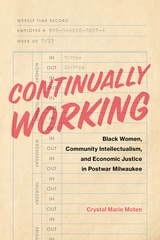
Continually Working
Black Women, Community Intellectualism, and Economic Justice in Postwar MilwaukeeCrystal Marie Moten
Vanderbilt University Press, 2023
Moten emphasizes the ways in which Black women transformed the urban landscape by simultaneously occupying spaces from which they had been historically excluded and creating their own spaces. Black women refused to be marginalized within the historically white and middle‑class Milwaukee Young Women's Christian Association (MYWCA), an association whose mission centered on supporting women in urban areas. Black women forged interracial relationships within this organization and made it, not without much conflict and struggle, one of the most socially progressive organizations in the city. When Black women could not integrate historically white institutions, they created their own. They established financial and educational institutions, such as Pressley School of Beauty Culture, which beautician Mattie Pressley DeWese opened in 1946 as a result of segregation in the beauty training industry. This school served economic, educational, and community development purposes as well as created economic opportunities for Black women. Historically and contemporarily, Milwaukee has been and is still known as one of the most segregated cities in the nation. Black women have always contested urban inequality, by making space for themselves and others on the margins. In so doing, they have transformed both the urban landscape and urban history.
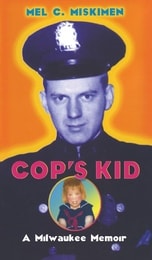
Cop's Kid
A Milwaukee MemoirMel C. Miskimen
University of Wisconsin Press, 2003
B-Day, as it came to be known, finally arrived. It was a Friday. A school day. I identified with Cinderella as I watched Dad get ready for work. Holster, check. Gun, check. Billy club, check. Handcuffs, check. . . . Saturday morning I got up early. Dad was already gone. Back to work. Ushering the Beatles out of town. On the table . . . there were two small bars of soap, slightly used, the words "Coach House Inn" still legible. One book of matches with four missing. And a note from Dad, "From their room." . . . No one else’s dad comes home from work with something that might, just might, have been intimate with a Beatle.
Growing up, Mel Miskimen thought that a gun and handcuffs on the kitchen table were as normal as a gallon of milk and a loaf of Mrs. Karl’s bread. Her father, a Milwaukee cop for almost forty years was part Super Hero (He simply held up his hand and three lanes of traffic came to a screeching halt) and part Supreme Being (He could be anywhere at anytime. I never knew when or where he would pop up.) Miskimen’s memoir, told in humorous vignettes, tells what it was like for a girl growing up with a dad who packed a lunch and packed heat.
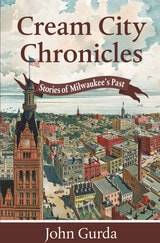
Cream City Chronicles
Stories of Milwaukee’s PastJohn Gurda
Wisconsin Historical Society Press, 2016

Damn the Old Tinderbox!
Milwaukee’s Palace of the West and the Fire that Defined an EraMatthew J. Prigge
Wisconsin Historical Society Press, 2019
Damn the Old Tinderbox! is the gripping tale of one of the Gilded Age’s forgotten calamities, a fire that remains among the deadliest unsolved arsons in American history, and a significant chapter in both the history of Milwaukee and the Midwest.
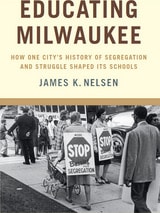
Educating Milwaukee
How One City’s History of Segregation and Struggle Shaped Its SchoolsJames K. Nelsen
Wisconsin Historical Society Press, 2015
"Milwaukee's story is unique in that its struggle for integration and quality education has been so closely tied to [school] choice." --from the Introduction
"Educating Milwaukee: How One City's History of Segregation and Struggle Shaped Its Schools" traces the origins of the modern school choice movement, which is growing in strength throughout the United States. Author James K. Nelsen follows Milwaukee's tumultuous education history through three eras--"no choice," "forced choice," and "school choice." Nelsen details the whole story of Milwaukee's choice movement through to modern times when Milwaukee families have more schooling options than ever--charter schools, open enrollment, state-funded vouchers, neighborhood schools--and yet Milwaukee's impoverished African American students still struggle to succeed and stay in school. "Educating Milwaukee" chronicles how competing visions of equity and excellence have played out in one city's schools in the modern era, offering both a cautionary tale and a "choice" example.
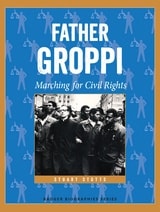
Father Groppi
Marching for Civil RightsStuart Stotts
Wisconsin Historical Society Press, 2013
Father Groppi Marched to Change Milwaukee
"Father Groppi: Marching for Civil Rights" tells the story of Father James Groppi, a Catholic priest from Milwaukee, Wis., who stood up for civil rights in the 1960s and 1970s.
This important new addition to the Badger Biographies series for young readers also tells about a turbulent time in Wisconsin history and sheds light on the civil rights movement and its place in the North.
Growing up on the south side of Milwaukee as the son of Italian immigrants, young James Groppi learned early on what it felt like to be made fun of just because of who you are, and he learned to respect people from other races and ethnic groups. Later, while studying to become a priest, he saw the discrimination African Americans faced. It made him angry, and he vowed to do whatever he could to fight racism.
Father Groppi marched with Dr. Martin Luther King Jr. and other leaders of the civil rights movement. But he knew there was work to be done in his own city. In Milwaukee, he teamed up with the NAACP and other organizations, protesting discrimination and segregation wherever they saw it. It wasn't always easy, and Father Groppi and the other civil rights workers faced great challenges.

Friend of Kissinger
A NovelDavid Milofsky
University of Wisconsin Press, 2003
In this lively coming-of-age novel, young Danny Meyer lays bare a landscape of illness and despair but emerges triumphant, with a new awareness of the limitations of security and the lessons of eternity. Danny’s bubble-like existence in paradisal Madison is broken when his father, a concert pianist and professor, is stricken with illness and must give up his professorship. The family is forced to move to Milwaukee to live at the brink of poverty while his father gets sicker, his artistic mother struggles as bread-winner, and his brother becomes delusional. Here, Danny finds himself in the uncertain position of having to accept the responsibilities of manhood while still struggling with adolescence.
In a world that keeps shifting, Danny befriends the son of a gangster and, through his brushes with that compelling world of crime, finds his way to a new confidence. Realistically portrayed, A Friend of Kissinger, captures an authentic sense of place that is one part arty, heartland Main Street and one part shady, small-time gangsterland.
Illuminating the Particular
Photographs of Milwaukee's Polish South SideChristel T. Maass
Wisconsin Historical Society Press, 2003
While Kwasniewski's camera captured the sights and sounds of Milwaukee at the turn of the century from the perspective of a single ethnic group in a single neighborhood, his photographs resonate far beyond Milwaukee's Polish South Side. They illuminate the particulars of American life during the early decades of the twentieth century. "What we see, reflected in the distant mirror," says John Gurda, "is ourselves."

Latina Lives in Milwaukee
Theresa Delgadillo
University of Illinois Press, 2015

Meet Me Halfway
Milwaukee StoriesJennifer Morales
University of Wisconsin Press, 2015
Morales gives life to multifaceted characters—white schoolteachers and senior citizens, Latino landlords, black and Puerto Rican teens, political activists, and Vietnam vets. As their lives unfold in these stories, we learn about Johnquell’s family—his grandparents’ involvement in the local Black Panther Party, his sister’s on-again, off-again friendship with a white classmate, and his aunt’s identity crisis as she finds herself falling in love with a woman. We also meet Johnquell’s mother, Gloria, and his school friend Taquan, who is struggling to chart his own future.
As an activist mother in the thick of Milwaukee politics, Morales developed a keen ear and a tender heart for the kids who have inherited the city’s troubled racial legacy. With a critical eye on promises unfulfilled, Meet Me Halfway raises questions about the notion of a “postracial” society and, with humor and compassion, lifts up the day-to-day work needed to get there.
Runner-up, Short Story/Anthology, Midwest Book Awards
Best books for public & secondary school libraries from university presses, American Library Association
Wisconsin representative for “Great Lakes Reads,” Library of Congress Center for the Book and its affiliated Midwest centers
Outstanding Achievement Award, Wisconsin Library Association (one of ten 2015 books chosen)
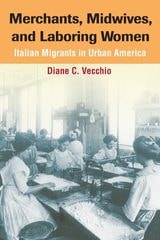
Merchants, Midwives, and Laboring Women
ITALIAN MIGRANTS IN URBAN AMERICADiane C. Vecchio
University of Illinois Press, 2006
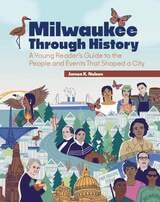
Milwaukee Through History
A Young Reader's Guide to the People and Events That Shaped a CityJames K. Nelsen
Wisconsin Historical Society Press, 2025
This richly illustrated book for middle grade and high school learners uses primary sources and archival photos to explore Milwaukee’s role in Wisconsin and US history. Milwaukee Through History highlights the city’s multiple transformations—from a resource-rich homeland of Ho-Chunk, Menominee, Ojibwe, Potawatomi, and other Native peoples to an immigrant hub to an industrial boomtown and, finally, to a vibrant tourist destination that continues to grapple with issues of poverty and inequality.
Readers will discover key people, places, events, and innovations that made Milwaukee—and national—history, including:
• Freedom seeker Joshua Glover
• Industrial giants like Harley Davidson & Allen Bradley
• Whitnall Park and the North Point Water Tower
• Labor movements and the fair housing marches
• Civil rights leader Vel Phillips
Author James K. Nelsen sheds new light on important events and milestones in history, including the American Revolution, the War of 1812, the Civil War, and the Great Migration. Written with middle and high school readers in mind, the book will appeal to people of all ages who are curious about Milwaukee’s history and culture. Milwaukee Through History is both an engaging supplement to Wisconsin and US history curricula and a great read for anyone seeking a deeper understanding of a diverse and dynamic city.
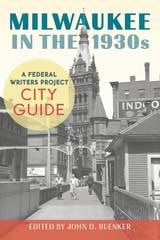
Milwaukee in the 1930s
A Federal Writers Project City GuideJohn D. Buenker
Wisconsin Historical Society Press, 2016
What would it be like to take an intensive tour of Milwaukee as it was during the late 1930s—at the confluence of the Great Depression, the New Deal, and the run-up to World War II? That is precisely what the participants in the Federal Writers Project did while researching their Guide to Milwaukee. The fruits of their labors were ready for publication by 1940, but for a number of reasons the finished product never saw the light of day—until now.
Fortunately, the manuscript has been carefully preserved in the Wisconsin Historical Society Archives
. Seventy-five years after the work’s completion, the Wisconsin Historical Society Press and historian John D. Buenker present this guide—now serving as a time machine, ready to transport readers back to the Milwaukee of the 1930s, neighborhood by neighborhood, building by building. Much more than a nostalgic snapshot, the book examines Milwaukee’s history from its earliest days to 1940.
Buenker’s thoughtful introduction provides historical context, detailing the FWP’s development of this guide, as well as Milwaukee’s political climate leading up to, and during, the 1930s. Next, essays on thirteen "areas," ranging from Civic Center to Bay View, delve deeper into the geography, economy, and culture of old Milwaukee’s neighborhoods, and simulated auto tours take readers to locales still familiar today, exploring the city’s most celebrated landmarks and institutions. With a calendar of annual events and a list of public services and institutions, plus dozens of photographs from the era, Milwaukee in the 1930s provides a unique record of a pre–World War II American city.

Milwaukee
A City Built on WaterJohn Gurda
Wisconsin Historical Society Press, 2026
The success and survival of Milwaukee lies in the rivers that meander through its streets and the great lake at its eastern boundary. The Indigenous peoples of the region recognized the value of an abundant, clean water supply for food and transportation. Generations of immigrants, entrepreneurs, innovators, and recreationists used the same waters to travel greater distances, power million-dollar industries, and even have a bit of fun.
In Milwaukee: A City Built on Water, celebrated historian John Gurda relates the history of the waters that gave Milwaukee life—and occasionally threatened the city through erosion, invasive species, and water-borne diseases. Telling tales of brewers, brickmakers, ecologists, and engineers, Gurda explores the city’s complicated connections with its most precious resource and greatest challenge. You’ll meet the generations of people, from a Potawatomi chief to fur traders and fishermen, who settled on the small spit of land known as Jones Island; learn how Milwaukee’s unique water composition creates its distinct cream-colored bricks; visit Wisconsin’s first waterparks; and see how city leaders transformed the Milwaukee River—once described as a “vast sewer” with an “odorous tide”—into today’s lively and lovely Riverwalk.
Now available in paperback, Milwaukee: A City Built on Water is the sweeping chronicle of a critical natural resource that has weathered heavy use and flagrant abuse to emerge as a focal point of both celebration and concern in the twenty-first century.
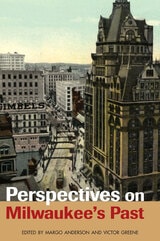
Perspectives on Milwaukee's Past
Edited by Margo Anderson and Victor Greene
University of Illinois Press, 2008
In this volume, a diverse group of scholars explores key themes in the distinctive history of Milwaukee, from settlement to the present, both in terms of the area's internal development and its comparative standing with other Great Lakes cities. Contributors discuss the importance of socialism and labor in local politics; Milwaukee's ethnic diversity, including long-standing African American, Latino, and Asian communities as well as an unusually large and significant German American population; the function and origins of the city's residential architecture; and the role of religious and ethnic culture in forming the city's identity. Rich in detail, the essays also challenge readers and researchers to pursue additional research on the city and the region by identifying critical areas and methods for future investigations into Milwaukee's past.
Contributors are Margo Anderson, Steven M. Avella, John D. Buenker, Jack Dougherty, Eric Fure-Slocum, Victor Greene, Thomas C. Hubka, Judith T. Kenny, Genevieve G. McBride, Aims McGuinness, Anke Ortlepp, Joseph A. Rodriguez, and N. Mark Shelley.

Setting the Lawn on Fire
A NovelMack Friedman
University of Wisconsin Press, 2007
Setting the Lawn on Fire, the first novel by critically acclaimed writer Mack Friedman, trails its narrator through his obsessions with sex, drugs, art, and poison. Ivan, a young Jewish boy from Milwaukee, embarks on a journey of sexual discovery that leads him from Wisconsin to Alaska, Philadelphia, and Mexico through stints as a fishery worker, artist, and finally a hustler who learns to provide the blank canvas for other people’s dreams. The result is a new kind of coming-of-age story that sees passion from every angle because its protagonist is every kind of lover: the seducer and the seduced, the pornographer and the model, the hunter and the prey, the trick and the john. In the end, Setting the Lawn on Fire is also something rare—a fully realized, contemporary romance that illuminates the power of desire and the rituals of the body, the brain, and the heart that attempt to contain our passions.
Sister
An African American Life in Search of JusticeSylvia Bell White and Jody LePage
University of Wisconsin Press, 2013
Winner, Wisconsin Historical Society Book Award of Merit
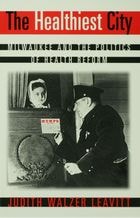
The Healthiest City
Milwaukee and the Politics of Health ReformJudith W. Leavitt
University of Wisconsin Press, 1996
Between 1850 and 1900, Milwaukee’s rapid population growth also gave rise to high death rates, infectious diseases, crowded housing, filthy streets, inadequate water supplies, and incredible stench. The Healthiest City shows how a coalition of reform groups brought about community education and municipal action to achieve for Milwaukee the title of “the healthiest city” by the 1930s. This highly praised book reminds us that cutting funds and regulations for preserving public health results in inconvenience, illness, and even death.
“A major work. . . . Leavitt focuses on three illustrative issues—smallpox, garbage, and milk, representing the larger areas of infectious disease, sanitation, and food control.”—Norman Gevitz, Journal of the American Medical Association
“Leavitt’s research provides additional evidence . . . that improvements in sanitation, living conditions, and diet contributed more to the overall decline in mortality rates than advances in medical practice. . . . A solid contribution to the history of urban reform politics and public health.”—Jo Ann Carrigan, Journal of American History

Valiant Vel
Vel Phillips and the Fight for Fairness and EqualityJerrianne Hayslett
Wisconsin Historical Society Press, 2025
An illustrated biography of groundbreaking civil rights activist Vel Phillips for young readers
Fair housing advocate, civil rights champion, and civic leader Vel Phillips spent her life breaking barriers and fighting for justice for all people. As the first Black woman on the Milwaukee Common Council, Wisconsin’s first Black judge, and the first Black woman to win statewide office when she was elected secretary of state of Wisconsin, Phillips left a lasting legacy that has inspired generations to continue the fight for justice and equality.
Valiant Vel depicts Phillips’s captivating story for young readers in middle and high school—from her childhood experiences facing racial discrimination, to achieving her dream of becoming a lawyer, to her long career in politics and civil rights. In the 1960s, Phillips spearheaded a campaign to advocate for fair housing in Milwaukee, joining forces with the NAACP Youth Council and marching alongside other activists in the face of violent opposition. In 1968, Phillips’s persistence paid off when the Milwaukee Common Council passed a fair housing ordinance.
Beautifully illustrated with historic photographs and original artwork by Milwaukee artist Aaron Boyd, Valiant Vel makes an excellent addition to young readers’ bookshelves at school and at home. With an afterword by Phillips’s son, Michael, a glossary of terms, and sources for further research, this book provides a thorough look at an inspirational activist who dedicated her life to making the world a better place.
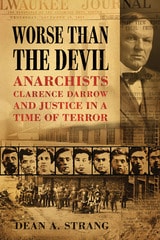
Worse than the Devil
Anarchists, Clarence Darrow, and Justice in a Time of TerrorDean A. Strang
University of Wisconsin Press, 2013
Largely overlooked for almost a century, the compelling story of this case emerges vividly in this meticulously researched book by Dean A. Strang. In its focus on a moment when patriotism, nativism, and terror swept the nation, Worse than the Devil exposes broad concerns that persist even today as the United States continues to struggle with administering criminal justice to newcomers and outsiders.