Results by title
129 books match the query 'Mind, Body, Spirit' and 7 start with a

A Liminal Life
A Medium's MemoirAntoinette "Tiyi" Schippers
Parkhurst Brothers, Inc., 2023
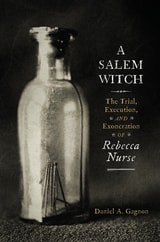
A Salem Witch
The Trial, Execution, and Exoneration of Rebecca NurseDaniel A. Gagnon
Westholme Publishing, 2023
The accusations against Nurse, a well-respected member in the community, seemed unbelievable. Unflinchingly, this ailing elderly woman insisted on her innocence and refused to falsely confess. Supported by many in Salem, Nurse’s family and neighbors challenged her accusers in court and prepared a thorough defense for her, yet nothing could surmount the fear of witchcraft, and she was sentenced to death. Nurse, seen as a martyr for the truth, later became the first person accused of witchcraft to be memorialized in North America.
In A Salem Witch: The Trial, Execution, and Exoneration of Rebecca Nurse, the first full account of Nurse’s life, Daniel A. Gagnon vividly recreates seventeenth-century Salem, and in the process challenges previous interpretations of Nurse’s life and the 1692 witch hunt in general. Through primary source research, he reveals how the Nurse family’s role in several disputes prior to the witch hunt was different than previously thought, as well as how Nurse’s case helps answer the important question of whether the accusations of witchcraft were caused by mental illness or malicious intent. A Salem Witch reveals a remarkable woman whose legacy has transformed how the witch hunt has been remembered and memorialized.
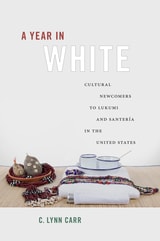
A Year in White
Cultural Newcomers to Lukumi and Santería in the United StatesCarr, C. Lynn
Rutgers University Press, 2016
In her intimate investigation of the “year in white,” Carr draws on fifty-two in-depth interviews with other participants, an online survey of nearly two hundred others, and almost a decade of her own ethnographic fieldwork, gathering stories that allow us to see how cultural newcomers and natives thought, felt, and acted with regard to their initiation. She documents how, during the iyawo year, the ritual slowly transforms the initiate’s identity. For the first three months, for instance, the iyawo may not use a mirror, even to shave, and must eat all meals while seated on a mat on the floor using only a spoon and their own set of dishes. During the entire year, the iyawo loses their name and is simply addressed as “iyawo” by family and friends.
Carr also shows that this year-long religious ritual—which is carried out even as the iyawo goes about daily life—offers new insight into religion in general, suggesting that the sacred is not separable from the profane and indeed that religion shares an ongoing dynamic relationship with the realities of everyday life. Religious expression happens at home, on the streets, at work and school.
Offering insight not only into Santería but also into religion more generally, A Year in White makes an important contribution to our understanding of complex, dynamic religious landscapes in multicultural, pluralist societies and how they inhabit our daily lives.

After Foucault
Jonathan Arac
Rutgers University Press, 1988
The essays in this collection assess the impact of Michel Foucault’s work on the conditions of disciplinary knowledge in humanistic studies and speculate on the directions we might take from his work. They cover a wide range of fundamental concerns: from philosophy of knowledge in both theoretical and applied forms to philology, history, psychoanalysis, feminism, and politics. The result is a lively debate and further probing beyond disciplinary boundaries. After Foucault will interest political theorists, feminists, and scholars of history, philosophy, and literature.
Agape Love
Tradition In Eight World ReligionsSir John Templeton
Templeton Press, 1999
The tradition of agape, or unconditional love, is not exclusive to any religion. It is a primary underlying principle found in religions worldwide. The concept of altruistic love challenges the spiritual person to "love your enemies" or to "love without thought of return." It is a love that flows out to others through compassion, kindness, tenderness, and charitable giving.
Buddhists have a path of compassion, where caring for others becomes the motivating force behind existence. Hindus have a branch of yoga, the heart-centered path, that leads to enlightenment through an overwhelming love for God that takes the form of loving all humanity. Eastern religions, such as Taoism and Confucianism, see transcendent love as essential to true wisdom.
Love is a universal theme of love found in all religious traditions, Buddhist, Christian, Islam, or others. As we realize that all religions have this spiritual principle of love at their core, we can develop a sense of shared humanity. The religious tradition of agape love examined in this book will inspire those who are learning to grow in compassion and love for all people.

Ananda
Where Yoga LivesJohn Ball
University of Wisconsin Press, 1982
Whenever the subject of communities and communal living comes uo, a variety of doubts and suspicions is usually aroused. The possible brainwashing of impressionable young people is frequently mentioned. Although the idea itself is centuries old, it has yet to be accepted as an approved method of living, even in this so-called New Age.
Of the many hundreds that have been started, very few have proven successful. The fact that Ananda has done so remarkably well against terrifying odds, and that at every time of crisis help always seems to come in some extraordinary way, invites attention. During his lifetime, which ended in 1952, Yogananda called for the founding of spiritual communities dedicated to world brotherhood and to "simple living and high thinking." Ananda is the first response to this directive. Its remarkable history, and its present expanding horizons, are the subject of this work.
Authors of the Impossible
The Paranormal and the SacredJeffrey J. Kripal
University of Chicago Press, 2010
Most scholars dismiss research into the paranormal as pseudoscience, a frivolous pursuit for the paranoid or gullible. Even historians of religion, whose work naturally attends to events beyond the realm of empirical science, have shown scant interest in the subject. But the history of psychical phenomena, Jeffrey J. Kripal contends, is an untapped source of insight into the sacred and by tracing that history through the last two centuries of Western thought we can see its potential centrality to the critical study of religion.
Kripal grounds his study in the work of four major figures in the history of paranormal research: psychical researcher Frederic Myers; writer and humorist Charles Fort; astronomer, computer scientist, and ufologist Jacques Vallee; and philosopher and sociologist Bertrand Méheust. Through incisive analyses of these thinkers, Kripal ushers the reader into a beguiling world somewhere between fact, fiction, and fraud. The cultural history of telepathy, teleportation, and UFOs; a ghostly love story; the occult dimensions of science fiction; cold war psychic espionage; galactic colonialism; and the intimate relationship between consciousness and culture all come together in Authors of the Impossible, a dazzling and profound look at how the paranormal bridges the sacred and the scientific.