Results by title
30 books match the query 'Mineral industries'
Afterlives of Discovery
Speculative Geographies in the Settler Colonial Imaginaryheidi andrea restrepo rhodes
Duke University Press, 2025

Creating Worlds Otherwise
Art, Collective Action, and (Post)ExtractivismPaula Serafini
Vanderbilt University Press, 2022
Extractivism has increasingly become the ground on which activists and scholars in Latin America frame the dynamics of ecological devastation, accumulation of wealth, and erosion of rights. These maladies are the direct consequences of long-standing extraction-oriented economies, and more recently from the expansion of the extractive frontier and the implementation of new technologies in the extraction of fossil fuels, mining, and agriculture. But the fields of sociology, political ecology, anthropology, and geography have largely ignored the role of art and cultural practices in studies of extractivism and post-extractivism.
The field of art theory, on the other hand, has offered a number of texts that put forward insightful analyses of artwork addressing extraction, environmental devastation, and the climate crisis. However, an art theory perspective that does not engage firsthand and in depth with collective action remains limited and fails to provide an account of the role, processes, and politics of art in anti- and post-extractivist movements.
Creating Worlds Otherwise examines the narratives that subaltern groups generate around extractivism, and how they develop, communicate, and mobilize these narratives through art and cultural practices. It reports on a six-year project on creative resistance to extractivism in Argentina and builds on long-term engagement working on environmental justice projects and campaigns in Argentina and the UK.
It is an innovative contribution to the fields of Latin American studies, political ecology, cultural studies, and art theory, and addresses pressing questions regarding what post-extractivist worlds might look like as well as how such visions are put into practice.
Earthmoving
Extractivism, War, and Visuality in Northern KurdistanEray Çayli
University of Texas Press, 2025
Focuses on contemporary art and media to examine the role of visuals in environmental violence and war in Northern Kurdistan.
Extractivism—exploiting the earth for resources—has long driven racial capitalism and colonialism. And yet, how does extractivism operate in a world where ecological and humanitarian sensibilities are unprecedentedly widespread? Eray Çaylı argues it does so by mobilizing these sensibilities in new ways. Extractivism is no longer only about moving the earth—displacing peoples, fossils, minerals, and waters—but also leaving those who witness this violent displacement sentimentally moved.
Earthmoving conceptualizes this duality. Derived from Çaylı’s years-long work in Northern Kurdistan, home to the world’s largest stateless nation—rendered stateless by colonial policies since the nineteenth century—Earthmoving focuses on the 2010s, a decade that began with peace talks between Turkey and the Kurdish liberation movement but ended with war. The decade saw extractivism intensify in the region and images of its harm proliferate across art and media. Together with contemporary artists, Çaylı shows that images challenge extractivism both by making its harm visible and by fostering self-reflexive and reciprocal collaboration that breaks with its valuation of the colonized and the racialized only in quantifiable and marketable terms.
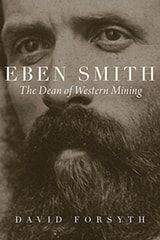
Eben Smith
The Dean of Western MiningDavid Forsyth
University Press of Colorado, 2021
The mining teams Smith formed with Chaffee and with industrialist David Moffat were among the most successful and respected in Colorado, and many in the state held Smith in high regard. Yet despite the credit he received during his lifetime for establishing Colorado’s mining industry, Smith has not received much attention from historians, perhaps because he was content to leave public-facing duties to his partners while he concerned himself with managing mine operations.
From Smith’s early years and his labor in the mines to his rise to prominence as an investor and developer, Forsyth shows how Smith used the mining and milling knowledge he acquired in California to become a leader in technological innovation in Colorado’s mining industry.

Entranced Earth
Art, Extractivism, and the End of LandscapeJens Andermann
Northwestern University Press, 2023
A sweeping analysis of the lasting effects of neocolonial extractivism in Latin American aesthetic modernity from 1920 to the present
Looking to the extractive frontier as a focal point of Latin American art, literature, music, and film, Jens Andermann asks what emerges at the other end of landscape. Art in the Global South has long represented and interrogated “insurgent nature”—organic and inorganic matter, human and nonhuman life, thrown into turmoil.
In Entranced Earth: Art, Extractivism, and the End of Landscape, Andermann traces the impact of despaisamiento—world-destroying un-landscaping—throughout the Latin American modernist archive. At the same time, he explores innovative, resilient modes of allyship forged between diverse actors through their shared experiences of destruction. From the literary regionalism of the 1930s to contemporary bio art, from modernist garden architecture to representations of migration and displacement in sound art and film, Entranced Earth tracks the crisis of landscape and environmental exhaustion beyond despair toward speculative, experimental forms of survival.
Fighting for Andean Resources
Extractive Industries, Cultural Politics, and Environmental Struggles in PeruVladimir R. Gil Ramón, Foreword by Enrique Mayer
University of Arizona Press, 2020
2021 American Anthropological Association´s, finalist of the Association for Political and Legal Anthropology Book Prize in Critical Anthropology
Mining investment in Peru has been presented as necessary for national progress; however, it also has brought socioenvironmental costs, left unfulfilled hopes for development, and has become a principal source of confrontation and conflict.
Fighting for Andean Resources focuses on the competing agendas for mining benefits and the battles over their impact on proximate communities in the recent expansion of the Peruvian mining frontier. The book complements renewed scrutiny of how globalization nurtures not solely antagonism but also negotiation and participation.
Having mastered an intimate knowledge of Peru, Vladimir R. Gil Ramón insightfully documents how social technologies of power are applied through social technical protocols of accountability invoked in defense of nature and vulnerable livelihoods. Although analyses point to improvements in human well-being, a political and technical debate has yet to occur in practice that would define what such improvements would be, the best way to achieve and measure them, and how to integrate dimensions such as sustainability and equity.
Many confrontations stem from frustrated expectations, environmental impacts, and the virtual absence of state apparatus in the locations where new projects emerged. This book presents a multifaceted perspective on the processes of representation, the strategies in conflicts and negotiations of development and nature management, and the underlying political actions in sites affected by mining.
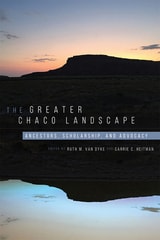
Greater Chaco Landscape
Ancestors, Scholarship, and AdvocacyRuth M. Van Dyke
University Press of Colorado, 2020
Contributors analyze many different dimensions of the Chacoan landscape and present the most effective, innovative, and respectful means of studying them, focusing on the significance of thousand-year-old farming practices; connections between early great houses outside the canyon and the rise of power inside it; changes to Chaco’s roads over time as observed in aerial imagery; rock art throughout the greater Chaco area; respectful methods of examining shrines, crescents, herraduras, stone circles, cairns, and other landscape features in collaboration with Indigenous colleagues; sensory experiences of ancient Chacoans via study of the sightlines and soundscapes of several outlier communities; and current legal, technical, and administrative challenges and options concerning preservation of the landscape.
An unusually innovative and timely volume that will be available both in print and online, with the online edition incorporating video chapters presented by Acoma, Diné, Zuni, and Hopi cultural experts filmed on location in Chaco Canyon, The Greater Chaco Landscape is a creative collaboration with Native voices that will be a case study for archaeologists and others working on heritage management issues across the globe. It will be of interest to archaeologists specializing in Chaco and the Southwest, interested in remote sensing and geophysical landscape-level investigations, and working on landscape preservation and phenomenological investigations such as viewscapes and soundscapes.
Contributors: R. Kyle Bocinsky, G. B. Cornucopia, Timothy de Smet, Sean Field, Richard A. Friedman, Dennis Gilpin, Presley Haskie, Tristan Joe, Stephen H. Lekson, Thomas Lincoln, Michael P. Marshall, Terrance Outah, Georgiana Pongyesva, Curtis Quam, Paul F. Reed, Octavius Seowtewa, Anna Sofaer, Julian Thomas, William B. Tsosie Jr., Phillip Tuwaletstiwa, Ernest M. Vallo Jr., Carla R. Van West, Ronald Wadsworth, Robert S. Weiner, Thomas C. Windes, Denise Yazzie, Eurick Yazzie
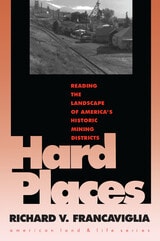
Hard Places
Reading the Landscape of America's Historic Mining DistrictsRichard V. Francaviglia
University of Iowa Press, 1997
Working with the premise that there are much meaning and value in the "repelling beauty" of mining landscapes, Richard Francaviglia identifies the visual clues that indicate an area has been mined and tells us how to read them, showing the interconnections among all of America's major mining districts. With a style as bold as the landscape he reads and with photographs to match, he interprets the major forces that have shaped the architecture, design, and topography of mining areas. Covering many different types of mining and mining locations, he concludes that mining landscapes have come to symbolize the turmoil between what our society elects to view as two opposing forces: culture and nature.
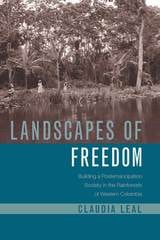
Landscapes of Freedom
Building a Postemancipation Society in the Rainforests of Western ColombiaClaudia Leal
University of Arizona Press, 2018
After emancipation in 1851, the African descendants living in the extra-humid rainforests of the Pacific coast of Colombia attained levels of autonomy hardly equaled anywhere else in the Americas. This autonomy rested on their access to a diverse environment—including small strips of fertile soils, mines, forests, rivers, and wetlands—that contributed to their subsistence and allowed them to procure gold, platinum, rubber, and vegetable ivory for export.
Afro-Colombian slave labor had produced the largest share of gold in the colony of New Granada. After the abolishment of slavery, some free people left the mining areas and settled elsewhere along the coast, making this the largest area of Latin America in which black people predominate into the present day. However, this economy and society, which lived off the extraction of natural resources, was presided over by a very small white commercial elite living in the region’s ports, where they sought to create an urban environment that would shelter them from the jungle.
Landscapes of Freedom reconstructs a nonplantation postemancipation trajectory that sheds light on how environmental conditions and management influenced the experience of freedom. It also points at the problematic associations between autonomy and marginality that have shaped the history of Afro-America. By focusing on racialized landscapes, Leal offers a nuanced and important approach to understanding the history of Latin America.
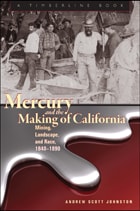
Mercury and the Making of California
Mining, Landscape, and Race, 1840–1890Andrew Scott Johnston
University Press of Colorado, 2015
Gold and silver could not be refined without mercury; therefore, its production and use were vital to securing power and wealth in the West. The first industrialized mining in California, mercury mining had its own particular organization, structure, and built environments. These were formed within the Spanish Empire, subsequently transformed by British imperial ambitions, and eventually manipulated by American bankers and investors. In California, mercury mining also depended on a workforce differentiated by race and ethnicity. The landscapes of work and camp and the relations among the many groups involved in the industry—Mexicans, Chileans, Spanish, English, Irish, Cornish, American, and Chinese—form a crucial chapter in the complex history of race and ethnicity in the American West.
This pioneering study explicates the mutual structuring of the built environments of the mercury-mining industry and the emergence of California’s ethnic communities. Combining rich documentary sources with a close examination of the existing physical landscape, Johnston explores both the detail of everyday work and life in the mines and the larger economic and social structures in which mercury mining was enmeshed, revealing the significance of mercury mining for Western history.
Mining America
The Industry and the Environment, 1800-1980Duane A. Smith
University Press of Colorado, 1994
Mining Encounters
Extractive Industries in an Overheated WorldEdited by Thomas Hylland Eriksen and Robert J. Pijpers
Pluto Press, 2018
Mining Encounters paints a broad picture, looking at resource extraction in numerous locations at different stages of development—covering coal, natural gas, gold, and cement mining in North, West, and South Africa, as well as in India, Kazakhstan, and Australia. The chapters answer key questions: How does mining transform the physical landscape? What are the value systems underlying the world’s mining industries? And how does the process of extracting resources determine which stakeholders become dominant and which marginalized?
Uncovering the tensions, negotiations, and disparities among different actors in the extractive industries, Mining Encounters will make a vital contribution to policy debates moving forward.
Mining in World History
Martin Lynch
Reaktion Books, 2004
Mining the Borderlands
Industry, Capital, and the Emergence of Engineers in the Southwest Territories, 1855-1910Sarah E. M. Grossman
University of Nevada Press, 2018
At the dawn of the twentieth century, the US-Mexico border was home to some of the largest and most technologically advanced industrial copper mines. This despite being geographically, culturally, and financially far-removed from traditional urban centers of power. Mining the Borderlands argues that this was only possible because of the emergence of mining engineers—a distinct technocratic class of professionals who connected capital, labor, and expertise.
Mining engineers moved easily between remote mining camps and the upscale parlors of east coast investors. Working as labor managers and technical experts, they were involved in the daily negotiations, which brought private US capital to the southwestern border. The success of the massive capital-intensive mining ventures in the region depended on their ability to construct different networks, serving as intermediaries to groups that rarely coincided.
Grossman argues that this didn’t just lead to bigger and more efficient mines, but served as part of the ongoing project of American territorial and economic expansion. By integrating the history of technical expertise into the history of the transnational mining industry, this in-depth look at borderlands mining explains how American economic hegemony was established in a border region peripheral to the federal governments of both Washington, D.C. and Mexico City.

Natural Resource Development and Human Rights in Latin America
State and non-state actors in the promotion of and opposition to extractivismEdited by Malayna Raftopoulos and Radoslaw Poweska
University of London Press, 2017
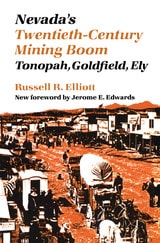
Nevada's Twentieth-Century Mining Boom
Tonopah, Goldfield, ElyRussell R. Elliott
University of Nevada Press, 1966
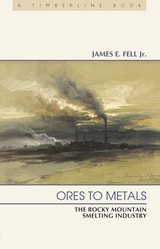
Ores to Metals
The Rocky Mountain Smelting IndustryJames E. Fell
University Press of Colorado, 2009
Although mining holds more of the glamour for those in and interested in the minerals industry, smelters have continuously played a critical role in the industry’s evolution since their introduction in Colorado in the 1860s. At that time, miners desperately needed new technology to recover gold and silver from ores resistant to milling. Beginning as small independent enterprises, progressing to larger integrated firms working in urban centers, and finally following a trend toward mergers, the entire industry was absorbed into one large holding company—the American Smelting and Refining Company. Over time, fortunes were won and lost, business success was converted to political success, and advances were made in science and metallurgy. Drawing on archival material, Fell expertly presents the triumphs and troubles of the entrepreneurs who built one of the great industries of the West.
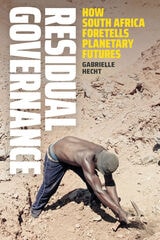
Residual Governance
How South Africa Foretells Planetary FuturesGabrielle Hecht
Duke University Press, 2023
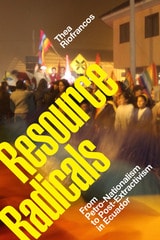
Resource Radicals
From Petro-Nationalism to Post-Extractivism in EcuadorThea Riofrancos
Duke University Press, 2020
Subterranean Matters
Cooperative Mining and Resource Nationalism in Plurinational BoliviaAndrea Marston
Duke University Press, 2024
Terror Capitalism
Uyghur Dispossession and Masculinity in a Chinese CityDarren Byler
Duke University Press, 2021
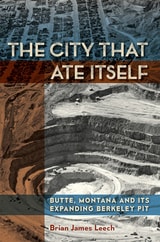
The City That Ate Itself
Butte, Montana and Its Expanding Berkeley PitBrian James Leech
University of Nevada Press, 2018
Brian James Leech provides a social and environmental history of Butte, Montana’s Berkeley Pit, an open-pit mine which operated from 1955 to 1982. Using oral history interviews and archival finds, The City That Ate Itself explores the lived experience of open-pit copper mining at Butte’s infamous Berkeley Pit. Because an open-pit mine has to expand outward in order for workers to extract ore, its effects dramatically changed the lives of workers and residents. Although the Berkeley Pit gave consumers easier access to copper, its impact on workers and community members was more mixed, if not detrimental.
The pit’s creeping boundaries became even more of a problem. As open-pit mining nibbled away at ethnic communities, neighbors faced new industrial hazards, widespread relocation, and disrupted social ties. Residents variously responded to the pit with celebration, protest, negotiation, and resignation. Even after its closure, the pit still looms over Butte. Now a large toxic lake at the center of a federal environmental cleanup, the Berkeley Pit continues to affect Butte’s search for a postindustrial future.
The Eyes of the World
Mining the Digital Age in the Eastern DR CongoJames H. Smith
University of Chicago Press, 2022
The digital devices that, many would argue, define this era exist not only because of Silicon Valley innovations but also because of a burgeoning trade in dense, artisanally mined substances like tantalum, tin, and tungsten. In the tentatively postwar Eastern DR Congo, where many lives have been reoriented around artisanal mining, these minerals are socially dense, fueling movement and innovative collaborations that encompass diverse actors, geographies, temporalities, and dimensions. Focusing on the miners and traders of some of these “digital minerals,” The Eyes of the World examines how Eastern Congolese understand the work in which they are engaged, the forces pitted against them, and the complicated process through which substances in the earth and forest are converted into commodified resources. Smith shows how violent dispossession has fueled a bottom-up social theory that valorizes movement and collaboration—one that directly confronts both private mining companies and the tracking initiatives implemented by international companies aspiring to ensure that the minerals in digital devices are purified of blood.
The History Of The Comstock Lode
Grant H. Smith
University of Nevada Press, 1998
The Lady In The Ore Bucket
A History of Settlement and Industry in the Tri-Canyon Area of the Wasatch MountainsCharles L Keller
University of Utah Press, 2001
These place names, as well as the physcial traces and artifacts that persist in three Wasatch canyons—Mill Creek, Big Cottonwood, and Little Cottonwood—tantalize with what they suggest, but do not tell, about the history of settlement and development in the canyons. Charles Keller has extracted a wealth of information to create The Lady in the Ore Bucket, a faxcinating history of the lumber, mining, and hydropower industries built from the rich natural resources of the canyons. With more than six dozen photographs and maps, the book is alive with details concerning the personalities, politics, pacts, and peregrinations of local leaders from white settlement in 1847 through the early 1900s. It will delight any reader with an interest in the magnificent canyones that open onto the modern Wasatch Front.
The Limits of Revolution
Worker Citizens in a Bolivian Mining CityElena McGrath
University of Texas Press, 2026
The role of Bolivian mining families in revolution and politics.
In 1952, Bolivia’s Revolutionary Nationalist Movement (MNR) swept into power, promising collective prosperity through class-based nationalism. The heroic symbol of the movement was the worker citizen—the formerly indigenous miner who would fuel economic development in a nationalized mining economy.
The Limits of Revolution explores this history from the worker barrios of the copper mining city of Corocoro. As the state walked back its promises of worker political power at the national level, mining men and women in Corocoro struggled—through protests, court battles, and barfights—to maintain the benefits of worker citizenship locally. After the MNR fell to a military dictatorship in 1964, however, families retreated to defending the nationalized mining company against an increasingly hostile state. In this battle to keep the revolution alive, the expansive potential of worker citizenship disappeared and old racial exclusions resurfaced. Largely forgotten today, Bolivia’s experience of revolution exposes the contradictions of postcolonial nationalism and sheds light on Latin America’s transition from Cold War–era class politics to twenty-first-century Pink Tide politics.
Underdeveloping the Amazon
Extraction, Unequal Exchange, and the Failure of the Modern StateStephen G. Bunker
University of Chicago Press, 1988
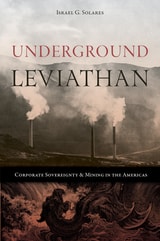
Underground Leviathan
Corporate Sovereignty and Mining in the AmericasIsrael G. Solares
University of Nevada Press, 2024
Author Israel G. Solares examines how the twentieth century multinational firm established and articulated multinational corporate sovereignty in ways that reflect other multinational titans, like the East Asian Trade companies, and presages the digital giants and space corporations of the twenty-first century. Bridging the domineering practices used during the colonization of Southern Asia with the futuristic colonies on the Moon, Underground Leviathan documents the cost of a corporation’s unyielding desire to consume the secrets at the center of the Earth.
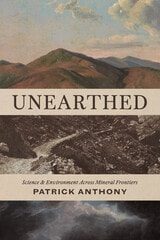
Unearthed
Science and Environment Across Mineral FrontiersPatrick Anthony
University of Chicago Press, 2026
Unearthed depicts a pivotal moment during the nineteenth century: As European and settler schemes to govern ever larger territories intensified, the earth and atmospheric sciences were also becoming more global in scope, assembling models of the planet while making use of militarized or highly industrialized systems. These efforts were informed by the physique du monde, or global physics, of Alexander von Humboldt (1769–1859), a program of vast data collection that spanned four hemispheres that aimed to determine general, scientific laws about the planet and its environments.
Using Humboldt’s itineraries as a frame, Unearthed traces an information order that linked far-flung industrial sites and frontier stations, from Prussian provinces to the Spanish and Russian empires. Humboldt intersected with Saxon miners, Mexican cartographers, and Siberian surveyors, among other itinerant Germans who mobilized the labor and resources of widespread mining operations for global surveys of earth and air. Interweaving the histories of capital and climate, Patrick Anthony takes readers from mines to mountains to show how the sciences of Humboldt’s circuits both measured and made modern natures. These sciences of the mineral frontier, he argues, ultimately laid the groundwork for carbon-intensive economics and a logic of unending extraction. Wide-ranging and ambitious, Unearthed will interest scholars working in the history of science, global history, and the environmental humanities.
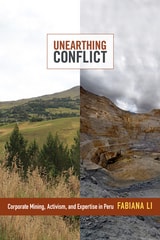
Unearthing Conflict
Corporate Mining, Activism, and Expertise in PeruFabiana Li
Duke University Press, 2015