Results by title
2 books match the query 'Minimalism'
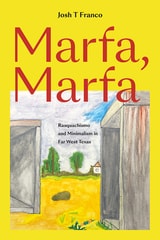
Marfa, Marfa
Rasquachismo and Minimalism in Far West TexasJosh T Franco
Duke University Press, 2026
Marfa, Texas, is a world-renowned art pilgrimage site. When Donald Judd moved there in 1971, he permanently installed works of art in and around the town. Catalyzed by Judd’s presence, the small southwestern town is now home to galleries, arts foundations, festivals, and studios. In Marfa, Marfa, Josh T Franco examines the minimalist frameworks and aesthetic paradigms Judd brought to Marfa and how they intersect with the rasquache sensibilities of the area’s Chicanx, Mexican American, and Catholic communities. Franco draws on his own family history in the town as well as Marfa’s complex history, culture, and memory, analyzing archival documents alongside the arts institutions that gave rise to the town’s identity. Marfa, Marfa employs a decolonial and experimental method to examine minimalist and Chicanx art through objects for public display, local dialects, and domestic observations, ultimately demonstrating Marfa’s unique role as a crossroads for minimalism and rasquachismo.
[more]
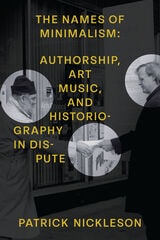
The Names of Minimalism
Authorship, Art Music, and Historiography in DisputePatrick Nickleson
University of Michigan Press, 2023
Minimalism stands as the key representative of 1960s radicalism in art music histories—but always as a failed project. In The Names of Minimalism, Patrick Nickleson holds in tension collaborative composers in the period of their collaboration, as well as the musicological policing of authorship in the wake of their eventual disputes. Through examinations of the droning of the Theatre of Eternal Music, Reich’s Pendulum Music, Glass’s work for multiple organs, the austere performances of punk and no wave bands, and Rhys Chatham and Glenn Branca’s works for massed electric guitars, Nickleson argues for authorship as always impure, buzzing, and indistinct.
Expanding the place of Jacques Rancière’s philosophy within musicology, Nickleson draws attention to disciplinary practices of guarding compositional authority against artists who set out to undermine it. The book reimagines the canonic artists and works of minimalism as “(early) minimalism,” to show that art music histories refuse to take seriously challenges to conventional authorship as a means of defending the very category “art music.” Ultimately, Nickleson asks where we end up if we imagine the early minimalist project—artists forming bands to perform their own music, rejecting the score in favor of recording, making extensive use of magnetic type as compositional and archival medium, hosting performances in lofts and art galleries rather than concert halls—not as a utopian moment within a 1960s counterculture doomed to fail, but as the beginning of a process with a long and influential afterlife.
Expanding the place of Jacques Rancière’s philosophy within musicology, Nickleson draws attention to disciplinary practices of guarding compositional authority against artists who set out to undermine it. The book reimagines the canonic artists and works of minimalism as “(early) minimalism,” to show that art music histories refuse to take seriously challenges to conventional authorship as a means of defending the very category “art music.” Ultimately, Nickleson asks where we end up if we imagine the early minimalist project—artists forming bands to perform their own music, rejecting the score in favor of recording, making extensive use of magnetic type as compositional and archival medium, hosting performances in lofts and art galleries rather than concert halls—not as a utopian moment within a 1960s counterculture doomed to fail, but as the beginning of a process with a long and influential afterlife.
[more]