Results by title
56 books match the query 'Mississippian culture' and 7 start with a
Ancient Chiefdoms of the Tombigbee
John H. Blitz
University of Alabama Press, 1993
Focuses on both the small- and large-scale Mississippian societies in the Tombigbee-Black Warrior River region of Alabama and Mississippi
Within the last 50 years archaeologists have discovered that around the 10th century AD, native southeastern peoples began a process of cultural change far more complex than anything that had occurred previously. These late prehistoric societies—known as Mississippian—have come to be regarded as chiefdoms. The chiefdoms are of great anthropological interest because in these kinds of societies social hierarchies or rank and status were first institutionalized.
Ancient Chiefdoms of the Tombigbee focuses on both the small- and large-scale Mississippian societies in the Tombigbee-Black Warrior River region of Alabama and Mississippi. Exploring the relationships involving polity size, degree of social ranking, and resource control provides insights into cycles of chiefdom development and fragmentation. Blitz concludes that the sanctified, security maintenance roles of communal food storage management and war leadership were a sufficient basis for formal chiefly authority but insufficient for economically based social stratification.
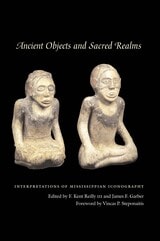
Ancient Objects and Sacred Realms
Interpretations of Mississippian IconographyEdited by F. Kent Reilly, III, and James F. Garber
University of Texas Press, 2006
Between AD 900-1600, the native peoples of the Mississippi River Valley and other areas of the Eastern Woodlands of the United States conceived and executed one of the greatest artistic traditions of the Precolumbian Americas. Created in the media of copper, shell, stone, clay, and wood, and incised or carved with a complex set of symbols and motifs, this seven-hundred-year-old artistic tradition functioned within a multiethnic landscape centered on communities dominated by earthen mounds and plazas. Previous researchers have referred to this material as the Southeastern Ceremonial Complex (SECC).
This groundbreaking volume brings together ten essays by leading anthropologists, archaeologists, and art historians, who analyze the iconography of Mississippian art in order to reconstruct the ritual activities, cosmological vision, and ideology of these ancient precursors to several groups of contemporary Native Americans. Significantly, the authors correlate archaeological, ethnographic, and art historical data that illustrate the stylistic differences within Mississippian art as well as the numerous changes that occur through time. The research also demonstrates the inadequacy of the SECC label, since Mississippian art is not limited to the Southeast and reflects stylistic changes over time among several linked but distinct religious traditions. The term Mississippian Iconographic Interaction Sphere (MIIS) more adequately describes the corpus of this Mississippian art. Most important, the authors illustrate the overarching nature of the ancient Native American religious system, as a creation unique to the native American cultures of the eastern United States.
Archaeology of Minnesota
The Prehistory of the Upper Mississippi River RegionGuy Gibbon
University of Minnesota Press, 2012
Histories of Minnesota typically begin with seventeenth-century French fur traders exploring the western shores of Lake Superior. And yet, archaeology reveals that Native Americans lived in the region at least 13,000 years before such European incursions. Archaeology of Minnesota tells their story—or as much as the region’s wealth of artifacts, evidence of human activity, and animal and plant remains can convey.
From archaeological materials, Guy Gibbon reconstructs the social, economic, and political systems—the lifeways—of those who inhabited what we now call Minnesota for thousands of years before the first contact between native peoples and Europeans. From the boreal coniferous forests to the north, to the tall grass prairie to the west and southwest, to the deciduous forest to the east and southeast, the richly diverse land of the upper Mississippi River region, crossed and bordered by all manner of waterways, was a virtual melting pot of prehistoric cultures.
Demonstrating how native cultures adapted and evolved over time, Gibbon provides an explanation that is firmly rooted in the nature of local environments. In doing so, he shows how the study of Minnesota archaeology is relevant to a broader understanding of long-term patterns of change in human development throughout the world.

Archaeology of the Central Mississippi Valley
Dan F. Morse
University of Alabama Press, 2009
The earliest recorded description of the Central Mississippi Valley and its inhabitants is contained within the DeSoto chronicles written after the conquistadors passed through the area between 1539 and 1543. In 1882 a field agent for the Bureau of American Ethnology conducted the first systematic archaeological survey of the region, an area that extends from near the mouth of the Ohio River to the mouth of the Arkansas River, bounded on the east by the Mississippi River and on the west by the Ozark Highlands and Grand Prairie. One hundred years later, the authors produced this first comprehensive overview of all of the archaeological research conducted in the valley during the interim. It is a well-organized compendium, written with both the professional archaeologist and the layperson in mind, and is profusely illustrated with maps, charts, artifact photographs, and drawings. This volume was the first published history of the archaeology of the region and stands as the basic resource for that work today.
Archaeology of the Moundville Chiefdom
Edited by Vernon James Knight Jr. and Vincas P. Steponaitis, with a foreword by Chistopher S. Peebles
University of Alabama Press, 2007
Built on a flat terrace overlooking the Black Warrior River in Alabama, the Moundville ceremonial center was at its height a densely occupied town of approximately 1,000 residents, with at least 29 earthen mounds surrounding a central plaza. Today Moundville is not only one of the largest and best-preserved Mississippian sites in the United States but also one of the most intensively studied. This volume brings together nine Moundville specialists who trace the site’s evolution and eventual decline.

Architectural Variability in the Southeast
Edited by Cameron H. Lacquement
University of Alabama Press, 2007
Some of the most visible expressions of human culture are illustrated architecturally. Unfortunately for archaeologists, the architecture being studied is not always visible and must be inferred from soil inconsistencies or charred remains. This study deals with research into roughly a millennium of Native American architecture in the Southeast and includes research on the variation of construction techniques employed both above and below ground. Most of the architecture discussed is that of domestic houses with some emphasis on large public buildings and sweat lodges. The authors use an array of methods and techniques in examining native architecture including experimental archaeology, ethnohistory, ethnography, multi-variant analysis, structural engineering, and wood science technology. A major portion of the work, and probably the most important in terms of overall significance, is that it addresses the debate of early Mississippian houses and what they looked like above ground and the changes that occurred both before and after the arrival of Europeans.
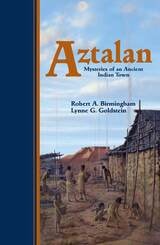
Aztalan
Mysteries of an Ancient Indian TownRobert A. Birmingham and Lynne Goldstein
Wisconsin Historical Society Press, 2006
Birmingham and Goldstein attempt to unlock some of the mysteries, providing insights and information about the group of people who first settled here in 1100 AD. Filled with maps, drawings, and photographs of artifacts, this small volume examines a time before modern Native American people settled in this area.