Results by title
210 books match the query 'Missouri' and 22 start with a
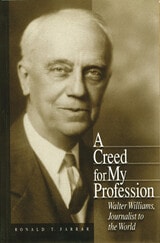
A Creed for My Profession
Walter Williams, Journalist to the WorldRonald T. Farrar
University of Missouri Press, 1998
This superb biography provides for the first time a candid look at the remarkable life of Walter Williams, the man who founded the world's first school of journalism and perhaps contributed more toward the promotion of professional journalism than any other person of his time.
Williams, the youngest of six children, was born in Boonville, Missouri, in 1864. Never an athletic child, he always had a love of books and of learning; yet, he scarcely had a high school education. He began his journalistic career as a printer's devil at seventy cents per week and eventually became editor and part- owner of a weekly in Columbia, Missouri. During his time as an editor, Williams became convinced that journalism would never reach its potential until its practitioners had the opportunity for university training in their field. After years of crusading, he established the first journalism school, on the University of Missouri campus. Later, he was chosen president of the University of Missouri, which he led with distinction during the Great Depression.
Williams was an unwavering advocate of high professional standards. His Journalist's Creed became one of the most widely circulated codes of professional ethics. Williams inspired the confidence of his fellow journalists, and he carried his message to nearly every country in which newspapers were published. Not only did he invent journalism education, he also created global organizations of journalists and spread the gospel of professionalism throughout the world. His death, in 1935, was mourned throughout the United States, and editorial tributes came from around the world. As one British editor succinctly put it, "Williams was not born to greatness. Neither was it thrust upon him. Literally, he achieved greatness."
A Fire Bell in the Past
The Missouri Crisis at 200, Volume I, Western Slavery, National ImpasseJeffrey L. Pasley
University of Missouri Press, 2021
Drawing on the participants in two landmark conferences held at the University of Missouri and the City University of New York, this first of two volumes finds myriad new perspectives on the Missouri Crisis. Celebrating Missouri’s bicentennial the scholarly way, with fresh research and unsparing analysis, this eloquent collection of essays from distinguished historians gives the epochal struggle over Missouri statehood its due as a major turning point in American history.
Contributors include the editors, Christa Dierksheide, David N. Gellman, Sarah L. H. Gronningsater, Robert Lee, Donald Ratcliffe, Andrew Shankman, Anne Twitty, John R. Van Atta, and David Waldstreicher.
A Fire Bell in the Past
The Missouri Crisis at 200, Volume II: “The Missouri Question” and Its AnswersJeffrey L. Pasley
University of Missouri Press, 2021
Drawn from the of participants in two landmark conferences held at the University of Missouri and the City University of New York, those who contributed original essays to this second of two volumes—a group that includes young scholars and foremost authorities in the field—answer the Missouri “Question,” in bold fashion, challenging assumptions both old and new in the long historiography by approaching the event on its own terms, rather than as the inevitable sequel of the flawed founding of the republic or a prequel to its near destruction.
This second volume of A Fire Bell in the Past features a foreword by Daive Dunkley. Contributors include Dianne Mutti Burke, Christopher Childers, Edward P. Green, Zachary Dowdle, David J. Gary, Peter Kastor, Miriam Liebman, Matthew Mason, Kate Masur, Mike McManus, Richard Newman, and Nicholas Wood.

A French Aristocrat in the American West
The Shattered Dreams of De Lassus De LuzièresCarl J. Ekberg & Foreword by Marie-Sol de La Tour d'Auvergne
University of Missouri Press, 2010
A History of Missouri (V1)
Volume I, 1673 to 1820William E. Foley
University of Missouri Press, 1971
Including a completely revised and updated bibliography, A History of Missouri: Volume I, 1673 to 1820 covers the pre-statehood history of Missouri, beginning with the arrival in 1673 of the first Europeans in the area, Louis Jolliet and Jesuit Father Jacques Marquette, and continuing through the development and growth of the region, to the final campaign for statehood in 1820. In tracing the broad outlines of Missouri's development through the formative years, the author examines the origins of Missouri's diverse heritage as the region passed under the control of French, Spanish, and American authorities.
A History of Missouri (V2)
Volume II, 1820 to 1860Perry McCandless
University of Missouri Press, 2000
With a newly revised bibliography, A History of Missouri: Volume II, 1820 to 1860 covers the turbulent years of Missouri's adolescence—from statehood to the outset of the Civil War.
A History of Missouri (V3)
Volume III, 1860 to 1875William E. Parrish
University of Missouri Press, 2001
A History of Missouri: Volume III, 1860 to 1875, now available in paperback with a new, up-to-date bibliography, follows the course of the state's history through the turbulent years of the Civil War and Reconstruction. Increasingly bitter confrontations over the questions of secession and neutrality divided Missourians irreparably in 1861, with the result that the state was represented in the armies both of the North and of the South. During the next four years, Missouri would be the scene of several important battles, including Wilson's Creek and Westport, and much bloody combat as secessionist guerrillas and Union militias engaged in constant encounters throughout the state. Indeed, Missouri probably saw more military encounters during the war than any other state.
Out of the chaos, the Radical party emerged as a powerful political force seeking to eradicate pro-Confederate influences, and its efforts made the Reconstruction era as volatile as the war years had been. Jesse and Frank James, who had been part of Quantrill's guerrillas, continued to provoke disorder through their numerous bank and train robberies. In their efforts to establish a "new order," the Radicals effected a new, highly proscriptive constitution. In the long run, however, they were unable to eradicate the strong conservative influences in the state, and by the mid-1870s reaction set in.
In addition to the important political events of the period, the social and economic conditions of the state immediately before, during, and after the war are treated in A History of Missouri: Volume III. Despite the ravages of war and political dispute, Missouri managed during Reconstruction to make impressive strides in economic development, education, and racial equality. The changes introduced by such industries as railroads, farming, and mining served to revitalize the state and to guarantee its future growth and development.
This volume will be an essential resource for anyone—scholars, students, and general readers—interested in this crucial and important part of Missouri's history.
A History of Missouri (V4)
Volume IV, 1875 to 1919Lawrence O. Christensen & Gary R. Kremer
University of Missouri Press, 2004
Drawing on original research in primary sources, this comprehensive study covers such topics as the Constitution of 1875, the impact of railroad expansion, the 1904 World's Fair, the Populist and Progressive movements, and World War I. It also deals with less familiar topics, such as the state's use of convict labor to save taxpayers money, the emergence of women's clubs, the arrival of moving pictures, and the terrible conditions under which coal miners worked and lived.
Research on the weekly newspapers of such towns as Edina, Bethany, Boonville, Mount Vernon, and Kennett provides a comparative regional and rural perspective on events that took place around the turn of the century, giving the reader a unique glimpse of what small-town life was like. The rapid growth of Missouri's cities is also discussed in detail. St. Louis's development as one of the nation's leading cities is fully recorded, as is the rise of smaller towns such as St. Joseph, Joplin, Springfield, and Sedalia. Kansas City's City Beautiful Movement and the rise of the Pendergast Machine are also treated.
Significant attention is given to World War I. The authors document Missourians' reliance on voluntarism to support the war effort, and they also explain how government officials mobilized the citizens of the state to support the war, especially Missourians of German ancestry. The book fully details the experiences of African Americans and women who lived in Missouri during the period.
This extensive and balanced coverage of Missouri as it moved into the twentieth century will be the authoritative volume on the subject for decades to come. Anyone with an interest in Missouri history will treasure this informative new resource.
A History of Missouri (V6)
Volume VI, 1953 to 2003Lawrence H. Larsen
University of Missouri Press, 2004
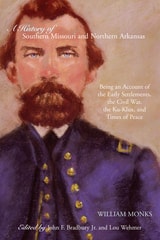
A History of Southern Missouri and Northern Arkansas
Being an Account of the Early Settlements, the Civil War, the Ku-Klux, and Times of PeaceWilliam Monks
University of Arkansas Press, 2006
Originally published in 1907 and now reprinted for the first time, this is the only account published by a Union guerrilla in the border region of the central Ozarks, where political and civil violence lasted from the Civil War well into the 1880s.
There were probably many people who wanted to shoot Billy Monks. He was a Union patriot and skilled guerrilla fighter to some, but others called him a bushwhacker, a murderer, and a thief. His was a very personal combat: he commanded, rallied, arrested, killed, quarreled with, and sued people he knew. His life provides a striking example of the cliché that the war did not end in 1865, but continued fiercely on several fronts for another decade as partisan factions settled old scores and battled for local political control.
This memoir was Monks’s last salvo at his old foes, by turns self-defense and an uncompromising affirmation of the Radical Union cause in the Ozarks. The editors include a new biographical sketch of the author, fill in gaps in his narrative, identify all the people and places to which he refers, and offer a detailed index. Monks himself illustrated the volume with staged photographs of key events re-created by aged comrades who appear to have been just barely able to hoist the muskets they hold as props.

A Life In The Struggle
Ivory Perry and the Culture of OppositionGeorge Lipsitz
Temple University Press, 1995
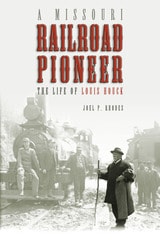
A Missouri Railroad Pioneer
The Life of Louis HouckJoel P. Rhodes
University of Missouri Press, 2013
Lawyer and journalist, entrepreneur and philanthropist, Louis Houck is often called the “Father of Southeast Missouri” because he brought the railroad to the region and opened this backwater area to industrialization and modernization. Although Houck’s name is little known today outside Missouri, Joel Rhodes shows how his story has relevance for both the state and the nation.
Rhodes presents a more complete picture of Houck than has ever been available: reviewing his life from his German immigrant roots, considering his career from both social and political perspectives, and grounding the story in both state and national history. He especially tells how, from 1880 to the 1920s, this self-taught railroader constructed a network of five hundred miles of track through the wilderness of wetlands known as “Swampeast Missouri”—and how these “Houck Roads” provided a boost for population, agriculture, lumbering, and commerce that transformed Cape Girardeau and the surrounding area.
Rhodes discusses how Houck fits into the era of economic individualism—a time when men with little formal training shaped modern industry—and also gives voice to Houck’s critics and shows that he was not always an easy man to work with. In telling the story of his railroading enterprise, Rhodes chronicles Houck’s battle with the Jay Gould railroad empire and offers key insight into the development of America’s railway system, from the cutthroat practices of ruthless entrepreneurs to the often-comic ineptness of start-up rail lines.
More than simply a biography of a business entrepreneur, the book tells how Houck not only developed the region economically but also followed the lead of Andrew Carnegie by making art, culture, and formal education available to all social classes. Houck also served for thirty-six years as president of the Board of Regents of Southeast Missouri State Teacher’s College, and as a self-taught historian he wrote the first comprehensive accounts of Missouri’s territorial period.
A Missouri Railroad Pioneer chronicles a multifaceted career that transformed a region. Solidly researched, this lively narrative also offers an entertaining read for anyone interested in Missouri history.
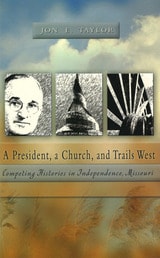
A President, a Church and Trails West
Competing Histories in Independence, MissouriJon E. Taylor
University of Missouri Press, 2008
Over the past century, three nationally significant histories have vied for space and place in Independence, Missouri. Independence was declared Zion by Joseph Smith, served as a gathering and provisioning point for trails west, and was called home by President Harry S. Truman for sixty-four years. Historian Jon E. Taylor has integrated research from newspapers, public documents, oral histories, and private papers to detail how the community has preserved and remembered these various legacies.
Truman’s legacy would appear to have been secured in Independence via three significant designations—his presidential library opened there in 1957, his neighborhood was designated a national historic landmark in 1972, and his home was declared a national historic site in 1982. However, Taylor argues that Truman’s seeming dominance in the community’s memory is in fact endangered by competition from the other aspects of the town’s historical heritage.
Taylor considers the role Mormon history has played in the city's history and chronicles how the Reorganized Church of Jesus Christ of Latter Day Saints returned to Independence to fulfill Joseph Smith's dream of creating Zion in the city, a situation that impacted neighborhoods near the Truman home. Taylor also examines the city's fascination with the Santa Fe, Oregon, and California trails, detailing how that history was lost and remembered and is now immortalized on the Independence square and in the National Frontier Trails Museum.
In the 1980s, the city council reduced the size of the Truman Heritage District, created to maintain Truman’s association with his neighborhood, after church opposition. At the same time, city officials pushed to make Independence a major tourist destination, a move largely dependent upon the city capitalizing on its association with Truman. These inconsistent policies and incongruous goals have led to innumerable changes in the landscape Truman enjoyed during his legendary morning walks.
A President, a Church, and Trails West chronicles one city’s struggle to preserve its history and the built environment. Taylor places the role of preservation in Independence not only within the larger context of preservation in the United States but also within the context of American environmental history. This volume is sure to appeal to anyone interested in public history, historic preservation, history and memory, and local history.
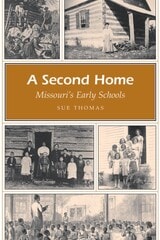
A Second Home
Missouri's Early SchoolsSue Thomas
University of Missouri Press, 2006
The one-room schoolhouse may be a thing of the past, but it is the foundation on which modern education rests. Sue Thomas now traces the progress of early education in Missouri, demonstrating how important early schools were in taming the frontier.
A Second Home offers an in-depth and entertaining look at education in the days when pioneers had to postpone schooling for their children until they could provide shelter for their families and clear their fields for crops, while well-to-do families employed tutors or sent their children back east. Thomas tells of the earliest known English school at the Ramsay settlement near Cape Girardeau, then of the opening of a handful of schools around the time of the Louisiana Purchase—such as Benjamin Johnson’s school on Sandy Creek, Christopher Schewe’s school for boys when St. Louis was still a village, and the Ste. Genevieve Academy, where poor and Indian children were taught free of charge. She describes how, as communities grew, additional private schools opened—including “dame schools,” denominational schools, and subscription schools—until public education came into its own in the 1850s.
Drawing on oral histories collected throughout the state, as well as private diaries and archival research, the book is full of firsthand accounts of what education once was like—including descriptions of the furnishings, teaching methods, and school-day activities in one-room log schools. It also includes the experiences of former slaves and free blacks following the Civil War when they were newly entitled to public education, with discussions of the contributions of John Berry Meachum, James Milton Turner, and other African American leaders.
With its remembrances of simpler times, A Second Home tells of community gatherings in country schools and events such as taffy pulls and spelling bees, and offers tales of stern teachers, student pranks, and schoolyard games. Accompanying illustrations illuminate family and school life in the colonial, territorial, early statehood, and post-Civil War periods. For readers who recall older family members’ accounts or who are simply fascinated by the past, this is a book that will conjure images of a bygone time while opening a new window on Missouri history.
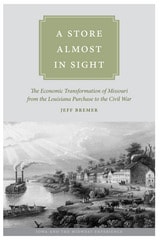
A Store Almost in Sight
The Economic Transformation of Missouri from the Lousiana Purchase to the Civil WarJeff Bremer
University of Iowa Press, 2014
Most Missourians welcomed the opportunity to take part in commercial markets. Farmwomen sold eggs or butter to peddlers and in nearby towns, while men took surplus corn or pork to stores for credit. Immigrants searched for the most fertile land closest to waterways, to ensure they would have large harvests and an easy way to ship them to market. Families floated farm goods downriver until steamboats transformed rural life by drastically reducing the cost of transportation and boosting farm production and consumption. Traders also trekked west across the plains to trade at the inland entrepôt of Santa Fe. The waves of migrants headed for Oregon and California in the 1840s and 1850s further encouraged commercial development. However, most white settlers lacked the necessary financial means to be capitalists in a technical sense, seeking instead a “competency,” or comfortable independence.
This fresh reinterpretation of the American frontier will interest anyone who wants to understand the economic and social significance of westward migration in U.S. history. It gives the reader a gritty, grassroots sense of how ordinary people made their livings and built communities in the lands newly opened to American settlement.
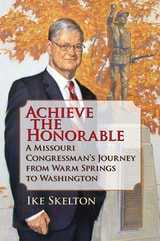
Achieve the Honorable
A Missouri Congressman's Journey from Warm Springs to WashingtonIke Skelton
Southern Illinois University Press, 2013
During his years in the U.S. House of Representatives, Skelton became known as a bipartisan negotiator and a champion of the Armed Services. Throughout the decades, he helped steer the nation through its most dangerous challenges, from Communism to terrorism; took a leading role in the reform of the Department of Defense; dedicated himself to fulfilling the interests of his constituents; and eventually rose to become chair of the House Armed Services Committee during such pivotal events as the wars in Iraq and Afghanistan. In addition to detailing Skelton’s political career and its accompanying challenges and triumphs, Achieve the Honorable provides inside glimpses into the lives of political titans like Harry Truman, Richard Nixon, and Bill Clinton. Along the way, we are treated to Skelton’s engaging humor and shrewd insight into twentieth- and twenty-first-century U.S. politics.
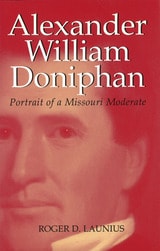
Alexander William Doniphan
Portrait of a Missouri ModerateRoger D. Launius
University of Missouri Press, 1997
Alexander William Doniphan (1808-1887)--Missouri attorney, military figure, politician, and businessman--is one of the most significant figures in antebellum Missouri. From the 1830s to the 1880s, Doniphan was active in a variety of affairs in Missouri and held firm to several underlying principles, including loyalty, hard work, the sanctity of the republic, and commitment to Christian charity. However, the key to Doniphan's importance was his persistent moderation on the critical issues of his day.
Doniphan became a household name when he served as the commanding officer of the famed First Missouri Mounted Volunteers during the Mexican-American War. It was during this time that he won two battles, established an Anglo-American-based democracy in New Mexico, and paved the way for the annexation of the territory that became New Mexico and Arizona. He is also recognized by the Mormons for his assistance to their beleaguered church during Missouri's "Mormon War" and for his refusal to execute Joseph Smith when ordered to do so by his commanding officer.
Although Doniphan was a slaveholding unionist, he sought a middle ground to stave off war in the 1850s and early 1860s and served as a delegate to the Washington Peace Conference in 1861. When conflict escalated along the western border of Missouri in 1862, Doniphan moved to St. Louis, where he worked as a lawyer with the Missouri Claims Commission, seeking pensions for refugees.
Doniphan early adopted the Whig ideal of the "positive liberal state" and sought to use the power of government to remake society into something better. Once he saw the heavy-handed use of state power during Reconstruction, however, Doniphan reversed his views on the role of the government in society. For the rest of his life, he resisted government incursions into the lives of the people and sought to restore a healthy Union.
Alexander William Doniphan will be of interest to academic specialists and general readers alike, especially those interested in Mormon studies, Missouri history, military history, and Western history.
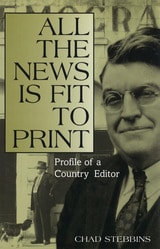
All the News Is Fit to Print
Profile of a Country EditorChad Stebbins
University of Missouri Press, 1998
For nearly half a century, Arthur Aull captivated a rural Missouri town and a national audience with his sensationalistic, all-the- news-is-fit-to-print approach to journalism. As editor and publisher of the Lamar Democrat from 1900 to 1948, he disregarded most of the traditional rules of news coverage. Every scandal and piece of gossip he could turn up helped fill the pages of his newspaper, an afternoon daily in a town of about 2,300. His tales of grisly accidents, murders, rapes, juvenile crime, suicides, and sensational divorces reminded skeptics of the earlier yellow journalism era.
Aull embellished nearly all of his stories with a personal, homespun flavor, and that's what caught the attention of syndicated columnists O. O. McIntyre and Ted Cook in the late 1920s. They started sprinkling their columns with curious items from the Democrat, and soon after unusual stories from the paper began showing up in the New York Times, the New York World-Telegram, the New Yorker, and even the Journal of the American Medical Association. Feature stories about Aull appeared in Publishers' Auxiliary, the Chicago Daily News, Life, Time, Newsweek, American Magazine, and Harper's. Aull became known coast to coast as one of the most colorful figures in country journalism, and the Democrat attracted subscribers in all forty-eight states plus Canada and England. Even President Truman, who was born in Lamar, noted Aull's death on May 7, 1948, declaring that an "able and picturesque figure in American journalism has passed on."
Despite the national acclaim, Aull remained an unpretentious small- town editor. He had his own code of ethics, which he refused to modify to reflect the changing times. He was sued for libel three times, assaulted with a club, threatened with other kinds of bodily harm, and cursed by many. Yet, he persisted in scouring the town of Lamar for any news that would help him sell a few more copies of the Democrat.
Although the influence of country journalism on American society cannot be disputed, relatively little has been written on the vital role country journalists play. All the News Is Fit to Print, which traces Aull's transformation from a struggling schoolteacher to one of the best-known small-town newspapermen in America, will help remedy that oversight. Anyone with an interest in the history of journalism or small-town life will find this work fascinating.

America's Deadliest Twister
The Tri-State Tornado of 1925Geoff Partlow
Southern Illinois University Press, 2014
Winner, ISHS Certificate of Excellence, 2015
Disaster relief as we know it did not exist when the deadliest tornado in U.S. history gouged a path from southeast Missouri through southern Illinois and into southwestern Indiana. The tri-state tornado of 1925 hugged the ground for 219 miles, generated wind speeds in excess of 300 miles per hour, and killed 695 people. Drawing on survivor interviews, public records, and newspaper archives, America’s Deadliest Twister offers a detailed account of the storm, but more important, it describes life in the region at that time as well as the tornado’s lasting cultural impact, especially on southern Illinois.
Author Geoff Partlow follows the storm from town to town, introducing us to the people most affected by the tornado, including the African American population of southern Illinois. Their narratives, along with the stories of the heroes who led recovery efforts in the years following, add a hometown perspective to the account of the storm itself.
In the discussion of the aftermath of the tornado, Partlow examines the lasting social and economic scars in the area, but he also looks at some of the technological firsts associated with this devastating tragedy. Partlow shows how relief efforts in the region began to change the way people throughout the nation thought about disaster relief, which led to the unified responses we are familiar with today.
An Irish-American Odyssey
The Remarkable Rise of the O'Shaughnessy BrothersColum Kenny
University of Missouri Press, 2014

Angel Acronym
A Mystery Introducing Toom TaggartPaul M. Edwards
Signature Books, 2003
Finding the church archivist dead in the temple complex was somewhat awkward for the RLDS church hierarchy. What was the archivist doing in the temple in the middle of the night and what was he doing with President Fred M. Smith’s declaration of supreme directional control?
For the public relations department, this was all a day’s work—something not so very difficult to explain away with a few carefully worded phrases. That would have been that, had the director of church education, erstwhile philosopher Toom Taggart, not smelled something rotten on the second floor.
Alternately suspenseful and humorous, The Angel Acronym romps through the corridors of religious orthodoxy and the pages of history to probe the perplexities of religious truth, public image, and a bureaucratic mindset.

Autobiography of Samuel S. Hildebrand
The Renowned Missouri BushwhackerKirby Ross
University of Arkansas Press, 2016