Results by title
6 books match the query 'Modern Era'
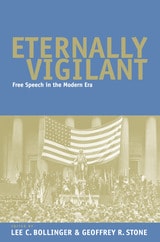
Eternally Vigilant
Free Speech in the Modern EraEdited by Lee C. Bollinger and Geoffrey R. Stone
University of Chicago Press, 2001
"With group efforts, such as this collection of essays, it is almost inevitable that there will be a couple—and often several—duds among the bunch, or at least a dismaying repetition of ideas. Such is not the case here. . . . Whether one agrees with a given author or not (and it is possible to do both with any of the essays), each has something to add. Overall, Eternally Vigilant is a thoughtful and thought-provoking book, consistently intelligent and, at times, brilliant."—Richard J. Mollot, New York Law Journal
Contributors:
Lillian R. BeVier
Vincent Blasi
Lee C. Bollinger
Stanley Fish
Owen M. Fiss
R. Kent Greenawalt
Richard A. Posner
Robert C. Post
Frederick Schauer
Geoffrey R. Stone
David A. Strauss
Cass R. Sunstein
Lethal Injection
Capital Punishment in Texas during the Modern EraBy Jon Sorensen and Rocky LeAnn Pilgrim
University of Texas Press, 2006
Few state issues have attracted as much controversy and national attention as the application of the death penalty in Texas. In the years since the death penalty was reinstated in 1976, Texas has led the nation in passing death sentences and executing prisoners. The vigor with which Texas has implemented capital punishment has, however, raised more than a few questions. Why has Texas been so fervent in pursuing capital punishment? Has an aggressive death penalty produced any benefits? Have dangerous criminals been deterred? Have rights been trampled in the process and, most importantly, have innocents been executed? These important questions form the core of Lethal Injection: Capital Punishment in Texas during the Modern Era.
This book is the first comprehensive empirical study of Texas's system of capital punishment in the modern era. Jon Sorensen and Rocky Pilgrim use a wealth of information gathered from formerly confidential prisoner records and a variety of statistical sources to test and challenge traditional preconceptions concerning racial bias, deterrence, guilt, and the application of capital punishment in this state. The results of their balanced analysis may surprise many who have followed the recent debate on this important issue.
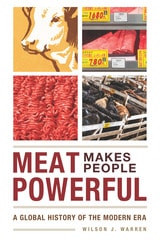
Meat Makes People Powerful
A Global History of the Modern EraWilson J. Warren
University of Iowa Press, 2018
From large-scale cattle farming to water pollution, meat— more than any other food—has had an enormous impact on our environment. Historically, Americans have been among the most avid meat-eaters in the world, but long before that meat was not even considered a key ingredient in most civilizations’ diets. Labor historian Wilson Warren, who has studied the meat industry for more than a decade, provides this global history of meat to help us understand how it entered the daily diet, and at what costs and benefits to society.
Spanning from the nineteenth century to current and future trends, Warren walks us through the economic theory of food, the discovery of protein, the Japanese eugenics debate around meat, and the environmental impact of livestock, among other topics. Through his comprehensive, multifaceted research, he provides readers with the political, economic, social, and cultural factors behind meat consumption over the last two centuries. With a special focus on East Asia, Meat Makes People Powerful reveals how national governments regulated and oversaw meat production, helping transform virtually vegetarian cultures into major meat consumers at record speed.
As more and more Americans pay attention to the sources of the meat they consume, Warren’s compelling study will help them not only better understand the industry, but also make more informed personal choices. Providing an international perspective that will appeal to scholars and nutritionists alike, this timely examination will forever change the way you see the food on your plate.
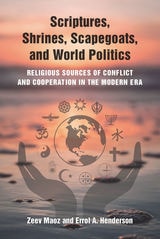
Scriptures, Shrines, Scapegoats, and World Politics
Religious Sources of Conflict and Cooperation in the Modern EraZeev Maoz and Errol A. Henderson
University of Michigan Press, 2021
The effect of religious factors on politics has been a key issue since the end of the Cold War and the subsequent rise of religious terrorism. However, the systematic investigations of these topics have focused primarily on the effects of religion on domestic and international conflict. Scriptures, Shrines, Scapegoats, and World Politics offers a comprehensive evaluation of the role of religion in international relations, broadening the scope of investigation to such topics as the relationship between religion and cooperation, religion and conflict, and the relationship between religion and the quality of life. Religion is often manipulated by political elites to advance their principal goal of political survival. Zeev Maoz and Errol A. Henderson find that no specific religion is either consistently more bellicose or consistently more cooperative than other religions. However, religious similarity between states tends to reduce the propensity of conflict and increase the opportunity for security cooperation. The authors find a significant relationship between secularism and human security.
The Jews of Europe in the Modern Era
A Socio-Historical OutlineVictor Karady
Central European University Press, 2003
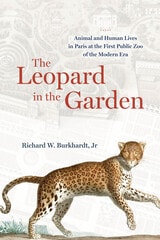
The Leopard in the Garden
Animal and Human Lives in Paris at the First Public Zoo of the Modern EraRichard W. Burkhardt, Jr.
University of Chicago Press, 2026
The Paris menagerie at the Paris Museum of Natural History has a special significance in the history of zoos. Founded in 1793–1794 at the height of the French Revolution, it was the model for the other great zoos of the nineteenth century that followed, beginning with London in 1828, Amsterdam in 1838, and Berlin in 1844.
Richard W. Burkhardt Jr. has written the definitive history of the Paris zoo and its early inhabitants, human and nonhuman. The book features narrative or thematic chapters interwoven with chapters focused on particular animals. Combining current scholarship with fresh discoveries gleaned from his immersion in the Paris Zoo’s extensive archive, Burkhardt shares historical treasures that illuminate not only the workings of the menagerie but also various dimensions of the golden age of French zoology (the years of Jean-Baptiste Lamarck, Geoffroy Saint-Hilaire, and Georges Cuvier). His history reconstructs the diverse sources of specimens, the growth of the collection over time, the efforts to make the menagerie scientifically significant, contemporary attitudes toward animals, and the lives of the animals themselves in colonial and diplomatic contexts.