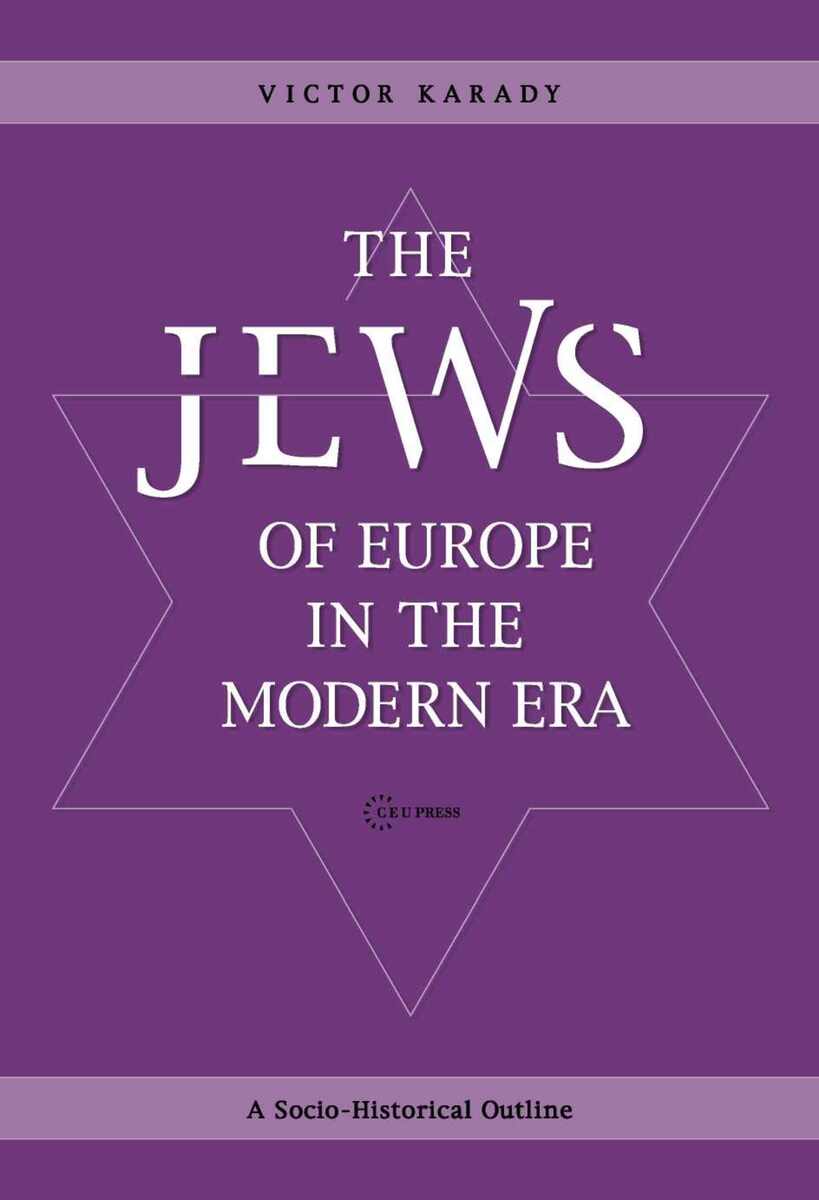
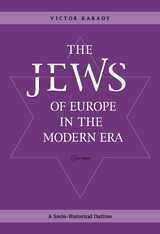
The Jews of Europe in the Modern Era: A Socio-Historical Outline
The Jews of Europe in the Modern Era: A Socio-Historical Outline
by Victor Karady
Central European University Press, 2003 Cloth: 978-963-9241-52-7 | eISBN: 978-963-386-388-6 (PDF) Library of Congress Classification DS135.E83K3713 2004 Dewey Decimal Classification 940.04924
ABOUT THIS BOOK | AUTHOR BIOGRAPHY | REVIEWS | TOC
ABOUT THIS BOOK
Discusses the socio-historical problem areas related to the presence of Jews in major European societies from the 18th century to our days; differently from most other studies, covers the post-Shoah situation also. The approach is multi-disciplinary, mobilizing resources gained from sociology, demography and political science, based on substantial statistical information. Presents and compares the different patterns of Jewish policies of the emerging nation states and established empires. Discusses education and socio-professional stratification of Jews. Deals with the challenges of emancipation and assimilation, the emergence of Jewish nationalism in various forms, Zionism above all, as well as antisemitic ideologies. The book ends with a scrutiny of post-Shoah situation opposing in this regard Western Europe to the Sovietised East, discussing finally strategies of dissimulation or reconstruction of Jewish identity.
AUTHOR BIOGRAPHY
Victor Karady was senior research director with the French CNRS (National Center for Scientific Research) in Paris; recurrent professor at the Central European University in Budapest
REVIEWS
"Karady's book cogently analyzes the structural transformations of European Jewry from the 18th century to the present, with data drawn from cases as disparate as liberal England and Bolshevik Russia. The book's four long chapters examine demography and social stratification, Jewish emancipation, identity strategies after the Haskalah, and antisemitism and the Shoah; a long epilogue ties together these themes for the era after 1945. Lucidly written and well translated, Karady's book offers many important insights into the main historical processes and structures of the modern era."
-- Protestant-Jewish Conundrum
TABLE OF CONTENTS
List of Tables Preface Chapter 1 Demography and Social (Re)Stratification The Diaspora in Europe and the world in numbers Beginnings of ‘strategic’ migrations in the modern era and the immigration into Hungary The logic of the East–West migratory movements ‘Overurbanization’ Residential differentiation, segregation and urbanization ‘Demographic transition’ and modernization Social circumstances of rapid demographic modernization Demographic consequences of renouncing religious affiliation Heterogamy and de-Judaization Dismantling of feudalism as a liberating process Historical antecedents of economic modernization: exclusion and its compensation Religious intellectualism and economic modernization Collective dispositions and group identity as economic capital External socio–historical conditions of restratification General features of economic modernization: self-sufficiency and urban concentration Free-market propensities and entrepreneurial flair Reproduction of intermediary functions in commerce and finance Specialization and capital concentration in commerce and credit Archaism and modernization in industry Traditionalism and restratification in intellectual occupations Cultural capital and the ‘dual structure’ of intellectual markets The cultural industry, assimilation, and intellectual achievements Social circumstances of Jewish ‘overeducation’ ‘Overeducation,’ assimilation and strategies of integration Assimilatory pressure and the influence of cultural heritage on restratification within the intelligentsia Assimilationist compensation and creativity Chapter 2 The Challenge of Emancipation. Jewish Policies of the New Nation-States and Empires (18th–19th centuries) Circumstances of political renewal Modernization programs affecting the Jews Post-feudalistic sources of the ‘Jewish Question’ Social circumstances of (near-) unconditional emancipation and integration in the West Denominational components of integration and emancipation in the West Local approaches to integration in the West ‘Enlightened’ absolutism, or historical antecedents of the modern ‘Jewish policy’ of Central European powers Seeds of absolutist emancipation and Jewry in the Habsburg Empire Aufklärung, Haskalah and ‘conditional emancipation’ in the German world Haskalah and modalities of national assimilation in the Austrian Monarchy Hungary and the Balkans: more or less successful examples of national integration Political sources of the rejection of emancipation in Russia and Romania Integration and exclusion under Russian absolutism Pogrom policy and state anti-Semitism at the end of the tsarist régime Emancipation and forced assimilation after 1917: the ordeals of the Russian Civil War and Bolshevik dictatorship United Romania, or a case study in Judaeophobic nation-building Chapter 3 Identity Constructions and Strategies since the Haskalah. Assimilation, its crises and the Birth of Jewish Nationalisms Inherited group identity and the challenge of assimilation Concomitants of the new identity strategies Assimilation as an impossible undertaking Paradigms of rapprochement: acculturation and ‘adoptive nationalism’ Religious indifferentism and religious reform Factors influencing social integration and ‘counter-assimilation’ Modernization of society at large and chances of assimilation ‘Counter-assimilation’ Self-denial and conversion: a forced path of assimilation Conversion, mixed marriage, ‘nationalization’ of surname Crisis of assimilation as a psychic disturbance and traumatic experience Other pathologies of assimilation: dissimulation, compensation and dissimilation The crisis of assimilation and the nationalist responses Main socio-historical dimensions of Jewish nationalism Intellectual forerunners of Zionism ‘Lovers of Zion,’ or the ‘practical Zionists’ Establishment of political Zionism and its initial dilemmas The ideological complexion of Zionism and the ‘Zionist synthesis’ The organization of Zionism in Europe The anti-Zionist ....