Results by title
6 books match the query 'Modern France'
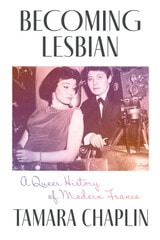
Becoming Lesbian
A Queer History of Modern FranceTamara Chaplin
University of Chicago Press, 2024
In Becoming Lesbian, historian Tamara Chaplin argues that the history of female same-sex intimacy is central to understanding the struggle to control the public sphere. This monumental study draws on undiscovered sources culled from cabaret culture, sexology, police files, radio, TV, photography, the Minitel (an early form of internet), and private letters, as well as over one hundred interviews filmed by the author. Becoming Lesbian demonstrates how women of diverse classes and races came to define themselves as lesbian and used public spaces and public media to exert claims on the world around them in ways that made possible new forms of gendered and sexual citizenship. Chaplin begins in the sapphic cabarets of interwar Paris. These venues, she shows, exploited female same-sex desire for profit while simultaneously launching an incipient queer female counterpublic. Refuting claims that World War II destroyed this female world, Chaplin reveals instead how prewar sapphic subcultures flourished in the postwar period, laying crucial groundwork for the politicization of lesbian identity into the twenty-first century.
Becoming Lesbian is filled with colorful vignettes about female cabaret owners, singers, TV personalities, writers, and activists, all brought to life to make larger points about rights, belonging, and citizenship. As a history of lesbianism, this book represents a major contribution to modern French history, queer studies, and genealogies of the media and its publics.
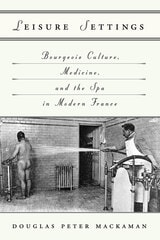
Leisure Settings
Bourgeois Culture, Medicine, and the Spa in Modern FranceDouglas P. Mackaman
University of Chicago Press, 1998
Taking us into the vibrant social world of France's great spas, Mackaman explores the links between class identity and vacationing. Mackaman shows how, after 1800, physicians and entrepreneurs zealously tried to break their milieu's strong association with aristocratic excess and indecency by promoting spas as a rational, ordered equivalent to the busy lives of the bourgeoisie. Rather than seeing leisure time as slothful, Mackaman argues, the bourgeoisie willingly became patients at spas and viewed this therapeutic vacation as a sensible, even productive, way of spending time. Mackaman analyzes this transformation, and ultimately shows how the premier vacation of an era made and was made by the bourgeoisie.
Making Spirit Matter
Neurology, Psychology, and Selfhood in Modern FranceLarry Sommer McGrath
University of Chicago Press, 2020
The connection between mind and brain has been one of the most persistent problems in modern Western thought; even recent advances in neuroscience haven’t been able to explain it satisfactorily. Historian Larry Sommer McGrath’s Making Spirit Matter studies how a particularly productive and influential group of nineteenth- and early twentieth-century French thinkers attempted to solve this puzzle by showing the mutual dependence of spirit and matter. The scientific revolution taking place at this point in history across disciplines, from biology to psychology and neurology, located our mental powers in the brain and offered a radical reformulation of the meaning of society, spirit, and the self. Tracing connections among thinkers such as Henri Bergson, Alfred Fouillée, Jean-Marie Guyau, and others, McGrath plots alternative intellectual movements that revived themes of creativity, time, and experience by applying the very sciences that seemed to undermine metaphysics and religion. Making Spirit Matter lays out the long legacy of this moment in the history of ideas and how it might renew our understanding of the relationship between mind and brain today.
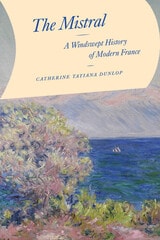
The Mistral
A Windswept History of Modern FranceCatherine Tatiana Dunlop
University of Chicago Press, 2024
Every year, the chilly mistral wind blows through the Rhône valley of southern France, across the Camargue wetlands, and into the Mediterranean Sea. Most forceful when winter turns to spring, the wind knocks over trees, sweeps trains off their tracks, and destroys crops. Yet the mistral turns the sky clear and blue, as it often appears in depictions of Provence. The legendary wind is central to the area’s regional identity and has inspired artists and writers near and far for centuries.
This force of nature is the focus of Catherine Dunlop’s The Mistral, a wonderfully written examination of the power of the mistral wind, and in particular, the ways it challenged central tenets of nineteenth-century European society: order, mastery, and predictability. As Dunlop shows, while the modernizing state sought liberation from environmental realities through scientific advances, land modification, and other technological solutions, the wind blew on, literally crushing attempts at control, and becoming increasingly integral to regional feelings of place and community.
Unruly Spirits
The Science of Psychic Phenomena in Modern FranceM. Brady Brower
University of Illinois Press, 2010
Vital Minimum
Need, Science, and Politics in Modern FranceDana Simmons
University of Chicago Press, 2015
The result was the concept of the "vital minimum"--the living wage, a measure of physical and social needs. In this book, Dana Simmons traces the history of this concept, revealing the intersections between technologies of measurement, such as calorimeters and social surveys, and technologies of wages and welfare, such as minimum wages, poor aid, and welfare programs. In looking at how we define and measure need, Vital Minimum raises profound questions about the authority of nature and the nature of inequality.