Results by title
5 books match the query 'Modern Poetry'
Missing Measures
Modern Poetry and the Revolt Against MeterTimothy Steele
University of Arkansas Press, 1990
By the close of the nineteenth century, many poets had abandoned rhyme and meter in favor of “free verse.” Nearly one hundred years later, a growing number of younger poets are reclaiming traditional conventions of prosody by composing rhymed and measured poetry.
Missing Measures is the first full articulation of the aesthetics of this new movement. Timothy Steele, one of the best of those poets who are sometimes called the “New Formalists,” treats his subject against a backdrop of the long history of ideas about poetry, formulated first by the ancients and re-examined and re-interpreted by subsequent writers.
Steele offers a new perspective on the wholesale departure from tradition proclaimed in modernist critical justifications. A rare marriage of clear writing, careful scholarship, and bold thinking, Missing Measures provides a vital new movement with a critical manifesto.
Singing the Chaos
Madness and Wisdom in Modern PoetryWilliam Pratt
University of Missouri Press, 1996
Singing the Chaos: Madness and Wisdom in Modern Poetry combines both a historical and a critical approach toward the works of major British, American, French, German, and Russian poets. Comprehensive in scope and arranged chronologically to survey a century of high poetic achievement, the study is unified by Pratt's overriding argument that "modern poets have endowed a disintegrating civilization with humane wisdom by 'singing the chaos' that surrounds them, making ours a great age in spite of itself."
In developing this central theme, Pratt brings alive the energy, the freshness, and the originality of technique that made Baudelaire, Pound, Yeats, Rilke, Eliot, and others the initiators of the revolution in poetry. He brings a more complete, clearer perspective to other major themes: modernism as an age of irony; poets as both madmen and geniuses; the modern poet as tragic hero; the dominance of religious or visionary truths over social or political issues; and the combination of radical experiments in poetic form with an apocalyptic view of Western civilization. His detailed treatment of the Fugitive poets and his recognition of their prominent role in twentieth-century literature constitute an important historical revision.
Brilliantly informed, insightful, and, above all, accurately sympathetic to the points of view of the poets Pratt presents, Singing the Chaos is that rare book that belongs on all shelves devoted to modernist poetry.
Skeptical Music
Essays on Modern PoetryDavid Bromwich
University of Chicago Press, 2001
The two general essays that frame Skeptical Music make Bromwich's aesthetic commitments clear. In "An Art without Importance," published here for the first time, Bromwich underscores the trust between author and reader that gives language its subtlety and depth, and makes the written word adequate to the reality that poetry captures. For Bromwich, understanding the work of a poet is like getting to know a person; it is a kind of reading that involves a mutual attraction of temperaments. The controversial final essay, "How Moral Is Taste?," explores the points at which aesthetic and moral considerations uneasily converge. In this timely essay, Bromwich argues that the wish for excitement that poetry draws upon is at once primitive and irreducible.
Skeptical Music most notably offers incomparable readings of individual poets. An essay on the complex relationship between Hart Crane and T. S. Eliot shows how the delicate shifts of tone and shading in their work register both affinity and resistance. A revealing look at W. H. Auden traces the process by which the voice of a generation changed from prophet to domestic ironist. Whether discussing heroism in the poetry of Wallace Stevens, considering self-reflection in the poems of Elizabeth Bishop, or exploring the battle between the self and its images in the work of John Ashbery, Skeptical Music will make readers think again about what poetry is, and even more important, why it still matters.
Sound and Form in Modern Poetry
A Study of Prosody from Thomas Hardy to Robert LowellHarvey Gross
University of Michigan Press, 1964
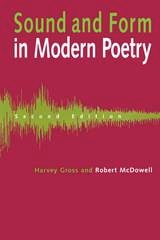
Sound and Form in Modern Poetry
Second EditionHarvey Gross and Robert McDowell
University of Michigan Press, 1996
Poet, critic, and editor Robert McDowell has updated this classic text in the light of the poetic and critical developments of the last three decades. Segments on Dickinson, Robinson, Frost, Jeffers, and Lowell, among other poets, have been greatly expanded, and Ashbery, Creeley, Ginsberg, Hall, Kees, Kumin, Levertov, Levine, O'Hara, Plath, Rich, Simpson, and Wilbur added, among others. The epilogue discusses a new generation of poets whose works will likely be read well into the next century-- among others, Thomas M. Disch, Rita Dove, Dana Gioia, Emily Grosholz, Mark Jarman, Molly Peacock, Gjertrud Schnackenberg, Timothy Steele, Mary Swander, and Marilyn Nelson Waniek.
Over the last ten years, the most inspiring topic of conversation and argument among poets and their readers has been the resurgence of narrative and traditional forms. The new Sound and Form in Modern Poetry is a seminal text in this discussion, examining not only this movement but all of the important developments (Dadaism, Surrealism, Imagism, Language Poetry, and the Confessional School) that have defined our poetry in the twentieth century and have set the stage for poetry's continued life in the twenty-first. The original Sound and Form in Modern Poetry enjoyed extensive classroom use as a text; the revised version promises to be even more accessible, and more essential, for years to come.
The late Harvey Gross was Professor of Comparative Literature, State University of New York at Stony Brook.
Robert McDowell is publisher and editor of Story Line Press, and is also poet, critic, translator, fiction writer, and essayist.