Results by title
3 books match the query 'Modern period, 1750-'
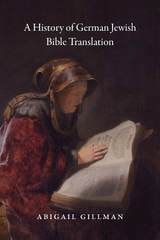
A History of German Jewish Bible Translation
Abigail Gillman
University of Chicago Press, 2018
This book is the first in English to offer a close analysis of German Jewish translations as part of a larger cultural project. Looking at four distinct waves of translations, Abigail Gillman juxtaposes translations within each that sought to achieve similar goals through differing means. As she details the history of successive translations, we gain new insight into the opportunities and problems the Bible posed for different generations and gain a new perspective on modern German Jewish history.
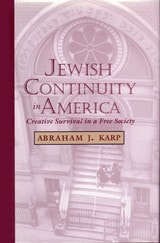
Jewish Continuity in America
Creative Survival in a Free SocietyAbraham J. Karp
University of Alabama Press, 1998
Presents an overview of a life's work by a preeminent scholar and brings new insight to the challenge of American Jewish continuity
Jews have historically lived within a paradox of faith and fear: faith that they are an eternal people and fear that their generation may be the last. In the United States, the Jewish community has faced to a heightened degree the enduring question of identity and assimilation: How does the Jewish community in this free, open, pluralistic society discover or create factors-both ideological and existential-that make group survival beneficial to the larger society and rewarding to the individual Jew?
Abraham J. Karp's Jewish Continuity in America focuses on the three major sources of American Judaism's continuing vitality: the synagogue, the rabbinate, and Jewish religious pluralism. Particularly illuminating is Karp's examination of the coexistence and unity-in-diversity of American religious Jewry's three divisions-Orthodox, Reform, and Conservative-and of how this Jewish religious pluralism fits into the larger picture of American religious pluralism.
Informing the larger enterprise through sharp and full delineation of discrete endeavors, the essays collected in Jewish Continuity in America-some already acknowledged as classics, some appearing here for the first time-describe creative individual and communal responses to the challenge of Jewish survival. As the title suggests, this book argues that continuity in a free and open society demands a high order of creativity, a creativity that, to be viable, must be anchored in institutions wholly pledged to continuity.
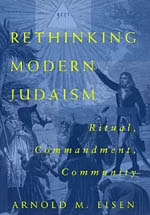
Rethinking Modern Judaism
Ritual, Commandment, CommunityArnold M. Eisen
University of Chicago Press, 1998
"Fascinating . . . an insightful entrance point to understanding the evolution of the theologies of America's largest Jewish denominations."—Tikkun
"I know of no other treatment of these issues that matches Eisen's talents for synthesizing a wide variety of historical, philosophical, and social scientific sources, and bringing them to bear in a balanced and open-minded way on the delicate questions of why modern Jews relate as they do to the practices of Judaism."—Joseph Reimer, Boston Book Review
"At once an incisive survey of modern Jewish thought and an inquiry into how Jews actually live their religious lives, Mr. Eisen's book is an invaluable addition to the study of American Judaism."—Elliott Abrams, Washington Times