Results by title
7 books match the query 'Monastic and religious life'
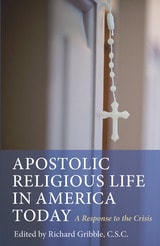
Apostolic Religious Life in America Today
A Response to the CrisisRichard Gribble
Catholic University of America Press, 2011
Divided into two parts, this volume first presents an analysis of the problem and secondly a solution to place apostolic religious life on a positive trajectory in the 21st century.
[more]

Cordially Yours, Brother Cadfael
Edited by Anne K. Kaler
University of Wisconsin Press, 1998
Detective, monk, father, herbalist, Crusader, sailor, Celt, friend—author Ellis Peters bestows all these attributes on her twelfth-century Benedictine monk-detective Brother Cadfael. As a detective, Cadfael uses his analytic mind to solve crimes and administer justice. As a man of God, he also dispenses mercy along with his famous cordials.
Why, essays ask, is a cloistered monk solving murders? How can an author combine a valid detective and an effective healer?
Why, essays ask, is a cloistered monk solving murders? How can an author combine a valid detective and an effective healer?
[more]
Letters, Volume 1
John Barsanuphius and John
Catholic University of America Press, 2006
No description available
[more]
Letters, Volume 2
John Barsanuphius and John
Catholic University of America Press, 2006
No description available
[more]
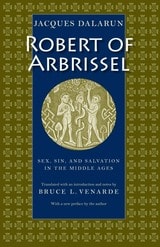
Robert of Arbrissel
Sex, Sin, and Salvation in the Middle AgesJacques Dalarun
Catholic University of America Press, 2006
This book tells the fascinating story of Robert of Arbrissel (ca. 1045-1116). Robert was a parish priest, longtime student, reformer, hermit, wandering preacher, and, most famously, founder of the abbey of Fontevraud
[more]

Sojiji
Discipline, Compassion, and Enlightenment at a Japanese Zen TempleJoshua A. Irizarry
University of Michigan Press, 2022
Sōjiji is one of the two head temples of Sōtō Zen, the largest sect of Japanese Buddhism. The temple is steeped in centuries of culture and tradition, but it is very much rooted in the present and future, performing functions and catering to needs that reflect the changing demographic, social, and religious landscapes of contemporary Japan.
Based on more than fifteen years of fieldwork, interviews, and archival research, Sōjiji: Discipline, Compassion, and Enlightenment at a Japanese Zen Temple immerses the reader in the lives and experiences of the different groups that comprise Sōjiji's contemporary religious community. Through clear and accessible prose, ethnographically-grounded analysis, and emotionally compelling stories, the reader will explore the rich pastiche of daily life and ritual activity at a major Japanese Zen temple in institutional, historical, and social context through the lived practices of its community of clergy, practitioners, parishioners, and visitors.
Based on more than fifteen years of fieldwork, interviews, and archival research, Sōjiji: Discipline, Compassion, and Enlightenment at a Japanese Zen Temple immerses the reader in the lives and experiences of the different groups that comprise Sōjiji's contemporary religious community. Through clear and accessible prose, ethnographically-grounded analysis, and emotionally compelling stories, the reader will explore the rich pastiche of daily life and ritual activity at a major Japanese Zen temple in institutional, historical, and social context through the lived practices of its community of clergy, practitioners, parishioners, and visitors.
[more]

The Chronicle of Andres
Leah Abbot William of Andres
Catholic University of America Press, 2017
Translated with Notes and Commentary by Leah Shopkow
In 1220 Abbot William of Andres, a monastery halfway between Calais and Saint-Omer on the busy road from London to Paris, sat down to write an ambitious cartulary-chronicle for his monastery. Although his work was unfinished at his death, William’s account is an unpolished gem of medieval historical writing. The Chronicle of Andres details the history of his monastery from its foundation in the late eleventh century through the early part of 1234. Early in the thirteenth century, the monks decided to sue for their freedom and appointed William as their protector. His travels took him on a 4000 km, four-year journey, during which he was befriended by Innocent III, among others, and where he learned to negotiate the labyrinthine system of the ecclesiastical courts. Upon winning his case, he was elected abbot on his return to Andres and enjoyed a flourishing career thereafter. A decade after his victory, William decided to put the history of the monastery on a firm footing.
This text not only offers insight into the practice of medieval canon law (from the perspective of a well-informed man with legal training), but also ecclesiastical policies, the dynamics of life within a monastery, ethnicity and linguistic diversity, and rural life. It is comparable in its frankness to Jocelin of Brakelord’s Chronicle of Bury. Because William drew on the historiographic tradition of the Southern Low Countries, his text also offers some insights into this subject, thus composing a broad picture of the medieval European monastic world.
[more]