Results by title

8 books match the query 'Mongolia'
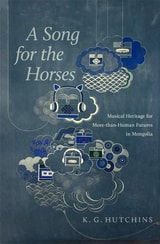
cover of A Song for the Horses: Musical Heritage for More-than-Human Futures in Mongolia

A Song for the Horses

Musical Heritage for More-than-Human Futures in Mongolia

K. G. Hutchins

University of Arizona Press, 2025

As permafrost in Siberia continues to melt and the steppe in the Gobi turns to desert, people in Mongolia are faced with overlapping climate crises. Some nomadic herders describe climate change as the end of a world. They are quick to add that the world has ended before for Indigenous people in North Asia, as waves of colonialism have left the steppe with a complicated web of apocalypses. A Song for the Horses by K. G. Hutchins examines cases in which people respond to the pressures of climate change by drawing on cultural heritage to foster social resiliency. 

Hutchins’s ethnographic research, spanning more than a decade, provides a vivid and intimate portrayal of Mongolian life. Musicians use the morin khuur, or ‘horse fiddle,’ to engage with the subjectivities and agencies of nonhuman animals and other beings. This work is a significant contribution to the posthuman turn in social sciences, engaging with theories from prominent scholars such as Donna Haraway and Anna Tsing  . 

As climate change continues to impact communities worldwide, this book offers a unique perspective on how cultural heritage can be mobilized to address environmental challenges, providing valuable lessons for global efforts to build sustainable and resilient futures. At the intersection of music, environment, and posthumanism, A Song for the Horses shows how Mongolian musicians use cultural traditions to imagine and build toward alternative futures beyond climate change and neoliberalism.
[more]
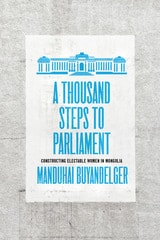
cover of A Thousand Steps to Parliament: Constructing Electable Women in Mongolia

A Thousand Steps to Parliament

Constructing Electable Women in Mongolia

Manduhai Buyandelger

University of Chicago Press, 2022

A Thousand Steps to Parliament traces how the complicated, contradictory paths to political representation that women in Mongolia must walk mirror those the world over.

Mongolia has often been deemed an “island of democracy,” commended for its rapid adoption of free democratic elections in the wake of totalitarian socialism. The democratizing era, however, brought alongside it a phenomenon that Manduhai Buyandelger terms “electionization”—a restructuring of elections from time-grounded events into a continuous neoliberal force that governs everyday life beyond the electoral period. In this way, electoral campaigns have come to substitute for the functions of governing, from social welfare to the private sector, requiring an accumulation of wealth and power beyond the reach of most women candidates. In A Thousand Steps to Parliament, Buyandelger shows how successful women candidates instead use strategies of self-polishing to cultivate charisma and a reputation for being oyunlag, or intellectful. This carefully crafted identity can be called the “electable self”: treating their bodies and minds as pliable and renewable, women candidates draw from the same practices of neoliberalism that have unsustainably commercialized elections. By tracing the complicated, contradictory paths to representation that women in Mongolia must walk, A Thousand Steps to Parliament holds a mirror up to democracies the world over, revealing an urgent need to grapple with the encroaching effects of neoliberalism in our global political systems.

[more]
cover of All This Belongs to Me: A Novel

All This Belongs to Me

A Novel

Petra Hulova

Northwestern University Press, 2009

Winner of the American Literary Translators Association 2010 National Translation Award 

Petra Hůlová became an overnight sensation when All This Belongs to Me was originally published in Czech in 2002, when the author was just twenty-three years old. She has since established herself as one of the most exciting young novelists in Europe today. Writings from an Unbound Europe is proud to publish the first translation of her work in English.

All This Belongs to Me chronicles the lives of three generations of women in a Mongolian family. Told from the point of view of a mother, three sisters, and the daughter of one of the sisters, this story of secrets and betrayals takes us from the daily rhythms of nomadic life on the steppe to the harsh realities of urban alcoholism and prostitution in the capital, Ulaanbaatar. All This Belongs to Me is a sweeping family saga that showcases Hůlová's genius.
[more]
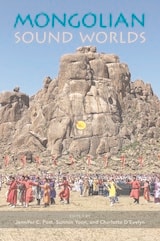
cover of Mongolian Sound Worlds

Mongolian Sound Worlds

Edited by Jennifer C. Post, Sunmin Yoon, and Charlotte D'Evelyn

University of Illinois Press, 2022

Music cultures today in rural and urban Mongolia and Inner Mongolia emerge from centuries-old pastoralist practices that were reshaped by political movements in the twentieth century. Mongolian Sound Worlds investigates the unique sonic elements, fluid genres, social and spatial performativity, and sounding objects behind new forms of Mongolian music--forms that reflect the nation’s past while looking towards its globalized future. Drawing on fieldwork in locations across the Inner Asian region, the contributors report on Mongolia’s genres and musical landscapes; instruments like the morin khuur, tovshuur, and Kazakh dombyra; combined fusion band culture; and urban popular music. Their broad range of concerns include nomadic herders’ music and instrument building, ethnic boundaries, heritage-making, ideological influences, nationalism, and global circulation.

A merger of expert scholarship and eyewitness experience, Mongolian Sound Worlds illuminates a diverse and ever-changing musical culture.

Contributors: Bayarsaikhan Badamsuren, Otgonbaayar Chuulunbaatar, Andrew Colwell, Johanni Curtet, Charlotte D’Evelyn, Tamir Hargana, Peter K. Marsh, K. Oktyabr, Rebekah Plueckhahn, Jennifer C. Post, D. Tserendavaa, and Sunmin Yoon
[more]
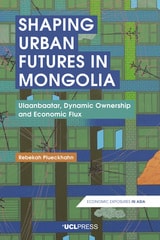
cover of Shaping Urban Futures in Mongolia: Ulaanbaatar, Dynamic Ownership and Economic Flux

Shaping Urban Futures in Mongolia

Ulaanbaatar, Dynamic Ownership and Economic Flux

Rebekah Plueckhahn

University College London, 2019

Shaping Urban Futures in Mongolia discusses the lived experience of urban development, redevelopment, and change in Ulaanbaatar. The fast rates of urbanization occurring in many parts of the world are often buoyed by increased investment of capital and ensuing construction, giving rise to other less visible effects among those living in cities—including diverse economic practices, politics, and ethics. Construction becomes a solution to the provision of housing but also simultaneously becomes a problem when economic processes fail to work as they should, or people are dispossessed of land to make way for further urban change.   
Rebekah Plueckhahn explores the inherent contradiction between solution and problem-making as experienced by residents of Ulaanbaatar during a tumultuous period in Mongolia’s economic history. She examines the ways residents attempt to own forms of real estate and, in turn, physically shape the city and its politics and urban economic forms from within. This book interlinks the intimate space of the home with ideologies of the national economy, urban development and disrepair and the types of politics and ethics that arise as a result.
 
[more]
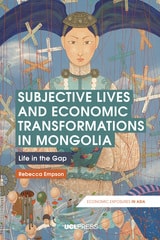
cover of Subjective Lives and Economic Transformations in Mongolia: Life in the Gap

Subjective Lives and Economic Transformations in Mongolia

Life in the Gap

Rebecca M. Empson

University College London, 2020
Almost 10 years ago the mineral-rich country of Mongolia experienced rapid economic growth, fueled by China’s need for coal and copper. Hopes were raised that the economy would avoid ‘over-heating’ and Mongolia could emerge independently wealthy and powerful. This period of growth is now over. The country is facing increasing public and private debt, conflicts around sovereignty and land, multiple forms of political protest that seem to go unnoticed, and a turn toward a more conservative politics that critiques ideas about democracy and protects its own but ignores the masses. This book details this story through the intimate lives of five women. It explores how they carve out a life for themselves in a landscape that is constantly shifting, while reflecting on past hopes and aspirations. Building on long-term friendships and familiarity with the region, Rebecca attends to the ways these women have come to theorize their experiences of living a ‘life in the gap’, between desired outcomes and actual materializations. In doing so, and through attention to their different strategies, she offers a re-viewing and re-configuring – to build on the analytical vocabulary developed in the book – of official accounts to describe what is going on in this extractivist-based economy.
 
[more]
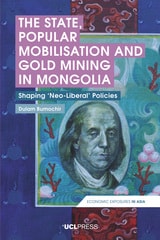
cover of The State, Popular Mobilisation and Gold Mining in Mongolia: Shaping ‘Neo-Liberal’ Policies

The State, Popular Mobilisation and Gold Mining in Mongolia

Shaping ‘Neo-Liberal’ Policies

Dulam Bumochir

University College London, 2020
Mongolia’s mining sector, along with its environmental and social costs, have been the subject of prolonged and heated debate. This debate has often cast the country as either a victim of the ‘resource curse’ or guilty of ‘resource nationalism’. In The State, Popular Mobilisation and Gold Mining in Mongolia, Dulam Bumochir aims to avoid the pitfalls of this debate by adopting an alternative theoretical approach. He focuses on the indigenous representations of nature, environment, economy, state, and sovereignty that have triggered nationalist and statist responses to the mining boom. In doing so, he explores the ways in which these responses have shaped the apparently ‘neo-liberal’ policies of twenty-first-century Mongolia, and the economy that has emerged from them, in the face of competing mining companies, protest movements, international donor organizations, economic downturn, and local and central government policies. Applying rich ethnography to a nuanced and complex picture, Bumochir’s analysis is essential reading for students and researchers studying the environment and mining, especially in Central and North-East Asia and post-Soviet regions, and also for readers interested in the relationship between neoliberalism, nationalism, environmentalism and state.
 
[more]
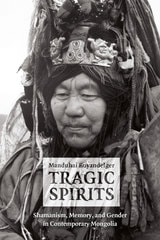
cover of Tragic Spirits: Shamanism, Memory, and Gender in Contemporary Mongolia

Tragic Spirits

Shamanism, Memory, and Gender in Contemporary Mongolia

Manduhai Buyandelger

University of Chicago Press, 2013

The collapse of socialism at the end of the twentieth century brought devastating changes to Mongolia. Economic shock therapy—an immediate liberalization of trade and privatization of publicly owned assets—quickly led to impoverishment, especially in rural parts of the country, where Tragic Spirits takes place. Following the travels of the nomadic Buryats, Manduhai Buyandelger tells a story not only of economic devastation but also a remarkable Buryat response to it—the revival of shamanic practices after decades of socialist suppression.
 
Attributing their current misfortunes to returning ancestral spirits who are vengeful over being abandoned under socialism, the Buryats are now at once trying to appease their ancestors and recover the history of their people through shamanic practice. Thoroughly documenting this process, Buyandelger situates it as part of a global phenomenon, comparing the rise of shamanism in liberalized Mongolia to its similar rise in Africa and Indonesia. In doing so, she offers a sophisticated analysis of the way economics, politics, gender, and other factors influence the spirit world and the crucial workings of cultural memory.
[more]