Results by title
3 books match the query 'Moral Responsibility'
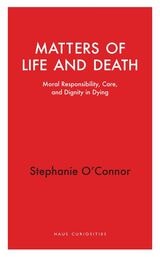
Matters of Life and Death
Moral Responsibility, Care, and Dignity in DyingStephanie O'Connor
Haus Publishing, 2026
A thoughtful examination of dignity at the end of life and the ethical limits of choice in modern medicine.
For most of human history, death was shaped by circumstance, custom, and human presence. Today, it is increasingly mediated by medicine, law, and the language of choice. Our expanding capacity to prolong life and manage dying has outstripped the moral habits that once helped us make sense of such moments. What confronts us now is not only the question of what may be done, or what is permitted, but also how moral responsibility is borne when knowledge is partial and responsibility is dispersed.
Resisting moral certainty and procedural comfort, Stephanie O’Connor considers what is revealed and obscured when complex situations are reduced to questions of choice or rights alone. Considering dignity as a guiding moral concern at the limits of life, and drawing on healthcare ethics, case law, and contemporary debates—including those surrounding assisted dying and artificial intelligence—this book examines how decisions made under conditions of vulnerability are shaped not only by autonomy and consent, but also by dependence, unequal power, and institutional practice. Acutely attentive to the tensions that exist between compassion and restraint, as well as personal agency and shared responsibility, O’Connor does not propose solutions or offer moral closure. Instead, she asks what is owed: to those whose lives are ending, to those who care for them, and to the fragile shared moral life that binds personal decisions to their public consequences.
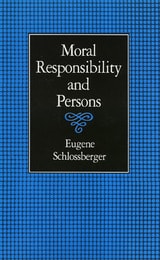
Moral Responsibility and Persons
Eugene Schlossberger
Temple University Press, 1992
Challenging traditional philosophical views of moral responsibility, Eugene Schlossberger argues that we are responsible not so much for what we do as for who we are. He explores what it means to be a person, concluding that personhood is the sum of beliefs and values—which are by no means entirely within our control. Consequently, the voluntariness of our acts—or even whether we act at all—is irrelevant to the moral evaluation of us as persons. Schlossberger contends that we are to be judged morally on the basis of what we are, our "world-view," rather than what we do.
In Moral Responsibility and Persons Schlossberger disputes various received philosophical positions. His challenging and entertaining account also examines psychology and its view of the nature of personhood, as well as insanity and the "personality" of animals, children, and computers. He explores the validity of emotions we may feel in response to others—especially gratitude and resentment. And finally, Schlossberger tackles the inevitable implications of his position in the area of crime and punishment.
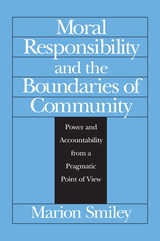
Moral Responsibility and the Boundaries of Community
Power and Accountability from a Pragmatic Point of ViewMarion Smiley
University of Chicago Press, 1992
In an argument both compelling and provocative, Marion Smiley demonstrates how attributions of blame—far from being based on an objective process of factual discovery—are instead judgments that we ourselves make on the basis of our own political and social points of view. She argues that our conception of responsibility is a singularly modern one that locates the source of blameworthiness in an individual's free will. After exploring the flaws inherent in this conception, she shows how our judgments of blame evolve out of our configuration of social roles, our conception of communal boundaries, and the distribution of power upon which both are based.
The great strength of Smiley's study lies in the way in which it brings together both rigorous philosophical analysis and an appreciation of the dynamics of social and political practice. By developing a pragmatic conception of moral responsibility, this work illustrates both how moral philosophy can enhance our understanding of social and political practices and why reflection on these practices is necessary to the reconstruction of our moral concepts.