Results by title
20 books match the query 'Mormon pioneers'
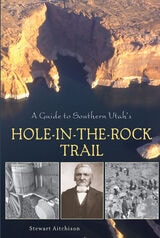
A Guide to Southern Utah's Hole-in-the-Rock Trail
Stewart Aitchison
University of Utah Press, 2005
Though the trail that these devoted pioneers broke across raw frontier was used for several years afterward, no highway was built over most of the route because it was deemed too rugged for modern vehicles. In addition to the historical value of the story of these pioneers, this guide includes road logs, maps, and hiking trails along the historic trail. It also points out fascinating natural history along the way, making A Guide to Southern Utah’s Hole-in-the-Rock Trail a significant reference for a variety of readers.

Emma Lee
Juanita Brooks
Utah State University Press, 1975
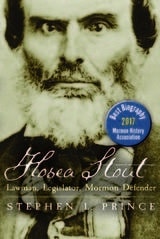
Hosea Stout
Lawman, Legislator, Mormon DefenderStephen L. Prince
Utah State University Press, 2016
Stout joined the Mormons in Missouri in 1838 and followed them to Nauvoo, where he rose quickly to become a top leader in the Nauvoo Legion and chief of police, a position he also held at Winter Quarters. He became the first attorney general for the Territory of Utah, was elected to the Utah Territorial Legislature, and served as regent for the University of Deseret (which later became the University of Utah) and as judge advocate of the Nauvoo Legion in Utah. In 1862, Stout was appointed US attorney for the Territory of Utah by President Abraham Lincoln. In 1867, he became city attorney of Salt Lake City and he was elected to the Utah House of Representatives in 1881.
But Stout’s history also had its troubled moments. Known as a violent man and aggressive enforcer, he was often at the center of controversy during his days on the police force and was accused of having a connection with deaths in Nauvoo and Utah. Ultimately, however, none of these allegations ever found traction, and the leaders of the LDS community, especially Brigham Young, saw to it that Stout was promoted to roles of increasing responsibility throughout his life. When he died in 1889, Hosea Stout left a complicated legacy of service to his state, his church, and the members of his faith community.
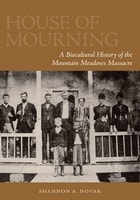
House of Mourning
A Biocultural History of the Mountain Meadows MassacreShannon A Novak
University of Utah Press, 2008
On September 11, 1857, some 120 men, women, and children from the Arkansas hills were murdered in the remote desert valley of Mountain Meadows, Utah. This notorious massacre was, in fact, a mass execution: having surrendered their weapons, the victims were bludgeoned to death or shot at point-blank range. The perpetrators were local Mormon militiamen whose motives have been fiercely debated for 150 years.
In House of Mourning, Shannon A. Novak goes beyond the question of motive to the question of loss. Who were the victims at Mountain Meadows? How had they settled and raised their families in the American South, and why were they moving west once again? What were they hoping to find or make for themselves at the end of the trail? By integrating archival records and oral histories with the first analysis of skeletal remains from the massacre site, Novak offers a detailed and sensitive portrait of the victims as individuals, family members, cultural beings, and living bodies.
The history of the massacre has often been treated as a morality tale whose chief purpose was to vilify (or to glorify) some collective body. Resisting this tendency to oversimplify the past, Novak explores Mountain Meadows as a busy and dangerous intersection of cultural and material forces in antebellum America. House of Mourning is a bold experiment in a new kind of history, the biocultural analysis of complex events.
Winner of the Society for Historical Archaeology James Deetz Book Award.
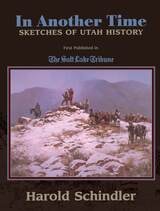
In Another Time
Harold Schindler
Utah State University Press, 1998
An illustrated collection of historical articles originally published in the Salt Lake Tribune from 1993 to 1996, In
Another Time provides both an entertaining introduction to Utah and a distinguished and popular historian's summary views of the state's peculiar history.
Another Time will entertain and inform newcomers seeking an introductory understanding of what has made Utah different, old hands wanting to know more about the rich complexity of the state's past, and anyone who enjoys well-told historical tales.
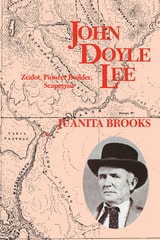
John Doyle Lee
Juanita Brooks
Utah State University Press, 1992
John D. Lee is most often remembered as the only man executed for his role in the infamous 1857 massacre by Mormons of a California-bound emigrant train at Mountain Meadows in southern Utah. This classic biography examines the circumstances and events which brought Lee to that end. It also, however, looks at the other dimensions of his active life, showing that he was a far more important and complex man than subsequent generations, eager for a dark symbol, have acknowledged. He was a leader in the Mormon colonization of southern Utah and northern Arizona. With the title Indian Farmer, he became his church's emissary to Indians in the area. During and prior to the Mormon migration west, he participated in and kept detailed accounts of the conflicts and other events in Missouri, Illinois, and along the trail. An early practitioner, and recorder, of the custom of plural marriage, he was the adopted son of Brigham Young and a close associate of other Mormon leaders. His occupations included builder, farmer, missionary, ferry operator, town founder, and faith leader.
Using Lee's extensive diaries, bolstered by numerous supporting accounts, Juanita Brooks has not only written a thorough and objective portrait of one man's life, a life which would be worthy of study even if it were not controversial, she also has provided numerous insights into early Mormon society and culture. Anyone interested in Mormon polygamy, family life, leadership, relations with Indians, or other aspects of their frontier existence will find this a storehouse of information.
This classic biography is now in its fourth Utah State University Press printing. It is unparalleled in providing a thorough and accurate account of John D. Lee's involvement in the tragic 1857 Mountain Meadows Massacre.
Making Space on the Western Frontier
Mormons, Miners, and Southern PaiutesW. Paul Reeve
University of Illinois Press, 2006
Mormon Trail
Yesterday and TodayWilliam E. Hill
Utah State University Press, 1996
Back in print, this essential reference for readers interested in the Mormon Trail is part history, part resource book, part guide and photographic essay. Driven from their home in Nauvoo, Illinois, Mormons led by Brigham Young began in 1846 to journey west to an expected haven in the Great Salt Lake Valley. The first party arrived there in July 1847. Thousands of members and converts later followed the Mormon Trail, which for much of its way traced the route of the Oregon Trail, although it generally stayed across the Platte River from the more-traveled way. It was thus, until the railroad's arrival in 1869, one of the West's most important and heavily used roads.
Although the Mormons' experience was in most ways similar to that of other emigrants, the religious motivations, tight organization, and family groups of the Mormons gave their migration a distinct character. William E. Hill introduces the Mormons, their eventful early history, and the characteristics of the migration west. His book also includes a chronology of trail-related events, excerpts from diaries and guidebooks, songs, historical maps, over 200 then-and-now illustrations, descriptions of major museums and displays on the trail, and recommendations for further reading.
Mormon Vanguard Brigade Of 1847
Norton Jacob's Recordedited by Ronald O. Barney
Utah State University Press, 2005
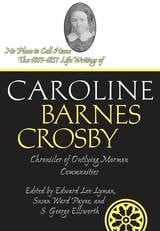
No Place To Call Home
The 1807-1857 Life Writings of Caroline Barnes Crosby, Chronicler of Outlying Mormon CommunitiesEdward Leo Lyman, Susan Ward Payne, and S. George Ellsworth
Utah State University Press, 2020
Caroline Crosby's life took a wandering course between her 1834 marriage to Jonathan Crosby and conversion to the infant Mormon Church and her departure for her final home, Utah, on New Year's Day, 1858. In the intervening years, she lived in many places but never long enough to set firm roots. Her adherence to a frontier religion on the move kept her moving, even after the church began to settle down in Utah. Despite the impermanence of her situation—perhaps even because of it—Caroline Crosby left a remarkably rich record of her life and travels, thereby telling us not only much about herself and her family but also about times and places of which her documentary record provides a virtually unparalleled view. A notable aspect of her memoirs and journals is what they convey of the character of their author, who, despite the many challenges of transience and poverty she faced, appears to have remained curious, dedicated, observant, and optimistic.
From Caroline's home in Canada, she and Jonathan Crosby first went to the headquarters of Joseph Smith's new church in Kirtland, Ohio. She recounts, in a memoir, the early struggles of his followers there. As the church moved west, the Crosbys did as well, but, as became characteristic, they did not move immediately with the main body to the center of the religion. For a while they settled in Indiana, finally reaching the new Mormon center of Nauvoo in 1842. Fleeing Nauvoo with the last of the Mormons in 1846, they spent two years in Iowa and set out for Utah in 1848, the account of which is the first of Caroline Crosby's vivid trail journals. The Crosbys were able to rest in Salt Lake City for less than two years before Brigham Young sent them on a church mission to the Society and Austral Islands in the South Pacific. She recorded, in detail, their overland travel to San Francisco and then by sea to French Polynesia and their service on the islands. In late 1852 the Crosbys returned to California, beginning what is probably the most historically significant time recorded in her writings, her diaries of life. First, in immediately post-Gold-Rush San Francisco and, second, in the new Mormon village of San Bernardino in southern California. There is no comparable record by a woman of 1850s life in these growing communities. The Crosbys responded in 1857 to Brigham Young's call for church members to gather in Utah and again abandoned a new home—the nicest one they had built and one of the finest houses in San Bernardino—again displaying their unquestioning loyalty to the Mormon church.
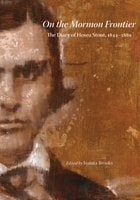
On the Mormon Frontier
The Diary of Hosea Stout, 1844-1889Juanita Brooks
University of Utah Press, 2009
This edition of On the Mormon Frontier presents Stout’s diary in a single volume, proving that it continues to be an essential work in the study of Mormon and American history.
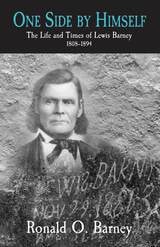
One Side By Himself
Ronald Barney
Utah State University Press, 2002

Plain but Wholesome
Foodways of the Mormon PioneersBrock Cheney
University of Utah Press, 2012
Plain But Wholesome presents a groundbreaking foray into Mormon history. Brock Cheney explores the foodways of Mormon pioneers from their trek west through the arrival of the railroad and reveals new perspectives on the fasci-nating Mormon settlement era. Relying on original diaries, newspaper accounts, and recipe books from the 1850s, Cheney draws a vivid portrait of what Mormon pioneers ate and drank. Although other authors have sketched the subject before, this portrait is the first effort that might be described as scholarly, though the lively prose will interest a broad general audience.
Presented here are the first explicit descriptions of the menus, food processes, and recipes of the Mormon pioneers. While many have supposed that earlier pioneer foodways continued to be handed down through Mormon families, Cheney has confirmed traditions going back generations and covering more than a century. The book also exposes myths and clichés about pioneer piety and hardships, as Cheney examines such pioneer extravagances as fresh “oysters on the half shell” and pioneer trends of alcohol consumption.
A perfect gift for the history buff or Dutch oven chef, Plain But Wholesome will also prove its place among scholars and historians. With its rollicking blend of historical source material and modern interpretation, this book will entertain and educate novice and expert alike.
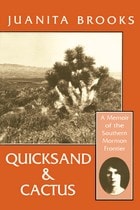
Quicksand and Cactus
Juanita Brooks
Utah State University Press, 1992
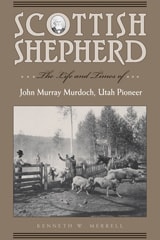
Scottish Shepherd
The Life and Times of John Murray Murdoch, Utah PioneerMerrell, Kenneth W
University of Utah Press, 2007
Murdoch embraced Mormonism and set out for the Utah Territory in 1852 with his wife, Ann, and their family. En route they suffered the deaths of their two young children. Two years later, John’s mother, Wee Granny, and Ann’s brother, James Steele, both perished, along with many others of the ill-fated Martin handcart company, as they attempted to immigrate to Salt Lake City.
Murdoch was a respected member of the community and participated in the military preparations and maneuvers against the U.S. Army in the 1857 Utah War. Eventually the family moved to the Heber valley as early settlers there. Murdoch later became one of Wasatch county’s first elected officials and helped establish the sheep-ranching industry in Utah. The 'everyman' aspect of John Murdoch’s life makes his a compelling story. It will fascinate anyone interested in the individuals who helped create Utah's history.
Winner of the Evans Handcart Award.
Sex and Death on the Western Emigrant Trail
The Biology of Three American TragediesDonald K. Grayson
University of Utah Press, 2018
The plights of these emigrant groups have been addressed by different historians in different ways; this book is the first to examine the tragedies in terms of biology. Grayson shows that who lived or died can largely be explained by age, sex, and family ties. His investigation reveals what happens when our cultural mechanisms for dealing with famine and extreme cold are reduced to only what our bodies can provide within structured social contexts. His results are surprising and not always intuitive as he investigates who survived in these life threatening situations.
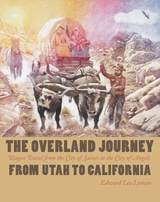
The Overland Journey From Utah To California
Wagon Travel From The City Of Saints To The City Of AngelsEdward Leo Lyman
University of Nevada Press, 2008
The wagon trail between Salt Lake City and Los Angeles is one of the most important and least-known elements of nineteenth-century Western migration. Known as the Southern Route, it included the western half of the Old Spanish Trail and was favored because it could be used for travel and freighting year-round. It was, however, likely the most difficult route that pioneers traveled with any consistency, following not rivers but leading from one--sometimes dubious--desert watering place to the next and offering few havens for the sick, weary, or unfortunate. Historian Edward Leo Lyman has provided the first history of the complete Southern Route and of the people who developed and used it. Based on extensive research in primary sources--including many early travelers’ accounts--and on Lyman’s own investigation of the route and its branches, the book discusses the exploration and development of the Old Spanish Trail, its horse thieves and traders, including Jed Smith and Kit Carson, along with government explorere John C. Frémont. Developing the old pack mule trail as a wagon road between Salt Lake City and Los Angeles, miners heading for the California gold fields first used the route extensively. Mormon missionaries and the colonizers of San Bernardino and other communities also traveled that way, as did a wide array of mail carriers, soldiers and world travelers. Later, a steady stream of Anglo-American emigrants seeking new homes or fortunes in California shared the road with a surprising number of freight wagon operators. The trail passed through the territories of numerous Native American peoples, and contacts with them--both friendly and hostile--played a significant role in the experiences of travelers and in the fates of Native American cultures in this region. Lyman’s discussions of Mormon-Indian relations and of the infamous Mountain Meadows Massacre offer fresh and important analyses of these vital aspects of the westward movement.
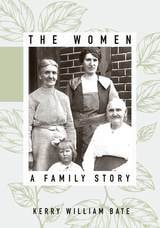
The Women
A Family StoryKerry William Bate
University of Utah Press, 2016
Kerry Bate proceeds on the premise that a story centering on the women of the clan could provide fresh perspective and insight. He portrays real people with well-rounded, flawed characters; builds from deep research; writes with a bit of style; and includes the rich context and detail of these lives. His main subjects are four generations of impressive women: the pioneer Catherine Campbell Steele; her daughter Young Elizabeth, the first Mormon child born in Utah; Kate, an accomplished community leader; and Sarah, a gifted seamstress trapped in an unhappy marriage. To enter their hardscrabble lives in small southern Utah communities is to meet women who pioneered in their own modest but determined ways.
Winner of the Mormon History Association's Best Personal History/Memoir Award.
Interview with Tom Williams on Access Utah
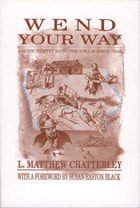
Wend Your Way
A Guide To Sites Along The Iowa Mormon TrailL. Matthew Chatterley
University of Iowa Press, 2007
Wend Your Way: A Guide to Sites Along the Mormon Trail tells the story of this great movement through Iowa. Tracing the trail from east to west through 12 counties the guide includes:
• Mormon Trail history for each county•Directs visitors to the 27 interpretive roadside panels that were constructed on the trail by U.S. National Park Service and Iowa Mormon Trails Association
•Reproduces the poignant illustrations that author L. Matthew Chatterley drew for these wayside exhibits
•Provides a map and directions by county to guide travelers to the route of the Mormon Trail, sites of Mormon camps and settlements and the interpretive roadside panels
•Lists other locations in southern Iowa that visitors will want to explore
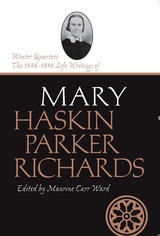
Winter Quarters
Maurine Ward
Utah State University Press, 2002
Volume 1, Life Writings of Frontier Women series, edited by Maureen Ursenbach Beecher
Mary Richard's journals and letters record a young woman's rare, but richly detailed view of life in the temporary Mormon pioneer communities in Iowa.