Results by title
3 books match the query 'Morphology (Animals)'
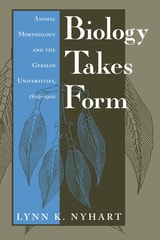
Biology Takes Form
Animal Morphology and the German Universities, 1800-1900Lynn K. Nyhart
University of Chicago Press, 1995
Morphology—the study of form—is often regarded as a failed science that made only limited contributions to our understanding of the living world. Challenging this view, Lynn Nyhart argues that morphology was integral to the life sciences of the nineteenth century. Biology Takes Form traces the development of morphological research in German universities and illuminates significant institutional and intellectual changes in nineteenth-century German biology.
Although there were neither professors of morphology nor a morphologists' society, morphologists achieved influence by "colonizing" niches in a variety of disciplines. Scientists in anatomy, zoology, natural history, and physiology considered their work morphological, and the term encompassed research that today might be classified as embryology, systematics, functional morphology, comparative physiology, ecology, behavior, evolutionary theory, or histology. Nyhart draws on research notes, correspondence, and other archival material to examine how these scientists responded to new ideas and to the work of colleagues. She examines the intertwined histories of morphology and the broader biological enterprise, demonstrating that the study of form was central to investigations of such issues as the relationships between an animal's structure and function, between an organism and its environment, and between living species and their ancestors.
Although there were neither professors of morphology nor a morphologists' society, morphologists achieved influence by "colonizing" niches in a variety of disciplines. Scientists in anatomy, zoology, natural history, and physiology considered their work morphological, and the term encompassed research that today might be classified as embryology, systematics, functional morphology, comparative physiology, ecology, behavior, evolutionary theory, or histology. Nyhart draws on research notes, correspondence, and other archival material to examine how these scientists responded to new ideas and to the work of colleagues. She examines the intertwined histories of morphology and the broader biological enterprise, demonstrating that the study of form was central to investigations of such issues as the relationships between an animal's structure and function, between an organism and its environment, and between living species and their ancestors.
[more]
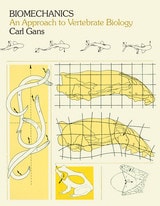
Biomechanics
An Approach to Vertebrate BiologyCarl Gans
University of Michigan Press, 1980
Offers an approach to the study of functional anatomy
[more]
Morphological Integration
Everett C. Olson and Robert L. Miller
University of Chicago Press, 1999
Despite recent advances in genetics, development, anatomy, systematics, and morphometrics, the synthesis of ideas and research agenda put forth in the classic Morphological Integration remains remarkably fresh, timely, and relevant. Pioneers in reexamining morphology, Everett Olson and Robert Miller were among the first to explore the concept of the integrated organism in both living and extinct populations. In a new foreword and afterword, biologists Barry Chernoff and Paul Magwene summarize the landmark achievements made by Olson and Miller and bring matters discussed in the book up to date, suggest new methods, and accentuate the importance of continued research in morphological integration.
Everett C. Olson was a professor at the University of Chicago and at the University of California, Los Angeles. He was a former president of the Society of Vertebrate Paleontology. Robert L. Miller was associate professor of geology at the University of Chicago, associate scientist in marine geology at the Woods Hole Oceanographic Institution, and a member of the board of editors of the Journal of Geology.
Everett C. Olson was a professor at the University of Chicago and at the University of California, Los Angeles. He was a former president of the Society of Vertebrate Paleontology. Robert L. Miller was associate professor of geology at the University of Chicago, associate scientist in marine geology at the Woods Hole Oceanographic Institution, and a member of the board of editors of the Journal of Geology.
[more]