Results by title
7 books match the query 'Motion pictures and music'
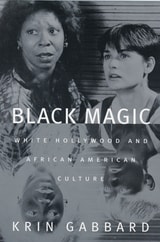
Black Magic
White Hollywood and African American CultureKrin Gabbard
Rutgers University Press, 2004
As Krin Gabbard brilliantly reveals in Black Magic, we duly recognize the cultural heritage of African Americans in literature, music, and art, but there is a disturbing pattern in the roles that blacks are asked to play-particularly in the movies. Many recent films, including The Matrix, Fargo, The Green Mile, Ghost, The Talented Mr. Ripley, Pleasantville, The Bridges of Madison County, and Crumb, reveal a fascination with black music and sexuality even as they preserve the old racial hierarchies. Quite often the dependence on African American culture remains hidden-although it is almost perversely pervasive. In the final chapters of Black Magic, Gabbard looks at films by Robert Altman and Spike Lee that attempt to reverse many of these widespread trends.
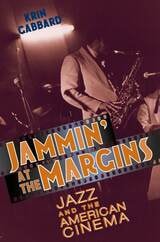
Jammin' at the Margins
Jazz and the American CinemaKrin Gabbard
University of Chicago Press, 1996
Gabbard's close look at jazz film biographies, from The Jazz Singer to Bird, reveals Hollywood's reluctance to acknowledge black subjectivity. Black and even white jazz artists have become vehicles for familiar Hollywood conceptions of race, gender, and sexuality. Even Scorsese's New York, New York and Spike Lee's Mo' Better Blues have failed to disentangle themselves from entrenched stereotypes and conventions.
Gabbard also examines Hollywood's confrontation with jazz as an elite art form, and the role of the jazz trumpet as a crucial signifier of masculinity. Finally, he considers the acting careers of Louis Armstrong, Nat King Cole, and Hoagy Carmichael; Duke Ellington's extraordinary work in films from 1929 until the late 1960s; and the forgotten career of Kay Kyser, star of nine Hollywood films and leader of a popular swing band.
This insightful look at the marriage of jazz and film is a major contribution to film, jazz, and cultural studies.
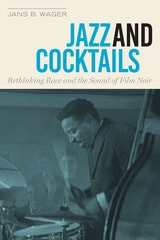
Jazz and Cocktails
Rethinking Race and the Sound of Film NoirBy Jans B. Wager
University of Texas Press, 2017
Film noir showcased hard-boiled men and dangerous femmes fatales, rain-slicked city streets, pools of inky darkness cut by shards of light, and, occasionally, jazz. Jazz served as a shorthand for the seduction and risks of the mean streets in early film noir. As working jazz musicians began to compose the scores for and appear in noir films of the 1950s, black musicians found a unique way of asserting their right to participate fully in American life.
Jazz and Cocktails explores the use of jazz in film noir, from its early function as a signifier of danger, sexuality, and otherness to the complex role it plays in film scores in which jazz invites the spectator into the narrative while simultaneously transcending the film and reminding viewers of the world outside the movie theater. Jans B. Wager looks at the work of jazz composers such as Miles Davis, Duke Ellington and Billy Strayhorn, Chico Hamilton, and John Lewis as she analyzes films including Sweet Smell of Success, Elevator to the Gallows, Anatomy of a Murder, Odds Against Tomorrow, and considers the neonoir American Hustle. Wager demonstrates how the evolving role of jazz in film noir reflected cultural changes instigated by black social activism during and after World War II and altered Hollywood representations of race and music.

Music and Levels of Narration in Film
Steps across the BorderGuido Heldt
Intellect Books, 2013
A PDF version of this book is available for free in open access via the OAPEN Library platform, www.oapen.org It has been made available under a Creative Commons Attribution 4.0 International Public License and is part of Knowledge Unlatched.
Soundtrack Available
Essays on Film and Popular MusicPamela Robertson Wojcik and Arthur Knight, eds.
Duke University Press, 2001
With a cross-cultural emphasis, the contributors focus on movies that use popular songs from a variety of genres, including country, bubble-gum pop, disco, classical, jazz, swing, French cabaret, and showtunes. The films discussed range from silents to musicals, from dramatic and avant-garde films to documentaries in India, France, England, Australia, and the United States. The essays examine both “nondiegetic” music in film—the score playing outside the story space, unheard by the characters, but no less a part of the scene from the perspective of the audience—and “diegetic” music—music incorporated into the shared reality of the story and the audience. They include analyses of music written and performed for films, as well as the now common practice of scoring a film with pre-existing songs. By exploring in detail how musical patterns and structures relate to filmic patterns of narration, character, editing, framing, and mise-en-scene, this volume demonstrates that pop music is a crucial element in the film experience. It also analyzes the life of the soundtrack apart from the film, tracing how popular music circulates and acquires new meanings when it becomes an official soundtrack.
Contributors. Rick Altman, Priscilla Barlow, Barbara Ching, Kelley Conway, Corey Creekmur, Krin Gabbard, Jonathan Gill, Andrew Killick, Arthur Knight, Adam Knee, Jill Leeper, Neepa Majumdar, Allison McCracken, Murray Pomerance, Paul Ramaeker, Jeff Smith, Pamela Robertson Wojcik, Nabeel Zuberi
Sync
Stylistics of Hieroglyphic TimeAuthored by James Tobias
Temple University Press, 2010
In Sync, James Tobias examines the development of musical sound and image in cinema and media art, indicating how these elements define the nature and experience of reception. Placing musicality at the center of understanding streaming media, Tobias presents six interwoven stories about synchronized audiovisual media—from filmmaker Sergei Eisenstein’s Alexander Nevsky to today’s contemporary digital art and computer games—to show how these effects are never merely "musical" in the literal sense of organized sound.
The Needle and the Lens
Pop Goes to the Movies from Rock 'n' Roll to SynthwaveNate Patrin
University of Minnesota Press, 2023
How the creative use of pop music in film—think Saturday Night Fever or Apocalypse Now—has shaped and shifted music history since the 1960s
Quick: What movie do you think of when you hear “The Sounds of Silence”? Better yet, what song comes to mind when you think of The Graduate? The link between film and song endures as more than a memory, Nate Patrin suggests with this wide-ranging and energetic book. It is, in fact, a sort of cultural symbiosis that has mutually influenced movies and pop music, a phenomenon Patrin tracks through the past fifty years, revealing the power of music in movies to move the needle in popular culture.
Rock ’n’ roll, reggae, R&B, jazz, techno, and hip-hop: each had its moment—or many—as music deployed in movies emerged as a form of interpretive commentary, making way for the legitimization of pop and rock music as art forms worthy of serious consideration. These commentaries run the gamut from comedic irony to cheap-thrills excitement to deeply felt drama, all of which Patrin examines in pairings such as American Graffiti and “Do You Want to Dance?”; Saturday Night Fever and “Disco Inferno”; Apocalypse Now and “The End”; Wayne’s World and “Bohemian Rhapsody”; and Jackie Brown and “Didn't I Blow Your Mind This Time?”.
What gives power to these individual moments, and how have they shaped and shifted music history, recasting source material or even stirring wider interest in previously niche pop genres? As Patrin surveys the scene—musical and cinematic—across the decades, expanding into the deeper origins, wider connections, and echoed histories that come into play, The Needle and the Lens offers a new way of seeing, and hearing, these iconic soundtrack moments.