Results by title
10 books match the query 'Mourning customs'
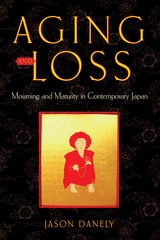
Aging and Loss
Mourning and Maturity in Contemporary JapanDanely, Jason
Rutgers University Press, 2015
Based on nearly a decade of research, Aging and Loss examines how the landscape of aging is felt, understood, and embodied by older adults themselves. In detailed portraits, anthropologist Jason Danely delves into the everyday lives of older Japanese adults as they construct narratives through acts of reminiscence, social engagement and ritual practice, and reveals the pervasive cultural aesthetic of loss and of being a burden.
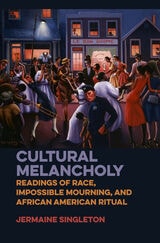
Cultural Melancholy
Readings of Race, Impossible Mourning, and African American RitualJermaine Singleton
University of Illinois Press, 2015
Singleton develops the concept of "cultural melancholy" as a response to scholarship that calls for the separation of critical race studies and psychoanalysis, excludes queer theoretical approaches from readings of African American literatures and cultures, and overlooks the status of racialized performance culture as a site of serious academic theorization. In doing so, he weaves critical race studies, psychoanalysis, queer theory, and performance studies into conversation to uncover a host of hidden dialogues—psychic and social, personal and political, individual and collective—for the purpose of promoting a culture of racial grieving, critical race consciousness, and collective agency.
Wide-ranging and theoretically bold, Cultural Melancholy counteracts the racial legacy effects that plague our twenty-first century multiculture.
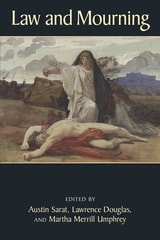
Law and Mourning
Austin Sarat
University of Massachusetts Press, 2017
In addition to the editors, the contributors include Andrea Brady, Catherine Kellogg, Shai Lavi, Ray Madoff, Ann Pelligrini, and Mark Sanders.
Memorializing Violence
Transnational Feminist ReflectionsAlison Crosby
Rutgers University Press, 2025
Our Grateful Dead
Stories of Those Left BehindVinciane Despret
University of Minnesota Press, 2021
An award-winning exploration of the presence of the dead in the lives of the living
A common remedy after suffering the loss of a loved one is to progress through the “stages of grief,” with “acceptance” as the final stage in the process. But is it necessary to leave death behind, to stop dwelling on the dead, to get over the pain? Vinciane Despret thinks not. In her fascinating, elegantly translated book, this influential thinker argues that, in practice, people in all cultures continue to enjoy a lively, inventive, positive relationship with their dead.
Through her unique storytelling woven from ethnographic sources and her own family history, Despret assembles accounts of those who have found ways to live their daily lives with their dead. She rejects the idea that one must either subscribe to “complete mourning” (in a sense, to get rid of the dead) or else fall into fantasy and superstition. She explores instead how the dead still play an active, tangible role through those who are living, who might assume their place in a family or in society; continue their labor or art; or thrive from a shared inheritance or an organ donation. This is supported by dreams and voices, novels, television and popular culture, the work of clairvoyants, and the everyday stories and activities of the living. For decades now, in the West, the dead have been discreet and invisible. Today, especially as a result of the Covid-19 pandemic, Despret suggests that perhaps we will be willing to engage with the dead in ways that bring us happiness despite our loss.
Despret’s unique method of inquiry makes her book both entertaining and instructive. Our Grateful Dead offers a new, pragmatic approach to social and cultural research and may indeed provide compassionate therapy for those of us coping with death.
Reading Death in Ancient Rome
Mario Erasmo
The Ohio State University Press, 2008
Sentimental Collaborations
Mourning and Middle-Class Identity in Nineteenth-Century AmericaMary Louise Kete
Duke University Press, 2000
Many scholars have written about the sentimental novel as a primarily female genre and have stressed its negative ideological aspects. Kete finds that in fact many men—from writers to politicians—participated in nineteenth-century sentimental culture. Importantly, she also recovers the utopian dimension of the phenomenon, arguing that literary sentimentality, specifically in the form of poetry, is the written trace of a broad cultural discourse that Kete calls “sentimental collaboration”—an exchange of sympathy in the form of gifts that establishes common cultural or intellectual ground. Kete reads the work of Ralph Waldo Emerson, Henry Wadsworth Longfellow, Mark Twain, Harriet Beecher Stowe, and Lydia Huntley Sigourney with an eye toward the deployment of sentimentality for the creation of Americanism, as well as for political and abolitionist ends. Finally, she locates the origins of sentimental collaboration in the activities of ordinary people who participated in mourning rituals—writing poetry, condolence letters, or epitaphs—to ease their personal grief.
Sentimental Collaborations significantly advances prevailing scholarship on Romanticism, antebellum culture, and the formation of the American middle class. It will be of interest to scholars of American studies, American literature, cultural studies, and women’s studies.
Songs for Dead Parents
Corpse, Text, and World in Southwest ChinaErik Mueggler
University of Chicago Press, 2017
Drawing on more than twenty years of fieldwork in a mountain community in Yunnan Province, Songs for Dead Parents shows how people view the dead as both material and immaterial, as effigies replace corpses, tombstones replace effigies, and texts eventually replace tombstones in a long process of disentangling the dead from the shared world of matter and memory. It is through these processes that people envision the cosmological underpinnings of the world and assess the social relations that make up their community. Thus, state interventions aimed at reforming death practices have been deeply consequential, and Mueggler traces the transformations they have wrought and their lasting effects.
The Death of the Child Valerio Marcello
Margaret L. King
University of Chicago Press, 1994
This child, scion of a family of power and privilege at Venice's time of greatness, left his father in a state of despair so profound and so public that it occasioned an outpouring of consoling letters, orations, treatises, and poems. In these documents, we find a firsthand account, richly colored by humanist conventions and expectations, of the life of the fifteenth-century boy, the passionate devotion of his father, the feelings of his brothers and sisters, the striking absence of his mother. The father's story is here as well: the career of a Venetian nobleman and scholar, patron and soldier, a participant in Venice's struggle for dominion in the north of Italy.
Through these sources also King traces the cultural trends that made Marcello's century famous. Her work enlarges our view of the literature of consolation, which had a distinctive tradition in Venice, and shifting attitudes toward death from the late Middle Ages onward.
For the depth and acuity of its insights into political, cultural, and private life in fifteenth-century Venice, this book will be essential reading for students of the Renaissance. For the grace and drama of its storytelling, it will be savored by anyone who wishes to look into life and death in a palace, and a city, long ago.
We Remember, We Love, We Grieve
Mortuary and Memorial Practice in Contemporary RussiaElizabeth Warner and Svetlana Adonyeva
University of Wisconsin Press, 2021
“We remember, we love, we grieve” is a common epitaph in this part of the world. As contemporary Russia contends with the Soviet Union’s legacy of dismantling older ways of life, the phrase ripples beyond individual loss—it encapsulates communities’ determination to preserve their customs when faced with oppression. This volume offers insight into a core cultural practice, exploring the dynamism of tradition.