Results by title
4 books match the query 'Movement (Acting)'

Beyond the Mask
Gordon Craig, Movement, and the ActorIrene Eynat-Confino
Southern Illinois University Press, 1987
Eynat-Confino goes beyond the usual consideration of Craig’s purported theories of the actor, scenery, and the scene painter to get at the heart of Craig’s idea of theater.
She draws not only on the research of contemporary Craig scholars but on material hitherto unavailable—his writings and daybooks and the writings of friends. She ties Craig’s encounter with Isadora Duncan to a decisive modification in his notion of movement. To have an instrument more controllable than the actor, he invented the über-marionette, a giant puppet. Craig also invented the “Scene,” a kinetic stage, the “screens” that brought him worldwide fame were simply an adaptation of this concept.
Eynat-Confino argues that a scenario Craig wrote in 1905, here published for the first time, reveals a theosophical system like that of Blake, a system that was the main force motivating Craig’s artistic quest. In her final chapter, she carefully examines the psychological, aesthetic, and circumstantial factors that kept Craig from completing his work to bring “friendliness—humor—love—ease—peace” to the world.
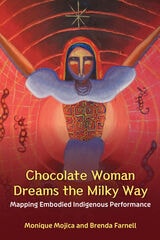
Chocolate Woman Dreams the Milky Way
Mapping Embodied Indigenous PerformanceMonique Mojica and Brenda Farnell
University of Michigan Press, 2023
Co-authored with anthropologist Brenda Farnell, the book challenges the divide between artist and scholar, and addresses the many levels of cultural, disciplinary, and linguistic translations required to achieve this. Placing the complex intellect inherent to Indigenous Knowledges at its center, the book engages Indigenous performance theory, and concepts that link body, land, and story, such as terra nullius/corpus nullius, mapping, pattern literacy, land literacy, and movement literacy. Enhanced by contributions from other artists and scholars, the book challenges Eurocentric ideologies about what counts as “performance” and what is required from an “audience,” as well as long-standing body-mind dualisms.
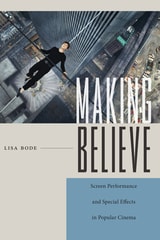
Making Believe
Screen Performance and Special Effects in Popular CinemaBode, Lisa
Rutgers University Press, 2017
Making Believe incorporates North American film reviews and editorials, actor and crew interviews, trade and fan magazine commentary, actor training manuals, and film production publicity materials to discuss the shifts in screen acting practice and philosophy around transfiguring makeup, doubles, motion capture, and acting to absent places or characters. Along the way it considers how performers and visual and special effects crew work together, and struggle with the industry, critics, and each other to define the aesthetic value of their work, in an industrial system of technological reproduction. Bode opens our eyes to the performing illusions we love and the tensions we experience in wanting to believe in spite of our knowledge that it is all make believe in the end.
Physical Expression and the Performing Artist
Moving Beyond the PlateauJerald Schwiebert
University of Michigan Press, 2011
All performers know that "tuning up the body" is necessary to maximize performance. A person's mannerisms, habitual patterns of movement, and posture can block the capacity for expression, often without the performer even noticing. Physical Expression and the Performing Artist offers an organized approach to movement for actors, conductors, dancers, singers, musicians---for performers of any kind.
Capturing the energy of the popular workshops presented by master movement teacher Jerald Schwiebert, the book draws from the wisdom of hatha yoga, tai chi, and Pilates as well as from the teachings of Stanislavski, Structural Integration (Rolfing), Alexander, Feldenkrais, and Laban to provide a fresh and accessible approach to movement. More than 300 anatomical drawings help readers pinpoint specific muscles, joints, and actions as they explore the capacity of the performer's physical instrument, the components of dynamic movement, and the anatomy of expression. The book's many detailed exercises bring awareness of habitual and inefficient movement and introduce the steps necessary for more efficient movement patterns in all parts of the body. This book will prove indispensable in movement courses and as a resource guide for professionals seeking to take their performances to the next level.