Results by title
10 books match the query 'Moving'
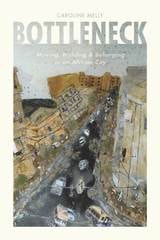
Bottleneck
Moving, Building, and Belonging in an African CityCaroline Melly
University of Chicago Press, 2017
Melly opens with an account of the generation of urban men who came of age on the heels of the era of structural adjustment, a diverse cohort with great dreams of building, moving, and belonging, but frustratingly few opportunities to do so. From there, she moves to a close study of taxi drivers and state workers, and shows how bottlenecks—physical and institutional—affect both. The third section of the book covers a seemingly stalled state effort to solve housing problems by building large numbers of concrete houses, while the fourth takes up the thousands of migrants who attempt, sometimes with tragic results, to cross the Mediterranean on rickety boats in search of new opportunities. The resulting book offers a remarkable portrait of contemporary Senegal and a means of theorizing mobility and its impossibilities far beyond the African continent.

Envisioning the Faculty for the Twenty-First Century
Moving to a Mission-Oriented and Learner-Centered ModelKezar, Adrianna
Rutgers University Press, 2016

Follow Your Heart
Moving with the Giants of Jazz, Swing, and Rhythm and BluesJoe Evans with Christopher Brooks
University of Illinois Press, 2008
Detailing the fascinating career of Joe Evans, Follow Your Heart chronicles the nearly thirty years that he spent immersed in one of the most exciting times in African American music history. An alto saxophonist who between 1939 and 1965 performed with some of America's greatest musicians, including Louis Armstrong, Cab Calloway, Charlie Parker, Jay McShann, Andy Kirk, Billie Holiday, Bill "Bojangles" Robinson, Lionel Hampton, and Ivory Joe Hunter, Evans warmly recounts his wide range of experience in the music industry. Readers follow Evans from Pensacola, Florida, where he first learned to play, to such exotic destinations as Tel Aviv and Paris, which he visited while on tour with Lionel Hampton. Evans also comments on popular New York City venues used for shaping and producing black music, such as the Apollo Theater, the Savoy, Minton's Playhouse, and the Rhythm Club.
Revealing Evans as a master storyteller, Follow Your Heart describes his stints as a music executive, entrepreneur, and musician. Evans provides rich descriptions of jazz, swing, and rhythm and blues culture by highlighting his experiences promoting tracks to radio deejays under Ray Charles's Tangerine label and later writing, arranging, and producing hits for the Manhattans and the Pretenders. Leading numerous musical ventures that included a publishing company and several labels--Cee Jay Records (with Jack Rags), Revival, and Carnival Records--Evans remained active in the music industry even after he stopped performing regularly. As one of the few who enjoyed success as both performer and entrepreneur, he offers invaluable insight into race relations within the industry, the development of African American music and society from the 1920s to 1970s, and the music scene of the era.
Interim Leadership in Libraries
Building Relationships, Making Decisions, and Moving OnJennifer E. Knievel
American Library Association, 2022
Interim Leadership in Libraries: Building Relationships, Making Decisions, and Moving On draws on evidence-based research, professional expertise, and personal experience to address the practical implications that arise from the decision to appoint interim leaders. Authors from a variety of institutions who have served in many different interim roles explore this unique type of leadership in five thorough sections:
- Building Relationships for Interim Leaders
- Leading with Confidence
- Making Long-Term Decisions as an Interim Leader
- Leading Through Contraction: When No One Can Be Hired
- Moving On: When the Dust Settles

Josie Mpama/Palmer
Get Up and Get MovingRobert R. Edgar
Ohio University Press, 2020
While African National Congress narratives dominate much of the scholarship on South Africa’s freedom struggle, Josie Mpama/Palmer’s political life offers a different perspective. Highly critical of the patriarchal attitudes that hindered black women from actively participating in politics, Mpama/Palmer was an outspoken advocate for women’s social equality and encouraged black women to become more involved in national conversations. The first black woman to join the Communist Party of South Africa and an antiapartheid activist, Josie Mpama/Palmer remained involved in critical issues all her life, especially protests against Bantu Education and other forms of racial and sexist discrimination. She was an integral figure in establishing the Federation of South African Women, an organization open to women of all races. Mpama/Palmer’s activism and political legacy would become an inspiring example for women in South Africa and around the world to get up and get moving.

Knowing as Moving
Perception, Memory, and PlaceSusan Leigh Foster
Duke University Press, 2025
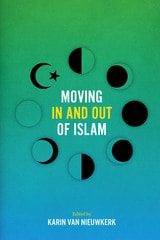
Moving In and Out of Islam
By Karin van Nieuwkerk
University of Texas Press, 2018
Embracing a new religion, or leaving one’s faith, usually constitutes a significant milestone in a person’s life. While a number of scholars have examined the reasons why people convert to Islam, few have investigated why people leave the faith and what the consequences are for doing so. Taking a holistic approach to conversion and deconversion, Moving In and Out of Islam explores the experiences of people who have come into the faith along with those who have chosen to leave it—including some individuals who have both moved into and out of Islam over the course of their lives.
Sixteen empirical case studies trace the processes of moving in or out of Islam in Western and Central Europe, the United States, Canada, and the Middle East. Going beyond fixed notions of conversion or apostasy, the contributors focus on the ambiguity, doubts, and nonlinear trajectories of both moving in and out of Islam. They show how people shifting in either direction have to learn or unlearn habits and change their styles of clothing, dietary restrictions, and ways of interacting with their communities. They also look at how communities react to both converts to the religion and converts out of it, including controversies over the death penalty for apostates. The contributors cover the political aspects of conversion as well, including debates on radicalization in the era of the “war on terror” and the role of moderate Islam in conversions.

Moving On
The Heroines of Shirley Ann Grau, Anne Tyler, and Gail GodwinSusan S. Kissel
University of Wisconsin Press, 1996
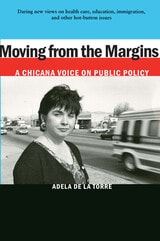
Moving from the Margins
A Chicana Voice on Public PolicyAdela de la Torre
University of Arizona Press, 2002
Addressing immigration, education, health care, and economic and political concerns, Adela de la Torre provides a distinctly Chicana perspective that often differs from that of mainstream readers and voters. Drawn from the author's syndicated column in the Los Angeles Times along with writings from other publications, Moving from the Margins includes incisive and often provocative commentaries that provide insights into the roots of ethnic tensions in the Golden State.
The book also includes readers' reactions to the articles, creating a dialogue of ideas while confronting fears of what many Americans view as an alien culture. Whether addressing entitlements granted to noncitizens, the future of public schools, or access to health care, de la Torre challenges readers to move beyond their own frame of reference and consider new points of view. The issues she faces have shaped today's California—and they also lie at the heart of urban public policy in America for the twenty-first century.

Moving the Mountain
The Women's Movement in America since 1960Flora Davis
University of Illinois Press, 1999