Results by title
11 books match the query 'Mozart, Wolfgang Amadeus'
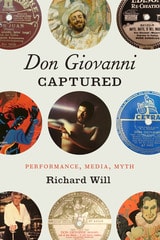
"Don Giovanni" Captured
Performance, Media, MythRichard Will
University of Chicago Press, 2022
Mozart’s opera Don Giovanni has long inspired myths about eros and masculinity. Over time, its performance history has revealed a growing trend toward critique—an increasing effort on the part of performers and directors to highlight the violence and predatoriness of the libertine central character, alongside the suffering and resilience of his female victims.
In “Don Giovanni” Captured, Richard Will sets out to analyze more than a century’s worth of recorded performances of the opera, tracing the ways it has changed from one performance to another and from one generation to the next. Will consults audio recordings, starting with wax cylinders and 78s, as well as video recordings, including DVDs, films, and streaming videos. As Will argues, recordings and other media shape our experience of opera as much as live performance does. Seen as a historical record, opera recordings are also a potent reminder of the refusal of works such as Don Giovanni to sit still. By choosing a work with such a rich and complex tradition of interpretation, Will helps us see Don Giovanni as a standard-bearer for evolving ideas about desire and power, both on and off the stage.
Bach Perspectives, Volume 14
Bach and Mozart: Connections, Patterns, and PathwaysEdited by Paul Corneilson
University of Illinois Press, 2022
An official publication of the American Bach Society, Bach Perspectives, Volume 14 draws on a variety of approaches and a broad range of subject matter in presenting a new wave of innovative classical musical scholarship.
Contributors: Eleanor Selfridge-Field, Yoel Greenberg, Noelle M. Heber, Michael Maul, Stephen Roe, and David Schulenberg
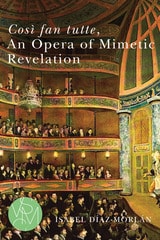
Così fan tutte, An Opera of Mimetic Revelation
Isabel Díaz-Morlán
Michigan State University Press, 2025
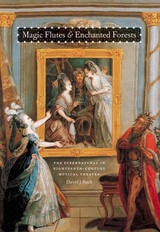
Magic Flutes and Enchanted Forests
The Supernatural in Eighteenth-Century Musical TheaterDavid J. Buch
University of Chicago Press, 2008
David J. Buch reveals that despite—and perhaps even because of—their fundamental irrationality, fantastic and exotic themes acquired extraordinary force and popularity during the period, pervading theatrical works with music in the French, German, and Italian mainstream. Considering prominent compositions by Gluck, Rameau, and Haydn, as well as many seminal contributions by lesser-known artists, Buch locates the origins of these magical elements in such historical sources as ancient mythology, European fairy tales, the Arabian Nights, and the occult. He concludes with a brilliant excavation of the supernatural roots of Mozart’s The Magic Flute and Don Giovanni, building a new foundation for our understanding of the magical themes that proliferated in Mozart’s wake.
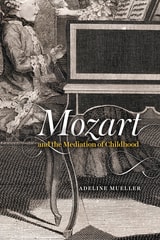
Mozart and the Mediation of Childhood
Adeline Mueller
University of Chicago Press, 2021
The story of Wolfgang Amadeus Mozart’s precocity is so familiar as to be taken for granted. In scholarship and popular culture, Mozart the Wunderkind is often seen as belonging to a category of childhood all by himself. But treating the young composer as an anomaly risks minimizing his impact. In this book, Adeline Mueller examines how Mozart shaped the social and cultural reevaluation of childhood during the Austrian Enlightenment. Whether in a juvenile sonata printed with his age on the title page, a concerto for a father and daughter, a lullaby, a musical dice game, or a mass for the consecration of an orphanage church, Mozart’s music and persona transformed attitudes toward children’s agency, intellectual capacity, relationships with family and friends, political and economic value, work, school, and leisure time.
Thousands of children across the Habsburg Monarchy were affected by the Salzburg prodigy and the idea he embodied: that childhood itself could be packaged, consumed, deployed, “performed”—in short, mediated—through music. This book builds upon a new understanding of the history of childhood as dynamic and reciprocal, rather than a mere projection or fantasy—as something mediated not just through texts, images, and objects but also through actions. Drawing on a range of evidence, from children’s periodicals to Habsburg court edicts and spurious Mozart prints, Mueller shows that while we need the history of childhood to help us understand Mozart, we also need Mozart to help us understand the history of childhood.
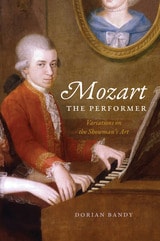
Mozart the Performer
Variations on the Showman's ArtDorian Bandy
University of Chicago Press, 2023
We know Mozart as one of history’s greatest composers. But his contemporaries revered him as a multi-instrumentalist, a dazzling improviser, and the foremost keyboard virtuoso of his time. When he composed, it was often with a single aim in mind: to set the stage, quite literally, for compelling and captivating performances. He wrote piano concertos not with an eye to posterity but to give himself a repertoire with which to flaunt his keyboard wizardry before an awestruck public. The same was true of his sonatas, string quartets, symphonies, and operas, all of which were painstakingly crafted to produce specific effects on those who played or heard them, amusing, stirring, and ravishing colleagues and consumers alike.
Mozart the Performer brings to life this elusive side of Mozart’s musicianship. Dorian Bandy traces the influence of showmanship on Mozart’s style, showing through detailed analysis and imaginative historical investigation how he conceived his works as a series of dramatic scripts. Mozart the Performer is a book for anyone who wishes to engage more deeply with Mozart’s artistry and legacy and understand why, centuries later, his music still captivates us.
Mozart's Piano Concertos
Text, Context, InterpretationNeal Zaslaw, Editor
University of Michigan Press, 1997
The volume's first section consists of commentaries on the texts of the concertos, including thoughts on creating a critical edition. In subsequent sections, contributors analyze the structure of the pieces and the circumstances in which they were first composed and performed. How do these works compare with other concertos of the period? Where were Mozart's contributions truly original, where conventional? What musical references did he expect his listeners to catch?
Generously illustrated with facsimiles, tables, and more than one-hundred musical examples, Mozart's Piano Concertos substantially advances our understanding of these wonderful works. Its exceptional scope--addressing everything from textual problems (what notes should be played?) to performance practice (how can we make the music sound more nearly as Mozart heard it?)--will make it invaluable to anyone who loves his piano concertos.
Contributors:
V. Kofi Agawu, Wye Jameson Allanbrook, Eva Badura-Skoda, Karol Berger, Richard Crawford, Ellwood Derr, Dexter Edge, Cliff Eisen, Martha Feldman, David Grayson, William Kinderman, Robert D. Levin, Janet M. Levy, David Rosen, Carl Schachter, Elaine Sisman, Jane R. Stevens, Alan Tyson, James Webster, Christoph Wolff, and Neal Zaslaw.
Neal Zaslaw is Professor of Music, Cornell University.
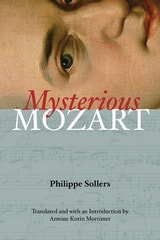
Mysterious Mozart
Philippe Sollers, Translated and with an Introduction by Armine Kotin Mortimer
University of Illinois Press, 2010
Both a beguiling portrait of the artist and an idiosyncratic self-portrait of the author, Mysterious Mozart is Philippe Sollers's alternately oblique and searingly direct interpretation of Wolfgang Amadeus Mozart's oeuvre and lasting mystique, audaciously reformulated for the postmodern age.
With a mix of slang, abstractions, quotations, first- and third-person narratives, and blunt opinion, French writer and critic Philippe Sollers taps into Mozart's playful correspondence and the lesser-known pieces of his enormous repertoire to analyze the popularity and public perceptions of his music. Detailing Mozart's drive to continue producing masterpieces even when saddled with debt and riddled with illness and anxiety, Sollers powerfully and meticulously analyzes Mozart's seven last great operas using a psychoanalytical approach to the characters' relationships.
As Sollers explores themes of constancy, prodigy, freedom, and religion, he offers up bits of his own history, revealing his affinity for the creative geniuses of the eighteenth century and a yearning to bring that era's utopian freedom to life in contemporary times. What emerges is an inimitable portrait of a man and a musician whose greatest gift is a quirky companionability, a warm and mysterious appeal that distinguishes Mozart from other great composers and is brilliantly echoed by Sollers's artful tangle of narrative.
Rhythmic Gesture in Mozart
Le Nozze di Figaro and Don GiovanniWye Jamison Allanbrook
University of Chicago Press, 1984
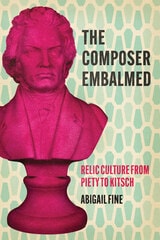
The Composer Embalmed
Relic Culture from Piety to KitschAbigail Fine
University of Chicago Press, 2025
During the nineteenth century, music institutions promoted artworks they deemed timeless and made composers into figureheads of a lasting Western canon. Alongside this institutional face of the canon was a more intimate impulse to preserve, touch, and embrace the residues of the dead. In Germany and Austria between 1870 and 1930, music lovers venerated the bodies, houses, and belongings of composers as relics, shrines, and talismans. In The Composer Embalmed, Abigail Fine documents the vernacular and eccentric ways that composers have been remembered.
Fine navigates a wealth of unknown archival material to recover the stories of devotees: from pilgrims who felt time stop in historic houses to music-loving doctors who made skulls into sacred specimens, dilettantes who displayed Beethoven’s mask as a relic of the “beautiful death,” and interwar critics of those dilettantes who disparaged piety as a false religion, a kitsch replica. In isolation, these practices may look like simple acts of affection. But in the aggregate, Fine asserts, acts of devotion constituted what we might broadly understand as relic culture—a culture that sought to possess the body of the departed genius, and that superimposed habits of anthropological collecting onto artifacts of Austro-German heritage. By excavating objects, ephemera, amateur lyric, visitors’ books, letters, and travelogues, The Composer Embalmed reveals the underbelly of the canon, where guilty pleasures blur the boundary between sanctity and desecration.
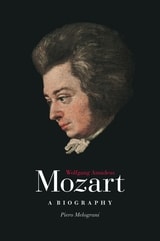
Wolfgang Amadeus Mozart
A BiographyPiero Melograni
University of Chicago Press, 2006
This year marks the 250th anniversary of the birth of Wolfgang Amadeus Mozart, one of the most enduringly popular and celebrated composers to have ever lived. His substantial oeuvre contains works that are considered to be among the most exquisite pieces of symphonic, chamber, and choral music ever written. His operas too cast a long shadow over those staged in their wake. And since his untimely death in 1791, he remains an enigmatic figure—the subject of fascination for aficionados and novices alike.
Piero Melograni here offers a wholly readable account of Mozart’s remarkable life and times. This masterful biography proceeds from the young Mozart’s earliest years as a Wunderkind—the child prodigy who traveled with his family to perform concerts throughout Europe—to his formative years in Vienna, where he fully absorbed the artistic and intellectual spirit of the Enlightenment, to his deathbed, his unfinished Requiem, and the mystery that still surrounds his burial. Melograni’s deft use of Mozart’s letters throughout confers authority and vitality to his recounting, and his expertise brings Mozart’s eighteenth-century milieu evocatively to life. Written with a gifted historian’s flair for narrative and unencumbered by specialized analyses of Mozart’s music, Melograni’s is the most vivid and enjoyable biography available.
At a time when music lovers around the world are paying honor to Mozart and his legacy, Wolfgang Amadeus Mozart will be welcomed by his enthusiasts—or anyone wishing to peer into the mind of one of the greatest composers ever known.