Results by title
3 books match the query 'Mrázek, Jan'
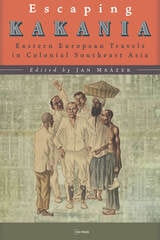
Escaping Kakania
Eastern European Travels in Colonial Southeast AsiaJan Mrázek
Central European University Press, 2024
Escaping Kakania is about fascinating characters—soldiers, doctors, scientists, writers, painters—who traveled from their eastern European homelands to colonial Southeast Asia. Their stories are told by experts on different countries in the two regions, who bring diverse approaches into a conversation that crosses disciplinary and national borders.
The 14 chapters deal with the diverse encounters of eastern Europeans with the many faces of colonial southeast Asia. Some essays directly engage with post-colonial studies, contributing to an ongoing critical re-evaluation of eastern European “semi-peripheral” (non-)involvement in colonialism. Other chapters disclose a range of perspectives and narratives that illuminate the plurality of the travelers’ positions while reflecting on the specificity of the eastern European experience.
The travellers moved—as do the chapter authors—between two regions that are off-centre, in-between, shiftingly “Eastern,” and disorientingly heterogeneous, thus complicating colonial and postcolonial notions of “Europe,” “East,” and East-West distinctions. Both at home and overseas, they navigated among a multiplicity of peoples, “races,” and empires, Occidents and Orients, fantasies of the Self and the Other, adopting/adapting/mimicking/rejecting colonialist identities and ideologies. They saw both eastern Europe and southeast Asia in a distinctive light, as if through each other—and so will the readers of Escaping Kakania.
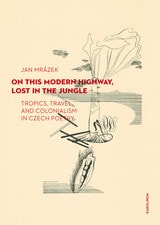
On This Modern Highway, Lost in the Jungle
Tropics, Travel, and Colonialism in Czech PoetryJan Mrázek
Karolinum Press, 2022
In 1926, the Communist avant-garde poet Konstantin Biebl (1898–1951) traveled from Czechoslovakia to the Dutch East Indies. In the writings from his journal—texts simultaneously poetic and comic—both landlocked Bohemia and the colonized tropical islands are seen in disorienting new perspectives, like “mirrors looking at themselves in each other.”
Jan Mrázek’s On This Modern Highway, Lost in the Jungle takes us on a journey of our own, crisscrossing Biebl’s life and work—with particular attention to his travel writing—as they mirror Mrázek’s own experiences as a multinational academic: a Prague conservatory graduate, educated at Michigan and Cornell, and now a scholar of Indonesia living in Singapore. Biebl’s writings are also the book’s point of departure for a broader exploration of the intersections of travel and poetry, issues of colonial and social injustice, and the representation of otherness in the Czech literary and visual imagination. In its attention to how poetic travel reflects the Czech historical experience in the shadow of imperial nations, Mrázek’s book elevates scholarly reflection on literary travel, modernity, and colonialism to a new level.
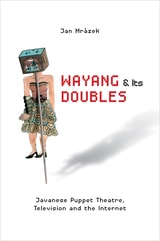
Wayang and Its Doubles
Javanese Puppet Theatre, Television and the InternetJan Mrázek
National University of Singapore Press, 2019
This book explores the ways two complex forms of media coexist and meet as well as haunt and invade each other. It looks at performance aesthetics and the technicalities of television production, as well as issues of time, space, light, place, and movement. It compares audience experiences of live and televised performances, and highlights the collaboration and struggle between performers and television producers. Interviews with performers from both sides are brought into a larger conversation on media and technology, one that includes ideas from Karl Marx, Martin Heidegger, Maurice Merleau-Ponty, Jacques Derrida, Paul Virilio, and James Siegel. The book also looks ahead to new formats that have the potential to disrupt in ways never imagined: the worlds of streaming and social media.