Results by title
2 books match the query 'Mughal Empire'

Imaging Sound
An Ethnomusicological Study of Music, Art, and Culture in Mughal IndiaBonnie C. Wade
University of Chicago Press, 1998
The rulers of the Mughal Empire of India, who reigned from 1526 to 1858, spared no expense as patrons of the arts. They left as their legacy an extraordinarily rich body of commissioned artistic projects, including illustrated manuscripts and paintings that represent music-making in numerous spheres of Mughal court life, particularly that of women. These images form the basis of Bonnie C. Wade's study of how musicians of Hindustan encountered and Indianized music from the Persian cultural sphere.
Combining ethnomusicological and art historical methods with history and lore, Wade focuses first on paintings for Akbar, showing how political and cultural agendas intertwined in the portrayal of his life and that of his grandfather Babur and father, Humayun. Wade then follows the depictions of music-making through paintings for Akbar's successors, Jahangir and Shah Jahan, to trace the gradual synthesis of Persian and Indian culture. Richly illustrated with reproductions of rare Mughal paintings, this work will appeal broadly to anyone interested in Indian history, ethnomusicology, and art history.
Combining ethnomusicological and art historical methods with history and lore, Wade focuses first on paintings for Akbar, showing how political and cultural agendas intertwined in the portrayal of his life and that of his grandfather Babur and father, Humayun. Wade then follows the depictions of music-making through paintings for Akbar's successors, Jahangir and Shah Jahan, to trace the gradual synthesis of Persian and Indian culture. Richly illustrated with reproductions of rare Mughal paintings, this work will appeal broadly to anyone interested in Indian history, ethnomusicology, and art history.
[more]
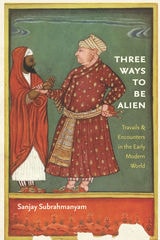
Three Ways to Be Alien
Travails and Encounters in the Early Modern WorldSanjay Subrahmanyam
Brandeis University Press, 2011
Sanjay Subrahmanyam’s Three Ways to Be Alien draws on the lives and writings of a trio of marginal and liminal figures cast adrift from their traditional moorings into an unknown world. The subjects include the aggrieved and lost Meale, a “Persian” prince of Bijapur (in central India, no less) held hostage by the Portuguese at Goa; English traveler and global schemer Anthony Sherley, whose writings reveal a surprisingly nimble understanding of realpolitik in the emerging world of the early seventeenth century; and Nicolò Manuzzi, an insightful Venetian chronicler of the Mughal Empire in the later seventeenth century who drifted between jobs with the Mughals and various foreign entrepôts, observing all but remaining the eternal outsider. In telling the fascinating story of floating identities in a changing world, Subrahmanyam also succeeds in injecting humanity into global history and proves that biography still plays an important role in contemporary historiography.
[more]