Results by title
44 books match the query 'Musical Instruments'
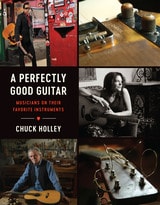
A Perfectly Good Guitar
Musicians on Their Favorite InstrumentsBy Chuck Holley
University of Texas Press, 2017
Ask guitar players about their instruments, and you’re likely to get a story—where the guitar came from, or what makes it unique, or why the player will never part with it. Most guitarists have strong feelings about their primary tool, and some are downright passionate about their axes. Chuck Holley is a professional photographer and writer who loves music and listening to musicians talk about their trade. For several years, he has been photographing guitarists with their prized instruments and collecting their stories. This beautifully illustrated book presents these stories in revelatory photographs and words.
The guitarists included in this book range from high-profile performers, including Rosanne Cash, Guy Clark, Laurence Juber, Jorma Kaukonen, JD Souther, Bill Frisell, Dave Alvin, and Kelly Willis, to renowned studio musicians and band members. Holley’s beautifully composed photographs portray them with their favorite guitar, including detail shots of the instrument. Accompanying the photographs are the musicians’ stories about the Gibsons, Fenders, Martins, and others that have become the guitar in their lives, the one that has a special lineage or intangible qualities of sustain, tone, clarity, and comfort that make it irreplaceable. Several musicians talk about how the guitar chose them, while others recount stories of guitars lost or stolen and then serendipitously recovered. Together, these photographs and stories underscore the great pleasure of performing with an instrument that’s become a trusted friend with a personality all its own.
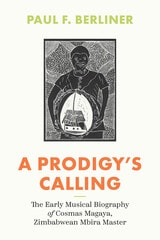
A Prodigy's Calling
The Early Musical Biography of Cosmas Magaya, Zimbabwean Mbira MasterPaul F. Berliner
University of Chicago Press, 2024
Ethnomusicologist Paul F. Berliner has been studying Zimbabwean mbira for more than fifty years. When he first arrived in what was then Rhodesia after the nation declared independence from the United Kingdom, he met Cosmas Magaya, a mbira player who would become his teacher and lifelong collaborator. A Prodigy’s Calling chronicles the early years of Magaya’s life, documenting the master mbira player’s journey from child prodigy to established expert. As a child, Magaya was immersed in mbira music through his father’s work as a healer and spirit medium. As Magaya grew, so too did his world; his performances extended beyond the family compound as his skill and knowledge increased, bringing him into contact with a society fraught with decolonial conflict.
Following Magaya’s childhood, readers will learn how his upbringing guided his journey through the community’s social networks and how his early sensibilities, proclivities, and talents shaped his development. At the same time, his deepening engagement with music and the ancestors was affected by overlapping tensions between Shona cosmology and Christian ideology, rural and urban lifestyles, and the escalating African nationalist struggle and the white supremacist state. While Magaya’s story reflects profound social changes in the nation, it is also a story of musical apprenticeship. Readers following Magaya’s discovery of ever finer details in the music’s richly layered patterns will enhance their ability to hear mbira music’s forms, variations, and sonic qualities. Linocut illustrations by South African artist Lucas Bambo bring the narrative to life, and Berliner’s spirited storytelling is accompanied by QR codes that take readers directly to recordings of music as Magaya learns it. Appendices for musicians interested in learning or improving their mbira playing complement the story of Magaya’s early life. Inviting the reader into the very tradition it recounts, the book offers intimate insights into the relationships among music, Shona cosmology, and colonial politics in everyday life.
American Luthier
Carleen Hutchins—the Art and Science of the ViolinQuincy Whitney
University Press of New England, 2016
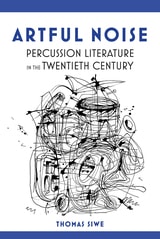
Artful Noise
Percussion Literature in the Twentieth CenturyThomas Siwe
University of Illinois Press, 2020
Percussionist Thomas Siwe organizes and analyzes the groundbreaking musical literature that arose during the twentieth century. Focusing on innovations in style and the evolution of the percussion ensemble, Siwe offers a historical overview that connects the music to scoring techniques, new instrumentation and evolving technologies as well as world events. Discussions of representative pieces by seminal composers examines the resources a work requires, its construction, and how it relates to other styles that developed during the same period. In addition, Siwe details the form and purpose of many of the compositions while providing background information on noteworthy artists. Each chapter is supported with musical examples and concludes with a short list of related works specifically designed to steer musicians and instructors alike toward profitable explorations of composers, styles, and eras.

Banjo Roots and Branches
Edited by Robert B. Winans
University of Illinois Press, 2018
Wide-ranging and illustrated with twenty color images, Banjo Roots and Branches offers a wealth of new information to scholars of African American and folk musics as well as the worldwide community of banjo aficionados.
Contributors: Greg C. Adams, Nick Bamber, Jim Dalton, George R. Gibson, Chuck Levy, Shlomo Pestcoe, Pete Ross, Tony Thomas, Saskia Willaert, and Robert B. Winans.
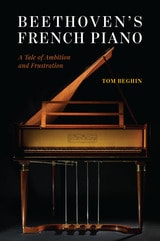
Beethoven's French Piano
A Tale of Ambition and FrustrationTom Beghin
University of Chicago Press, 2022
In 1803 Beethoven acquired a French piano from the Erard Frères workshop in Paris. The composer was “so enchanted with it,” one visitor reported, “that he regards all the pianos made here as rubbish by comparison.” While Beethoven loved its sound, the touch of the French keyboard was much heavier than that of the Viennese pianos he had been used to. Hoping to overcome this drawback, he commissioned a local technician to undertake a series of revisions, with ultimately disappointing results. Beethoven set aside the Erard piano for good in 1810.
Beethoven’s French Piano returns the reader to this period of Beethoven’s enthusiasm for all things French. What traces of the Erard’s presence can be found in piano sonatas like his “Waldstein” and “Appassionata”? To answer this question, Tom Beghin worked with a team of historians and musicians to commission the making of an accurate replica of the Erard piano. As both a scholar and a recording artist, Beghin is uniquely positioned to guide us through this key period of Beethoven’s work. Whether buried in archives, investigating the output of the French pianists who so fascinated Beethoven, or seated at the keyboard of his Erard, Beghin thinks and feels his way into the mind of the composer, bringing startling new insights into some of the best-known piano compositions of all time.
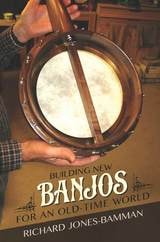
Building New Banjos for an Old-Time World
Richard Jones-Bamman
University of Illinois Press, 2017
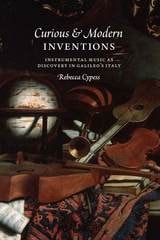
Curious and Modern Inventions
Instrumental Music as Discovery in Galileo's ItalyRebecca Cypess
University of Chicago Press, 2016
Rebecca Cypess shows that early modern thinkers were fascinated with instrumental technologies. The telescope, the clock, the pen, the lute—these were vital instruments for leading thinkers of the age, from Galileo Galilei to Giambattista Marino. No longer used merely to remake an object or repeat a process already known, instruments were increasingly seen as tools for open-ended inquiry that would lead to new knowledge. Engaging with themes from the history of science, literature, and the visual arts, this study reveals the intimate connections between instrumental music and the scientific and artisanal tools that served to mediate between individuals and the world around them.
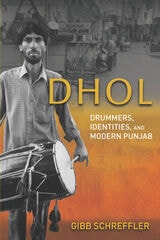
Dhol
Drummers, Identities, and Modern PunjabGibb Schreffler
University of Illinois Press, 2021
Gibb Schreffler draws on two decades of research to investigate dhol's place among the cultural formations within Punjabi communities. Analyzing the identities of musicians, Schreffler illuminates concepts of musical performance, looks at how these concepts help create or articulate Punjabi social structure, and explores identity construction at the intersections of ethnicity, class, and nationality in Punjab and the diaspora. As he shows, understanding the identities of dhol players is an ethical necessity that acknowledges their place in Punjabi cultural history and helps to repair their representation.
An engaging and rich ethnography, Dhol reveals a beloved instrumental form and the musical and social practices of its overlooked performers.
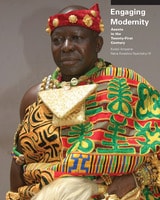
Engaging Modernity
Asante in the Twenty-First CenturyKwasi Ampene. Nana Kwadwo Nyantakyi III
Michigan Publishing Services, 2016
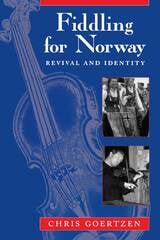
Fiddling for Norway
Revival and IdentityChris Goertzen
University of Chicago Press, 1997
The book begins with an investigation of the people and events important to Norwegian folk fiddling, tracing the history of Norwegian folk music and the growth and diversification of the folk music revival. The narrative takes us to fiddle clubs, concerts and competitions on the local, regional, and national levels, and shows how conflicting emphases—local vs. national identity, tradition vs. aesthetic qualities—continue to transform Norwegian folk music. Goertzen utilizes a large anthology of meticulously transcribed tunes to illustrate personal and regional repertoires, aspects of performance practice, melodic gesture and form, and tune relationships. Ethnomusicologists and readers who fiddle will enjoy both the music and the stories it tells.
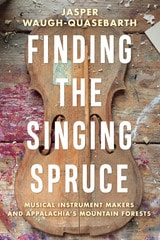
Finding the Singing Spruce
Musical Instrument Makers and Appalachia's Mountain ForestsJasper Waugh-Quasebarth
West Virginia University Press, 2023
Environment, craft, and meaning in the work of Appalachian instrument makers.
How can the craft of musical instrument making help reconnect people to place and reenchant work in Appalachia? How does the sonic search for musical tone change relationships with trees and forests? Following three craftspeople in the mountain forests of Appalachia through their processes of making instruments, Finding the Singing Spruce considers the meanings of work, place, and creative expression in drawing music from wood.
Jasper Waugh-Quasebarth explores the complexities and contradictions of instrument-making labor, which is deeply rooted in mountain forests and expressive traditions but also engaged with global processes of production and consumption. Using historical narratives and sensory ethnography, among other approaches, he finds that the craft of lutherie speaks to the past, present, and future of the region’s work and nature.
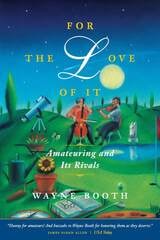
For the Love of It
Amateuring and Its RivalsWayne C. Booth
University of Chicago Press, 1999
"If, in truth, Booth is an amateur player now in his fifth decade of amateuring, he is certainly not an amateur thinker about music and culture. . . . Would that all of us who think and teach and care about music could be so practical and profound at the same time."—Peter Kountz, New York Times Book Review
"[T]his book serves as a running commentary on the nature and depth of this love, and all the connections it has formed in his life. . . . The music, he concludes, has become part of him, and that is worth the price."—Clea Simon, Boston Globe
"The book will be read with delight by every well-meaning amateur who has ever struggled. . . . Even general readers will come away with a valuable lesson for living: Never mind the outcome of a possibly vain pursuit; in the passion that is expended lies the glory."—John von Rhein, Chicago Tribune
"Hooray for amateurs! And huzzahs to Wayne Booth for honoring them as they deserve. For the Love of It celebrates amateurism with genial philosophizing and pointed cultural criticism, as well as with personal reminiscences and self-effacing wit."—James Sloan Allen, USA Today
"Wayne Booth, the prominent American literary critic, has written the only sustained study of the interior experience of musical amateurism in recent years, For the Love of It. [It] succeeds as a meditation on the tension between the centrality of music in Booth's life, both inner and social, and its marginality. . . . It causes the reader to acknowledge the heterogeneity of the pleasures involved in making music; the satisfaction in playing well, the pride one takes in learning a difficult piece or passage or technique, the buzz in one's fingertips and the sense of completeness with the bow when the turn is done just right, the pleasure of playing with others, the comfort of a shared society, the joy of not just hearing, but making, the music, the wonder at the notes lingering in the air."—Times Literary Supplement
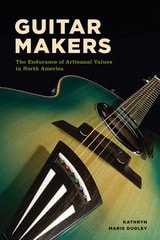
Guitar Makers
The Endurance of Artisanal Values in North AmericaKathryn Marie Dudley
University of Chicago Press, 2014
In Guitar Makers, Kathryn Marie Dudley introduces us to builders of artisanal guitars, their place in the art world, and the specialized knowledge they’ve developed. Drawing on in-depth interviews with members of the lutherie community, she finds that guitar making is a social movement with political implications. Guitars are not simply made—they are born. Artisans listen to their wood, respond to its liveliness, and strive to endow each instrument with an unforgettable tone. Although professional luthiers work within a market society, Dudley observes that their overriding sentiment is passion and love of the craft. Guitar makers are not aiming for quick turnover or the low-cost reproduction of commodities but the creation of singular instruments with unique qualities, and face-to-face transactions between makers, buyers, and dealers are commonplace.
In an era when technological change has pushed skilled artisanship to the margins of the global economy, and in the midst of a capitalist system that places a premium on ever faster and more efficient modes of commerce, Dudley shows us how artisanal guitar makers have carved out a unique world that operates on alternative, more humane, and ecologically sustainable terms.
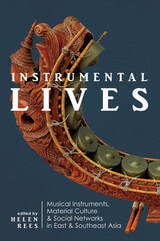
Instrumental Lives
Musical Instruments, Material Culture, and Social Networks in East and Southeast AsiaEdited by Helen Rees
University of Illinois Press, 2024
Original and expert, Instrumental Lives brings a new understanding of how musical instruments interact with their environments and societies. Contributors: Supeena Insee Adler, Marie-Pierre Lissoir, Terauchi Naoko, Jennifer C. Post, Helen Rees, Xiao Mei, Tyler Yamin, and Bell Yung
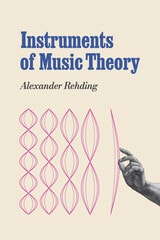
Instruments of Music Theory
Alexander Rehding
University of Chicago Press, 2027
Shows how musical instruments and the sounds they produce are not incidental, but an integral part of music theory.
Many musicians dread music theory: Its rules and diagrams can feel stern and lifeless, far removed from the sounds that make music so thrilling. In this book, Alexander Rehding looks at music theory from a different angle. He argues that the sounds of the instruments on which music theory is demonstrated—starting with the piano in the music classroom—play a much more active role than we usually notice. They are “instruments” in a double sense: musical noisemakers, but also tools in a kind of scientific experiment. Rehding strips these devices down to their sound-generating mechanisms to show us how to read musical instruments for their theoretical content.
Instruments of Music Theory turns our attention to instruments such as multiphonic sirens, tuning forks, Chladni plates, Aeolian harps, and Wheatstone concertinas—these devices generate sounds that call for new ways of listening, measuring, and thinking about music. Bringing together music theory, critical organology, and media theory, this book can be read as a user’s manual for how to put sound back into music theory. Rehding shows us how instruments do not only produce sound—they produce knowledge about music. Through the lens of these new instruments, Instruments of Music Theory recasts fundamental musical ideas such as pitch, harmony, form, and scale from the ground up to give new meaning to the stuff we call music.

Johann Scheibe
Organ Builder in Leipzig at the Time of BachLynn Edwards Butler
University of Illinois Press, 2022
Drawing on extensive research and previously untapped archival materials, Lynn Edwards Butler explores Scheibe's professional relationships and the full range of his projects. These assignments included the three-manual organ for St. Paul’s Church, renovations of the organs in the important churches of St. Thomas and St. Nicholas, and the lone surviving example of Scheibe's craft, a small organ in the nearby village of Zschortau. Viewing Scheibe within the context of the era, Butler illuminates the music scene of Bach's time as she follows the life of a gifted craftsman and his essential work on an instrument that anchored religious musical practice and community.
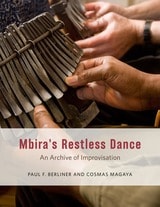
Mbira's Restless Dance
An Archive of ImprovisationPaul F. Berliner and Cosmas Magaya
University of Chicago Press, 2020
Mbira’s Restless Dance is written to be played. This two-volume, spiral-bound set features musical transcriptions of thirty-nine compositions and variations, annotated with the master player’s advice on technique and performance, his notes and observations, and commentary by Berliner. Enhanced with extensive website audiovisuals, Mbira’s Restless Dance is in effect a series of masterclasses with Magaya, suitable for experienced mbira players and those learning the fundamentals.
Together with Berliner's The Art of Mbira, in which he provides an indispensable historical and cultural guide to mbira in a changing world, Mbira's Restless Dance breaks new ground in the depth and specificity of its exploration of an African musical tradition, and in the entwining of the authors’ collaborative voices. It is a testament to the powerful relationship between music and social life—and the rewards of lifelong musical study, performance, and friendship.
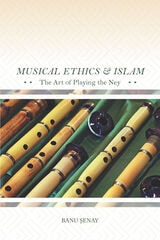
Musical Ethics and Islam
The Art of Playing the NeyBanu Senay
University of Illinois Press, 2020
Banu Şenay documents the years-long training required to become a neyzen—a player of the ney. The process holds a transformative power that invites students to create a new way of living that involves alternative relationships with the self and others, changing perceptions of the city, and a dedication to craftsmanship. Şenay visits reed harvesters and travels from studios to workshops to explore the practical processes of teaching and learning. She also becomes an apprentice ney-player herself, exploring the desire for spirituality that encourages apprentices and masters alike to pursue ney music and its scaffolding of Islamic ethics and belief.
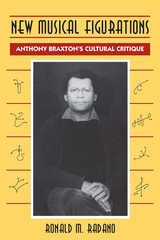
New Musical Figurations
Anthony Braxton's Cultural CritiqueRonald M. Radano
University of Chicago Press, 1993
Born in 1945, Braxton is not only a virtuoso jazz saxophonist but an innovative theoretician and composer of experimental art music. His refusal to conform to the conventions of official musical culture has helped unhinge the very ideologies on which definitions of "jazz," "black music," "popular music," and "art music" are founded.
New Musical Figurations gives the richest view available of this many-sided artist. Radano examines Braxton's early years on the South Side of Chicago, whose vibrant black musical legacy inspired him to explore new avenues of expression. Here is the first detailed history of Braxton's central role in the Association for the Advancement of Creative Musicians, the principal musician-run institution of free jazz in the United States. After leaving Chicago, Braxton was active in Paris and New York, collaborating with Philip Glass, Steve Reich, Frederic Rzewski, and other composers affiliated with the experimental-music movement. From 1974 to 1981, he gained renown as a popular jazz performer and recording artist. Since then he has taught at Mills College and Wesleyan University, given lectures on his theoretical musical system, and written works for chamber groups as well as large, opera-scale pieces.
The neglect of radical, challenging figures like Braxton in standard histories of jazz, Radano argues, mutes the innovative voice of the African-American musical tradition. Refreshingly free of technical jargon, New Musical Figurations is more than just another variation on the same jazz theme. Rather, it is an exploratory work as rich in theoretical vision as it is in historical detail.
On Concepts and Classifications of Musical Instruments
Margaret J. Kartomi
University of Chicago Press, 1990
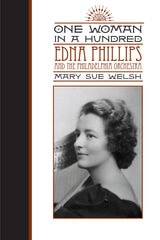
One Woman in a Hundred
Edna Phillips and the Philadelphia OrchestraMary Sue Welsh
University of Illinois Press, 2013
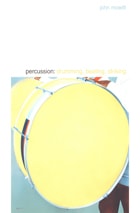
Percussion
Drumming, Beating, StrikingJohn Mowitt
Duke University Press, 2002
For Mowitt, percussion is both an experience of embodiment—making contact in and on the skin—and a provocation for critical theory itself. In delimiting the percussive field, he plays drumming off against the musicological account of the beat, the sociological account of shock and the psychoanalytical account of fantasy. In the process he touches on such topics as the separation of slaves and drums in the era of the slave trade, the migration of rural blacks to urban centers of the North, the practice and politics of "rough music," the links between interpellation and possession, the general strike, beating fantasies, and the concept of the "skin ego."
Percussion makes a fresh and provocative contribution to cultural studies, new musicology, the history of the body and critical race theory. It will be of interest to students of cultural studies and critical theory as well as readers with a serious interest in the history of music, rock-and-roll and drumming.
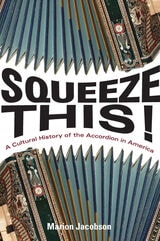
Squeeze This!
A Cultural History of the Accordion in AmericaMarion Jacobson
University of Illinois Press, 2012
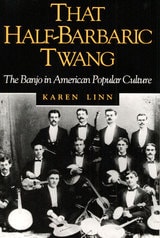
That Half-Barbaric Twang
The Banjo in American Popular CultureKaren Linn
University of Illinois Press, 1991
Long a symbol of American culture, the banjo actually originated in Africa before European-Americans adopted it. Karen Linn shows how the banjo--despite design innovations and several modernizing agendas--has failed to escape its image as a "half-barbaric" instrument symbolic of antimodernism and sentimentalism.
Caught in the morass of American racial attitudes and often used to express ambivalence toward modern industrial society, the banjo stood in opposition to the "official" values of rationalism, modernism, and belief in the beneficence of material progress. Linn uses popular literature, visual arts, advertisements, film, performance practices, instrument construction and decoration, and song lyrics to illustrate how notions about the banjo have changed.
Linn also traces the instrument from its African origins through the 1980s, alternating between themes of urban modernization and rural nostalgia. She examines the banjo fad of bourgeois Northerners during the late nineteenth century; the African-American banjo tradition and the commercially popular cultural image of the southern black banjo player; the banjo's use in ragtime and early jazz; and the image of the white Southerner and mountaineer as banjo player.

The Accordion in the Americas
Klezmer, Polka, Tango, Zydeco, and More!Edited by Helena Simonett
University of Illinois Press, 2012
This rich collection considers the accordion and its myriad forms, from the concertina, button accordion, and piano accordion familiar in European and North American music to the exotic-sounding South American bandoneon and the sanfoninha. Capturing the instrument's spread and adaptation to many different cultures in North and South America, contributors illuminate how the accordion factored into power struggles over aesthetic values between elites and working-class people who often were members of immigrant and/or marginalized ethnic communities. Specific histories and cultural contexts discussed include the accordion in Brazil, Argentine tango, accordion traditions in Colombia and the Dominican Republic, cross-border accordion culture between Mexico and Texas, Cajun and Creole identity, working-class culture near Lake Superior, the virtuoso Italian-American and Klezmer accordions, Native American dance music, and American avant-garde.
Contributors are María Susana Azzi, Egberto Bermúdez, Mark DeWitt, Joshua Horowitz, Sydney Hutchinson, Marion Jacobson, James P. Leary, Megwen Loveless, Richard March, Cathy Ragland, Helena Simonett, Jared Snyder, Janet L. Sturman, and Christine F. Zinni.
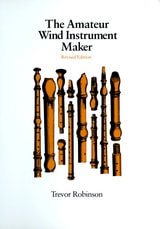
The Amateur Wind Instrument Maker
Trevor Robinson
University of Massachusetts Press, 1980
In The Amateur Wind Instrument Maker, Trevor Robinson provides clear, practical instructions for building a wide variety of wind instruments using materials and tools accessible to the dedicated amateur. Beginning with an introduction to the principles of wind instrument design and the basic woodworking materials required, Robinson proceeds through detailed plans and step-by-step guidance for constructing instruments including flutes and fifes, recorders, clarinets, shawms, and oboes, among others. Each chapter combines historical context with hands-on instruction, offering dimensions, bore specifications, tone hole placement, and finishing techniques that allow the builder to produce genuinely playable instruments.
Compact and accessibly written, the revised edition of The Amateur Wind Instrument Maker remains a foundational reference in the field of amateur instrument building, enabling generations of amateur builders to craft their own instruments, from straightforward projects suitable for beginners to more demanding undertakings for experienced woodworkers.
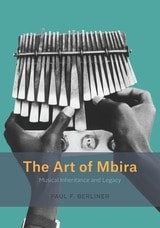
The Art of Mbira
Musical Inheritance and LegacyPaul F. Berliner
University of Chicago Press, 2020
In this book, Berliner provides insight into the communities of study, performance, and worship that surround mbira. He chronicles how master player Cosmas Magaya and his associates have developed their repertory and practices over more than four decades, shaped by musical interaction, social and political dynamics in Zimbabwe, and the global economy of the music industry. At once a detailed exposition of the music’s forms and practices, it is also an indispensable historical and cultural guide to mbira in a changing world.
Together with Berliner and Magaya's compendium of mbira compositions, Mbira’s Restless Dance, The Art of Mbira breaks new ground in the depth and specificity of its exploration of an African musical tradition, and in the entwining of the authors’ collaborative voices. It is a testament to the powerful relationship between music and social life—and the rewards of lifelong musical study, performance, and friendship.
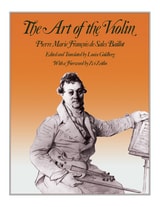
The Art of the Violin
Pierre Marie Francois de Sales Baillot
Northwestern University Press, 1991
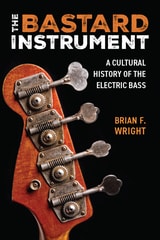
The Bastard Instrument
A Cultural History of the Electric BassBrian F. Wright
University of Michigan Press, 2024
The Devil Is in It
A History of the American Acoustic GuitarJohn Stubbings
University of Texas Press, 2025
The rich history of the acoustic guitar and its impact on the music world.
In 2020, guitar expert John Stubbings released a limited-edition book on the American acoustic guitar that sold out in days. Now, The Devil Is in It returns with additional research and subject matter for a new generation of readers. Stubbings traveled the country and met with guitar makers, players, collectors, and historians to unravel the long and rich history of the acoustic guitar, its evolution, and the music it has made over the last hundred years.
Starting with the eighteenth-century European classical guitar, luthiers altered the instrument, changing the way musicians played them, and in turn the music they made. This slow but steady transformation created the iconic American flat-top that became influential across genres and rooted itself in cultural significance. The guitar developed from an obscure instrument into a superstar of the musical world, rivaling then overshadowing its competition. Tied to artists from Gillian Welch and Tracy Chapman to Taylor Swift and Ed Sheeran, the acoustic guitar maintains its eminence in American music and culture. The story of an alluring instrument that shaped the music of the twentieth century, The Devil Is in It is a must-read for lovers of the acoustic guitar and the music it has made.
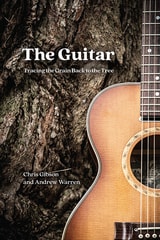
The Guitar
Tracing the Grain Back to the TreeChris Gibson and Andrew Warren
University of Chicago Press, 2021
Guitars inspire cult-like devotion: an aficionado can tell you precisely when and where their favorite instrument was made, the wood it is made from, and that wood’s unique effect on the instrument’s sound. In The Guitar, Chris Gibson and Andrew Warren follow that fascination around the globe as they trace guitars all the way back to the tree. The authors take us to guitar factories, port cities, log booms, remote sawmills, Indigenous lands, and distant rainforests, on a quest for behind-the-scenes stories and insights into how guitars are made, where the much-cherished guitar timbers ultimately come from, and the people and skills that craft those timbers along the way.
Gibson and Warren interview hundreds of people to give us a first-hand account of the ins and outs of production methods, timber milling, and forest custodianship in diverse corners of the world, including the Pacific Northwest, Madagascar, Spain, Brazil, Germany, Japan, China, Hawaii, and Australia. They unlock surprising insights into longer arcs of world history: on the human exploitation of nature, colonialism, industrial capitalism, cultural tensions, and seismic upheavals. But the authors also strike a hopeful note, offering a parable of wider resonance—of the incredible but underappreciated skill and care that goes into growing forests and felling trees, milling timber, and making enchanting musical instruments, set against the human tendency to reform our use (and abuse) of natural resources only when it may be too late. The Guitar promises to resonate with anyone who has ever fallen in love with a guitar.
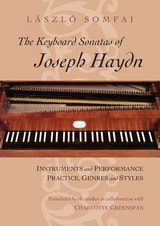
The Keyboard Sonatas of Joseph Haydn
Instruments and Performance Practice, Genres and StylesLászló Somfai
University of Chicago Press, 1995
Laszlo Somfai begins with a thorough study of Haydn's keyboard instruments and their development. After recommending instruments appropriate for modern use, he discusses performance practice and style, explains the peculiarities of Haydn's manuscripts in the context of eighteenth-century notation, and provides specific suggestions for playing ornaments, improvising, slurring, and dynamics. He also investigates Haydn's sonata genres within their historical context and discusses the problems of establishing a chronology of their composition. Finally, Somfai analyzes the organization and style of each musical form. The book includes an index listing the sonatas by date of first publication, and an extensive bibliography.
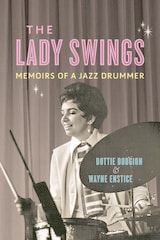
The Lady Swings
Memoirs of a Jazz DrummerDottie Dodgion and Wayne Enstice
University of Illinois Press, 2021
Vivid and always entertaining, The Lady Swings tells Dottie Dodgion's story with the same verve and straight-ahead honesty that powered her playing.
A Variety Best Music Book of 2021

The Organ in Manitoba
A History of the Instruments, the Builders, and the PlayersJames B. Hartman
University of Manitoba Press, 1997

The Organs of J.S. Bach
A HandbookChristoph Wolff and Markus Zepf
University of Illinois Press, 2012
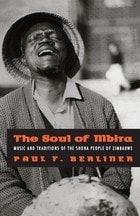
The Soul of Mbira
Music and Traditions of the Shona People of ZimbabwePaul F. Berliner
University of Chicago Press, 1993
"Paul Berliner's The Soul of Mbira is probably the best ethnography ever written about an African musical tradition. It is a complete classic . . . . I know of no other instrument with the range of the mbira, and the book is equal to the instrument."—John Chernoff
"[The Soul of Mbira] illustrates the fact that Shona mbira music in its beauty, subtlety, and virtuosity demands the same kind of respect that we might hold for any other classical music."—David Reck, Parabola
"The book is a model of ethnomusicological thinking and investigation and it suggests a specific way of approaching a complex socio-musical system."—John Baily, Popular Music
"When next someone asks 'What is ethnomusicology?' or 'What do ethnomusicologists do?' I shall suggest this book. . . . This is a landmark in ethnomusicological literature. Berliner succeeds in conveying both the joy that goes with mbira playing and the mystic relationship between the player and his instrument. In short, this is humanized ethnomusicology."—K.A. Gourlay, Ethnomusicology
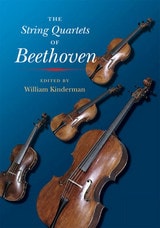
The String Quartets of Beethoven
Edited by William Kinderman
University of Illinois Press, 2020
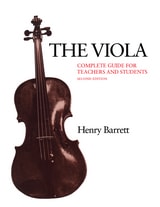
The Viola
Complete Guide for Teachers and StudentsBetsy Mason Barrett
University of Alabama Press, 1996
The second edition is extensively expanded in its graded lists of studies and solos
This book, in its encyclopedic catalog of viola literature in print, and (perhaps most important) in its treatment of the musical and pedagogical aspects of teaching the viola. A work already unique has been augmented in all its major aspects. The excerpts that follow are from reviews of the out-of-print first edition.
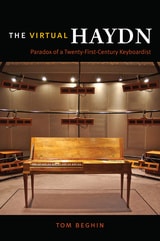
The Virtual Haydn
Paradox of a Twenty-First-Century KeyboardistTom Beghin
University of Chicago Press, 2015
With The Virtual Haydn, Tom Beghin—himself a professional keyboard player—delves deeply into eighteenth-century history and musicology to help us hear a properly complex Haydn. Unusually for a scholarly work, the book is presented in the first person, as Beghin takes us on what is clearly a very personal journey into the past. When a discussion of a group of Viennese sonatas, for example, leads him into an analysis of the contemporary interest in physiognomy, Beghin applies what he learns about the role of facial expressions during his own performance of the music. Elsewhere, he analyzes gesture and gender, changes in keyboard technology, and the role of amateurs in eighteenth-century musical culture.
The resulting book is itself a fascinating, bravura performance, one that partakes of eighteenth-century idiosyncrasy while drawing on a panoply of twenty-first-century knowledge.
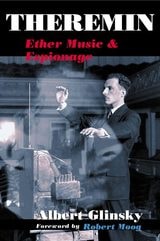
Theremin
Ether Music and EspionageAlbert Glinsky
University of Illinois Press, 2000
A creative genius and prolific inventor, Leon Theremin almost single-handedly launched the field of electronic music in 1920. The theremin--the only musical instrument that is played without being touched--created a sensation worldwide and paved the way for the modern synthesizer. But the otherworldly sound that entranced millions was only part of Theremin's epic life.
As a Soviet scientist, Theremin surrendered his life and work to the service of State espionage. On assignment in Depression-era America, he worked the engines of capitalist commerce while passing data on US industrial technology to the Soviet apparat. Following his sudden disappearance in 1938, Theremin vanished into the top-secret Soviet intelligence machine and was presumed dead for nearly thirty years. Using the same technology that spawned the theremin, he designed bugging devices and a host of other electronic wonders, including an early television and multimedia devices that anticipated performance art and virtual reality by decades.
Albert Glinsky's biography places the inventor at world events stretching from the Russian Revolution through the Cold War to perestroika. Throughout, he spins whimsy and treachery into an astonishing drama of one man's hidden loyalties, mixed motivations, and irrepressibly creative spirit.
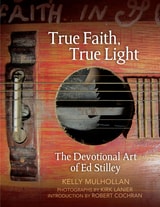
True Faith, True Light
The Devotional Art of Ed StilleyKelly Mulhollan
University of Arkansas Press, 2015
But one day Ed’s life was permanently altered. While plowing his field, he became convinced he was having a heart attack. Ed stopped his work and lay down on the ground. Staring at the sky, he saw himself as a large tortoise struggling to swim across a river. On his back were five small tortoises—his children—clinging to him for survival. And then, as he lay there in the freshly plowed dirt, Ed received a vision from God, telling him that he would be restored to health if he would agree to do one thing: make musical instruments and give them to children.
And so he did. Beginning with a few simple hand tools, Ed worked tirelessly for twenty-five years to create over two hundred instruments, each a crazy quilt of heavy, rough-sawn wood scraps joined with found objects. A rusty door hinge, a steak bone, a stack of dimes, springs, saw blades, pot lids, metal pipes, glass bottles, aerosol cans—Ed used anything he could to build a working guitar, fiddle, or dulcimer. On each instrument Ed inscribed “True Faith, True Light, Have Faith in God.”
True Faith, True Light: The Devotional Art of Ed Stilley documents Ed Stilley’s life and work, giving us a glimpse into a singular life of austere devotion.
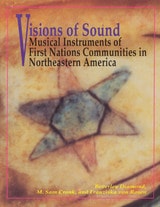
Visions of Sound
Musical Instruments of First Nation Communities in Northeastern AmericaBeverley Diamond, M. Sam Cronk, and Franziska von Rosen
University of Chicago Press, 1995
Featuring over two hundred photographs of instruments, dialogues among the coauthors, numerous interviews with individual music makers, and an appended catalogue of over seven hundred instrument descriptions, this is an important book for all ethnomusicologists and students of Native American culture as well as general readers interested in Native American mythology and religious life.
Wherever the Sound Takes You
Heroics and Heartbreak in Music MakingDavid Rowell
University of Chicago Press, 2019
This wide-ranging and openhearted book blossoms outward from there. Rowell visits clubs, concert halls, street corners, and open mics, traveling from the Rock and Roll Hall of Fame in Cleveland to a death metal festival in Maryland, with stops along the way in the Swiss Alps and Appalachia. His keen reportorial eye treats us to in-depth portraits of musicians from platinum-selling legend Peter Frampton to a devout Christian who spends his days alone in a storage unit bashing away on one of the largest drum sets in the world. Rowell illuminates the feelings that both spur music’s creation and emerge from its performance, as well as the physical instruments that enables their expression. With an uncommon sensitivity and grace, he charts the pleasure and pain of musicians consumed with what they do—as all of us listen in.