Results by title

10 books match the query 'Muslim'
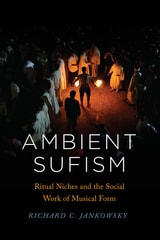
cover of Ambient Sufism: Ritual Niches and the Social Work of Musical Form

Ambient Sufism

Ritual Niches and the Social Work of Musical Form

Richard C. Jankowsky

University of Chicago Press, 2021
Ambient Sufism is a study of the intertwined musical lives of several ritual communities in Tunisia that invoke the healing powers of long-deceased Muslim saints through music-driven trance rituals. Richard C. Jankowsky illuminates the virtually undocumented role of women and minorities in shaping the ritual musical landscape of the region, with case studies on men’s and women’s Sufi orders, Jewish and black Tunisian healing musical troupes, and the popular music of hard-drinking laborers, as well as the cohorts involved in mass-mediated staged spectacles of ritual that continue to inject ritual sounds into the public sphere. He uses the term “ambient Sufism” to illuminate these adjacent ritual practices, each serving as a musical, social, and devotional-therapeutic niche while contributing to a larger, shared ecology of practices surrounding and invoking the figures of saints. And he argues that ritual musical form—that is, the large-scale structuring of ritual through musical organization—has agency; that is, form is revealing and constitutive of experience and encourages particular subjectivities. Ambient Sufism promises many useful ideas for ethnomusicology, anthropology, Islamic and religious studies, and North African studies. 
[more]
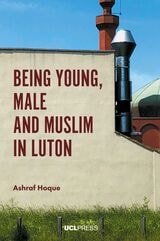
cover of Being Young, Male and Muslim in Luton

Being Young, Male and Muslim in Luton

Ashraf Hoque

University College London, 2018

What is it like to be a young Muslim man in the wake of the 2005 London bombings? What impact do political factors have on the multifaceted identities of young Muslim men?

Drawn from the author’s ethnographic research of British-born Muslim men in the English town of Luton, Being Young, Muslim and Male in Luton explores the everyday lives of young men and, focusing on how their identity as Muslims has shaped the way they interact with each other, the local community, and the wider world. Through a study of religious values, the pressures of masculinity, the complexities of family and social life, and attitudes towards work and leisure, Ashraf Hoque argues that young Muslims in Luton are subverting what it means to be “British” by consciously prioritizing and rearticulating their “Muslim identities” in novel and dynamic ways that suit their experiences. Employing rich interviews and extensive participant observation, Hoque paints a detailed picture of young Muslims living in a town consistently associated in the popular media with terrorist activity and as a hotbed for radicalization. He challenges widely held assumptions and gives voice to an emerging generation of Muslims who view Britain as their home and are very much invested in the long-term future of the country and their permanent place within it.

[more]
cover of Cultural Processes in Muslim and Arab Societies: Medieval and Early Modern Periods, Volume 14

Cultural Processes in Muslim and Arab Societies

Medieval and Early Modern Periods, Volume 14

Israel Gershoni and Ehud R. Toledano, eds.

Duke University Press, 0

This is the first installment of a series that grew out of the December 1991 Workshop on Cultural Processes in Muslim and Arab Societies held in Tel Aviv and Jerusalem. The issues employ cultural studies, anthropology, and literary theory to explore various aspects of Middle-Eastern history. Articles examine nationalism, the divisions between elite and popular culture, religious identity, gender, class formation, and the structures of political power.
[more]
cover of Cultural Processes in Muslim and Arab Societies: Modern Period I, Volume 14

Cultural Processes in Muslim and Arab Societies

Modern Period I, Volume 14

Israel Gershoni and Ehud R. Toledano, eds.

Duke University Press, 0

This is the second installment of a series that grew out of the December 1991 Workshop on Cultural Processes in Muslim and Arab Societies held in Tel Aviv and Jerusalem. The issues employ cultural studies, anthropology, and literary theory to explore various aspects of Middle-Eastern history. Articles examine nationalism, the divisions between elite and popular culture, religious identity, gender, class formation, and the structures of political power.
[more]
cover of Cultural Processes in Muslim and Arab Societies: Modern Period II, Volume 15

Cultural Processes in Muslim and Arab Societies

Modern Period II, Volume 15

Israel Gershoni and Ehud R. Toledano, eds.

Duke University Press, 0

This is the third installment of a series that grew out of the December 1991 Workshop on Cultural Processes in Muslim and Arab Societies held in Tel Aviv and Jerusalem. The issues employ cultural studies, anthropology, and literary theory to explore various aspects of Middle-Eastern history. Articles examine nationalism, the divisions between elite and popular culture, religious identity, gender, class formation, and the structures of political power.
[more]
cover of Death and the Dervish

Death and the Dervish

Mesa Selimovic

Northwestern University Press, 1996

Death and the Dervish is an acclaimed novel by Bosnian writer Mesa Selimovic. It recounts the story of Sheikh Nuruddin, a dervish residing in an Islamic monastery in Sarajevo in the eighteenth century during the Ottoman Turk hegemony over the Balkans. When his brother is arrested, he must descend into the Kafkaesque world of the Ottoman authorities in his search to discover what happened to him. He narrates his story in the form of an elaborate suicide note, regularly misquoting the Koran. In time, he begins to question his relations with society as a whole and, eventually, his life choices in general.

Hugely successful when published in the 1960s, Death and the Dervish is an enduring classic made into a feature length film in 1974.
[more]
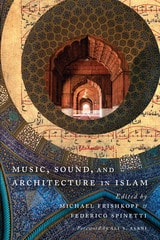
cover of Music, Sound, and Architecture in Islam

Music, Sound, and Architecture in Islam

Edited by Michael Frishkopf and Federico Spinetti

University of Texas Press, 2018

Tracing the connections between music making and built space in both historical and contemporary times, Music, Sound, and Architecture in Islam brings together domains of intellectual reflection that have rarely been in dialogue to promote a greater understanding of the centrality of sound production in constructed environments in Muslim religious and cultural expression.

Representing the fields of ethnomusicology, anthropology, art history, architecture, history of architecture, religious studies, and Islamic studies, the volume’s contributors consider sonic performances ranging from poetry recitation to art, folk, popular, and ritual musics—as well as religious expressions that are not usually labeled as “music” from an Islamic perspective—in relation to monumental, vernacular, ephemeral, and landscape architectures; interior design; decoration and furniture; urban planning; and geography. Underscoring the intimate relationship between traditional Muslim sonic performances, such as the recitation of the Qur’an or devotional songs, and conventional Muslim architectural spaces, from mosques and Sufi shrines to historic aristocratic villas, gardens, and gymnasiums, the book reveals Islam as an ideal site for investigating the relationship between sound and architecture, which in turn proves to be an innovative and significant angle from which to explore Muslim cultures.
[more]
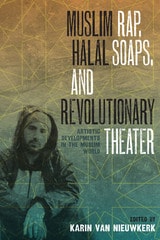
cover of Muslim Rap, Halal Soaps, and Revolutionary Theater: Artistic Developments in the Muslim World

Muslim Rap, Halal Soaps, and Revolutionary Theater

Artistic Developments in the Muslim World

Edited by Karin van Nieuwkerk

University of Texas Press, 2011

From "green" pop and "clean" cinema to halal songs, Islamic soaps, Muslim rap, Islamist fantasy serials, and Suficized music, the performing arts have become popular and potent avenues for Islamic piety movements, politically engaged Islamists, Islamic states, and moderate believers to propagate their religio-ethical beliefs. Muslim Rap, Halal Soaps, and Revolutionary Theater is the first book that explores this vital intersection between artistic production and Islamic discourse in the Muslim world.

The contributors to this volume investigate the historical and structural conditions that impede or facilitate the emergence of a "post-Islamist" cultural sphere. They discuss the development of religious sensibilities among audiences, which increasingly include the well-to-do and the educated young, as well as the emergence of a local and global religious market. At the heart of these essays is an examination of the intersection between cultural politics, performing art, and religion, addressing such questions as where, how, and why pop culture and performing arts have been turned into a religious mission, and whether it is possible to develop a new Islamic aesthetic that is balanced with religious sensibilities. As we read about young Muslims and their quest for a "cool Islam" in music, their struggle to quell their stigmatized status, or the collision of morals and the marketplace in the arts, a vivid, varied new perspective on Muslim culture emerges.
[more]
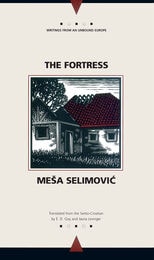
cover of The Fortress: A Novel

The Fortress

A Novel

Mesa Selimovic, translated from the Serbian by Edward Dennis Goy and Jasna Levinger-Goy

Northwestern University Press, 1999

The Fortress is one of the most significant and fascinating novels to come out of the former Yugoslavia. Published as Tvrđava in Serbian, it is the tenth and among the best-known novels by Mesa Selimovic (1910–1982). In the novel, Ahmet Shabo returns home to seventeenth-century Sarajevo from the war in Russia, numbed by the death in battle or suicide of nearly his entire military unit. In time he overcomes the anguish of war, only to find that he has emerged a reflective and contemplative man in a society that does not value, and will not tolerate, the subversive implications of these qualities.

Set in Bosnia in the late 1700s, the novel sometimes functions as an artful metaphor for the communist Yugoslavia of Selimovic's day. At other times, the author explores the nuances of Ottoman rule in the Balkans. Muslim Ahmet's sustaining marriage to a young Christian woman provides a multicultural tension that strongly resonates with contemporary readers and sensibilities.
[more]
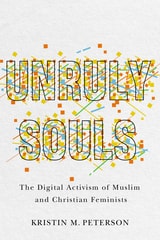
cover of Unruly Souls: The Digital Activism of Muslim and Christian Feminists

Unruly Souls

The Digital Activism of Muslim and Christian Feminists

Kristin M. Peterson

Rutgers University Press, 2022

Amid growing digital activism to address gender-based violence, institutional racism, and homophobia in U.S. society, Unruly Souls explores the intersectional feminist activism among young people within Islam and Evangelical Christianity. These religious misfits—marginalized from traditional religious spaces due to their sexuality, gender, or race—employ the creative tactics of digital media in their work to seek justice and to display their fundamental equality in the eyes of God. Through an analysis of various digital projects from hip-hop music videos and Instagram accounts to Twitter hashtags and podcasts, Kristin Peterson argues that the hybrid, flexible, playful, and sensory nature of digital media facilitate intersectional feminist activism within and beyond religious communities. Drawing on work from queer theory, decolonial theory, and Black feminist theory, this study explores how those who have been marginalized are able to effectively deploy their disregarded status along with digital media tactics to cultivate empathetic communities for those recovering from religious trauma.
 
[more]