Results by title
5 books match the query 'Muslim pilgrims and pilgrimages'
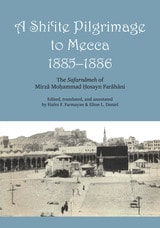
A Shi'ite Pilgrimage to Mecca, 1885-1886
The Safarnâmeh of Mirzâ Mo?ammad ?osayn FarâhâniBy Mirzâ Farâhâni
University of Texas Press, 1990
Western accounts of the Hajj, the ritual Muslim pilgrimage to Mecca, are rare, since access to Mecca is forbidden to non-Muslims. In the Muslim world, however, pilgrimage literature is a well-established genre, dating back to the earliest centuries of the Islamic era. A Shiʿite Pilgrimage to Mecca is taken from the original nineteenth-century Persian manuscript of the Safarnâmeh of Mirzâ Moḥammad Ḥosayn Farâhâni, a well-educated, keenly observant, Iranian Shiʿite gentleman.
This memoir holds a wealth of social and economic information about Czarist Russia, the Ottoman Empire, Egypt, Northern Iran, and Arabia. The author is a meticulous observer, recording details of distances, currencies, accommodations, modes of travel, and so on. He records the experiences encountered by pilgrims of his day: physical hardships, disease, generosity and compassion, banditry, hospitality, comradeship, and exaltation. And, without prejudice, he discusses the tensions between the Shiʿites and the Sunnites in the holy places—tensions that still exist and have erupted in bloody clashes during recent pilgrimages.
A Shiʿite Pilgrimage to Mecca will appeal to a wide audience of general readers, Middle Eastern scholars, anthropologists, and historians.
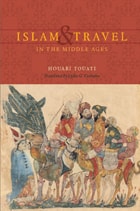
Islam and Travel in the Middle Ages
Houari Touati
University of Chicago Press, 2010
In the Middle Ages, Muslim travelers embarked on a rihla, or world tour, as surveyors, emissaries, and educators. On these journeys, voyagers not only interacted with foreign cultures—touring Greek civilization, exploring the Middle East and North Africa, and seeing parts of Europe—they also established both philosophical and geographic boundaries between the faithful and the heathen. These voyages thus gave the Islamic world, which at the time extended from the Maghreb to the Indus Valley, a coherent identity.
Islam and Travel in the Middle Ages assesses both the religious and philosophical aspects of travel, as well as the economic and cultural conditions that made the rihla possible. Houari Touati tracks the compilers of the hadith who culled oral traditions linked to the prophet, the linguists and lexicologists who journeyed to the desert to learn Bedouin Arabic, the geographers who mapped the Muslim world, and the students who ventured to study with holy men and scholars. Travel, with its costs, discomforts, and dangers, emerges in this study as both a means of spiritual growth and a metaphor for progress. Touati’s book will interest a broad range of scholars in history, literature, and anthropology.
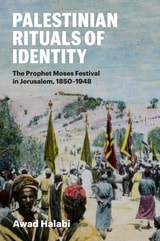
Palestinian Rituals of Identity
The Prophet Moses Festival in Jerusalem, 1850-1948Awad Halabi
University of Texas Press, 2023
Members of Palestine’s Muslim community have long honored al-Nabi Musa, or the Prophet Moses. Since the thirteenth century, they have celebrated at a shrine near Jericho believed to be the location of Moses’s tomb; in the mid-nineteenth century, they organized a civic festival in Jerusalem to honor this prophet. Considered one of the most important occasions for Muslim pilgrims in Palestine, the Prophet Moses festival yearly attracted thousands of people who assembled to pray, conduct mystical forms of worship, and hold folk celebrations.
Palestinian Rituals of Identity takes an innovative approach to the study of Palestine’s modern history by focusing on the Prophet Moses festival from the late Ottoman period through the era of British rule. Halabi explores how the festival served as an arena of competing discourses, with various social groups attempting to control its symbols. Tackling questions about modernity, colonialism, gender relations, and identity, Halabi recounts how peasants, Bedouins, rural women, and Sufis sought to influence the festival even as Ottoman authorities, British colonists, Muslim clerics, and Palestinian national leaders did the same. Drawing on extensive research in Arabic newspapers and Islamic and colonial archives, Halabi reveals how the festival has encapsulated Palestinians’ responses to modernity, colonialism, and the nation’s growing national identity.
Queer Companions
Religion, Public Intimacy, and Saintly Affects in PakistanOmar Kasmani
Duke University Press, 2022
The Medieval and Ottoman Hajj Route in Jordan
An Archaeological and Historical StudyA. Petersen
Council for British Research in the Levant, 2012