Results by title
13 books match the query 'Myth in literature'
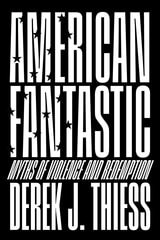
American Fantastic
Myths of Violence and RedemptionDerek J. Thiess
University of Wisconsin Press, 2025
Thiess’s interdisciplinary study examines America’s past and present imperial projects, from the Hawaiian Islands to the Eastern Seaboard, as they proliferate in popular story forms. By interrogating American myths, legends, and fantastic narratives across an impressive array of genres, including folk narratives, science fiction, movies, and more, Thiess exposes how the “myth of redemptive violence” manifests in contemporary constructions of America’s fantastic imaginaries.
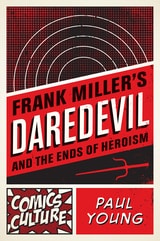
Frank Miller's Daredevil and the Ends of Heroism
Young, Paul
Rutgers University Press, 2016
In the late 1970s and early 1980s, writer-artist Frank Miller turned Daredevil from a tepid-selling comic into an industry-wide success story, doubling its sales within three years. Lawyer by day and costumed vigilante by night, the character of Daredevil was the perfect vehicle for the explorations of heroic ideals and violence that would come to define Miller’s work.
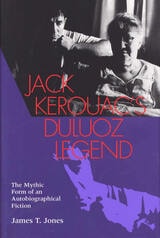
Jack Kerouac's Duluoz Legend
The Mythic Form of an Autobiographical FictionJames T. Jones
Southern Illinois University Press, 1999
In the only critical examination of all of Jack Kerouac's published prose, James T. Jones turns to Freud to show how the great Beat writer used the Oedipus myth to shape not only his individual works but also the entire body of his writing.
Like Balzac, Jones explains, Kerouac conceived an overall plan for his total writing corpus, which he called the Duluoz Legend after Jack Duluoz, his fictional alter ego. While Kerouac's work attracts biographical treatment—the ninth full-length biography was published in 1998—Jones takes a Freudian approach to focus on the form of the work. Noting that even casual readers recognize family relationships as the basis for Kerouac's autobiographical prose, Jones discusses these relationships in terms of Freud's notion of the Oedipus complex.
After establishing the basic biographical facts and explaining Freud's application of the Oedipus myth, Jones explicates Kerouac's novels of childhood and adolescence, focusing on sibling rivalry. Supporting his contention that the Beat writer worked according to a plan, Jones then shows how Kerouac revised The Town and the City (1950), his first published novel, in Vanity of Duluoz, the last novel published in his lifetime, to de-emphasize the death of the father. He treats three versions of Kerouac's road novel—including On the Road—as versions of Oedipus's fateful journey from Corinth to Thebes. And he argues that Pic, often considered peripheral to the Duluoz Legend, replicates the Oedipal themes.
Jones demonstrates that Maggie Cassidy, The Subterraneans, and Tristessa share a form that results from Kerouac's unresolved rivalry with his father for the love of his mother. He discusses Kerouac's replacement of the destructive brother figures in On the Road and Visions of Cody with the constructive hero of The Dharma Bums. He also shows how the Oedipal structure of the Duluoz Legend applies to Kerouac's nonfiction.
In the penultimate chapter, Jones explains how Big Sur, Kerouac's story of his alcohol-induced nervous breakdown, actually marks the climax of the Duluoz Legend. The alcoholism, Jones insists, is not the cause but a symptom of a breakdown brought on by his attachment to his mother. He shows how Kerouac's obsession with his family repeats Oedipal themes throughout the Duluoz Legend. Finally, he deals with Oedipal themes in Kerouac's nonnarrative work, including Old Angel Midnight, Some of the Dharma, The Scripture of the Golden Eternity, and several poems.

Jakobsonian Poetics and Slavic Narrative
From Pushkin to SolzhenitsynKrystyna Pomorska
Duke University Press, 1992
Forming an intellectual and methodological whole, these essays reveal Pomorska's commitment to the principles of Jakobsonian poetics, her consistent application of these basic theoretical concepts to the analysis of literary works, and her interest in the foundations and history of literary criticism. Pomorska explores problems in both poetics (of prose as well as poetry) and literary theory, especially the relationship between biography and myth.
In Krystyna Pomorska, structuralism found a most able practitioner, and Jakobson's oeuvre an authoritative exponent and interpreter. Her volume, a guidebook to a major strain in modern criticism, will be of great interest to a broad audience of literary theorists and students of Slavic literatures and literature in general.

Moorings and Metaphors
Figures of Culture and Gender in Black Women's LiteratureKarla F. Holloway
Rutgers University Press, 1991
Proceeding from a consideration of the imaginative textual languages of contemporary African-American and West African writers, Holloway asserts the intertextuality of black women's literature across two continents. She argues the subtext of culture as the source of metaphor and language, analyzes narrative structures and linguistic processes, and develops a combined theoretical/critical apparatus and vocabulary for interpreting these writers' works. The cultural sources and spiritual considerations that inhere in these textual languages are discussed within the framework Holloway employs of patterns of revision, (re)membrance, and recursion--all of which are vehicles for expressive modes inscribed at the narrative level. Her critical reading of contemporary black women's writing in the United States and West Africa is unique, radical, and sure to be controversial.
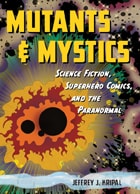
Mutants and Mystics
Science Fiction, Superhero Comics, and the ParanormalJeffrey J. Kripal
University of Chicago Press, 2011
But that's just scratching the surface, says Jeffrey Kripal. In Mutants and Mystics, Kripal offers a brilliantly insightful account of how comic book heroes have helped their creators and fans alike explore and express a wealth of paranormal experiences ignored by mainstream science. Delving deeply into the work of major figures in the field—from Jack Kirby’s cosmic superhero sagas and Philip K. Dick’s futuristic head-trips to Alan Moore’s sex magic and Whitley Strieber’s communion with visitors—Kripal shows how creators turned to science fiction to convey the reality of the inexplicable and the paranormal they experienced in their lives. Expanded consciousness found its language in the metaphors of sci-fi—incredible powers, unprecedented mutations, time-loops and vast intergalactic intelligences—and the deeper influences of mythology and religion that these in turn drew from; the wildly creative work that followed caught the imaginations of millions. Moving deftly from Cold War science and Fredric Wertham's anticomics crusade to gnostic revelation and alien abduction, Kripal spins out a hidden history of American culture, rich with mythical themes and shot through with an awareness that there are other realities far beyond our everyday understanding.
A bravura performance, beautifully illustrated in full color throughout and brimming over with incredible personal stories, Mutants and Mystics is that rarest of things: a book that is guaranteed to broaden—and maybe even blow—your mind.
Myth and Archive
A Theory of Latin American NarrativeRoberto González-Echevarría
Duke University Press, 1998
Providing ways to link literary and nonliterary narratives, González Echevarría examines a variety of archival writings—from the chronicles of the discovery and conquest of the New World to scientific travel narratives and records of criminal confessions—and explores the relationship of these writings to novels by authors such as García Márquez, Borges, Barnet, Sarmiento, Carpentier, and Garcilaso de la Vega. Moving beyond demonstrating that early forms of creative narrative had their geneses in the sixteenth-century authoritative discourse of the Spanish Empire, González Echevarría shows how this same originating process has been repeated in other key moments in the history of the Latin American narrative. He shows how the discourse of scientific discovery was the model for much nineteenth-century literature, as well as how anthropological writings on the nature of language and myth have come to shape the ideology and form of literature in the twentieth century. This most recent form of Latin American narrative creates its own mythic form through an atavistic return to its legal origins—the archive.
This acclaimed book—originally published in 1990—will be of continuing interest to historians, anthropologists, literary theorists, and students of Latin American culture.
Myth and Identity in the Epic of Imperial Spain
Elizabeth B. Davis
University of Missouri Press, 2026
The first in-depth analysis of some of the most important epic poems of the Spanish Golden Age, Myth and Identity in the Epic of Imperial Spain breathes new life into five of these long- neglected texts. Elizabeth Davis demonstrates that the epic must not be overlooked, for doing so creates a significant gap in one's ability to appraise not only the cultural practice of the imperial age, but also the purest expression of its ideology.
Davis's study focuses on heroic poetry written from 1569 to 1611, including Alonso de Ercilla's La Araucana, undeniably the most significant epic poem of its time. Also included are Diego de Hojeda's La Christiada, Juan Rufo's La Austriada,. Lope de Vega's Jerusalén Conquistada, and Cristóbal de Virués's Historia del Monserrate.
Examining these epics as the major site for the construction of cultural identities and Renaissance nationalist myths, Davis analyzes the means by which the epic constructs a Spanish sense of self. Because this sense of identity is not easily susceptible to direct representation, it is often derived in opposition to an "other," which serves to reaffirm Spanish cultural superiority. The Spanish Christian caballeros are almost always pitted against Amerindians, Muslims, Jews, or other adversaries portrayed as backward or heathen for their cultural and ethnic differences.
The pro-Castilian elite of sixteenth-century Spain faced the daunting task of constructing unity at home in the process of expansion and conquest abroad, yet ethnic and regional differences in the Iberian Peninsula made the creation of an imperial identity particularly difficult. The epic, as Davis shows, strains to convey the overriding image of a Spain that appears more unified than the Spanish empire ever truly was.
An important reexamination of the Golden Age canon, Myth and Identity in the Epic of Imperial Spain brings a new twist to the study of canon formation. While Davis does not ignore more traditional approaches to the literary text, she does apply recent theories, such as deconstruction and feminist criticism, to these poems, resulting in an innovative examination of the material.
Confronting such issues as canonicity, gender, the relationship between literature and Golden Age culture, and that between art and power, this publication offers scholars a new perspective for assessing Golden Age and Transatlantic studies.
Ritual, Myth, and Mysticism in the Work of Mary Butts
Between Feminism and ModernismFOY ROSLYN
University of Arkansas Press, 2000

Through the Open Door
A New Look at C.S. LewisDabney Adams Hart
University of Alabama Press, 1984
Unlocking the imagination, language, and vision that shaped C. S. Lewis's enduring legacy.
Through the Open Door: A New Look at C. S. Lewis offers a fresh and illuminating examination of one of the twentieth century's most beloved writers, scholars, and Christian thinkers. In this insightful study, Dabney Adams Hart moves beyond familiar assessments of C. S. Lewis as the creator of The Chronicles of Narnia to explore the intellectual foundations that shaped his work as a literary critic, educator, and defender of the Christian faith. Drawing on Lewis's essays, criticism, fiction, and apologetic writings, Hart reveals the central importance of imagination, language, myth, and meaning in Lewis's understanding of literature and human experience.
Rather than treating Lewis's diverse writings as separate endeavors, Hart demonstrates how they reflect a coherent and unified vision of truth, beauty, and morality. The book shows how Lewis used story and symbolism to address enduring questions about faith, reason, and the search for purpose in a modern world. Accessible to general readers while engaging for scholars, this volume provides valuable insight into the ideas that continue to make Lewis a significant figure in literary and religious studies. An important contribution to Lewis scholarship, Through the Open Door invites readers to discover anew the imagination and intellect behind one of the most influential Christian authors of the modern era.
Transfiguring America
Myth, Ideology, and Mourning in Margaret Fuller's WritingJeffrey Steele
University of Missouri Press, 2001
Transfiguring America is the product of more than ten years of research and numerous published articles on Margaret Fuller, arguably America's first feminist theorist and one of the most important woman writers in the nineteenth century. Focusing on Fuller's development of a powerful language that paired cultural critique with mythmaking, Steele shows why her writing had such a vital impact on the woman's rights movement and modern conceptions of gender.
This groundbreaking study pays special attention to the ways in which Fuller's feminist consciousness and social theory emerged out of her mourning for herself and others, her dialogue with Emersonian Transcendentalism, and her eclectic reading in occult and mythical sources. Transfiguring America is the first book to provide detailed analyses of all of Fuller's major texts, including her mystical Dial essays, correspondence with Emerson, Summer on the Lakes, 1844 poetry, Woman in the Nineteenth Century, and New York Tribune essays written both in New York and Europe.
Starting from her own profound sense of loss as a marginalized woman, Fuller eventually recognized the ways in which the foundational myths of American society, buttressed by conservative religious ideologies, replicated dysfunctional images of manhood and womanhood. With Woman in the Nineteenth Century, after exploring the roots of oppression in her essays and poetry, Fuller advanced the cause of woman's rights by conceptualizing a more fluid and equitable model of gender founded upon the mythical reconfiguration of human potential. But as her horizons expanded, Fuller demanded not only political equality for women, but also emotional, intellectual, and spiritual freedom for all victims of social oppression.
By the end of her career, Steele shows, Fuller had blended personal experience and cultural critique into the imaginative reconstruction of American society. Beginning with a fervent belief in personal reform, she ended her career with the apocalyptic conviction that the dominant myths both of selfhood and national identity must be transfigured. Out of the ashes of personal turmoil and political revolution, she looked for the phoenix of a revitalized society founded upon the ideal of political justice.
Virginia Woolf’s Mythic Method
Amy C. Smith
The Ohio State University Press, 2022
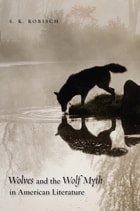
Wolves and the Wolf Myth in American Literature
S.K. Robisch
University of Nevada Press, 2009
The wolf is one of the most widely distributed canid species, historically ranging throughout most of the Northern Hemisphere. For millennia, it has also been one of the most pervasive images in human mythology, art, and psychology. Wolves and the Wolf Myth in American Literature examines the wolf’s importance as a figure in literature from the perspectives of both the animal’s physical reality and the ways in which writers imagine and portray it. Author S. K. Robisch examines more than two hundred texts written in North America about wolves or including them as central figures. From this foundation, he demonstrates the wolf’s role as an archetype in the collective unconscious, its importance in our national culture, and its ecological value. Robisch takes a multidisciplinary approach to his study, employing a broad range of sources: myths and legends from around the world; symbology; classic and popular literature; films; the work of scientists in a number of disciplines; human psychology; and field work conducted by himself and others. By combining the fundamentals of scientific study with close readings of wide-ranging literary texts, Robisch astutely analyzes the correlation between actual, living wolves and their representation on the page and in the human mind. He also considers the relationship between literary art and the natural world, and argues for a new approach to literary study, an ecocriticism that moves beyond anthropocentrism to examine the complicated relationship between humans and nature.