Results by title
3 books match the query 'Nair, Janaki'
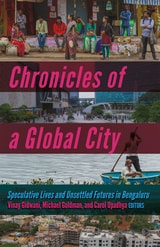
Chronicles of a Global City
Speculative Lives and Unsettled Futures in BengaluruVinay Gidwani
University of Minnesota Press, 2024
Tracking Bengaluru’s dramatic urban transformation through the entanglements of finance, land frenzy, real estate volatility, and livelihood upheavals
Over the past two decades, Bengaluru’s exploding real estate sector and massive infrastructure investments have led to land speculation targeting working-class neighborhoods and agricultural land for development. Chronicles of a Global City turns Bengaluru inside out to examine its “world-city” transformation that stimulated rapid urbanization and unbounded growth. Moving the spotlight away from the urban elites and “new middle class,” this book explores how people caught up in the whirlwinds of change in Bengaluru—from construction laborers, street vendors, domestic workers, and platform delivery workers to small-time property brokers, petty landlords, and local politicians—experience, struggle, aspire, invent, strive, and speculate to make a livable city for themselves.
Grounded in long-term ethnographic research and activist experiences, Chronicles of a Global City vividly illuminates the multifaceted entanglements of finance capital, real estate markets, livelihood struggles, and fraying ecologies in urban and peri-urban Bengaluru. Its anchoring concept, “speculative urbanism,” provides a powerful, innovative lens for understanding the risk-laden practices of leveraging land, labor, and resources for the promise of future profit.
Contributors: Hemangini Gupta, Pierre Hauser, Priyanka Krishna, Eesha Kunduri, Kaveri Medappa, Usha Rao, Shaheen Shasa, Swathi Shivanand, Vinay K. Sreenivasa.

Is a Single Teachable Indian Past Possible Today?
Janaki Nair
Seagull Books, 2024
More than ever before, the school history textbook in India has become an embattled object and the subject of many contestations from both above and below. It is vulnerable not only to the political vagaries of governments but also to the exclusive claims of myriad communities and groups to their sense of the past. What is the future of India’s textbook, arguably the most important repository of the country’s national past? Is a single teachable past even possible any longer?
In this essay, Janaki Nair uses the Indian predicament to discuss the possibility of building up a “historical temper” in the Indian classroom. Sharing examples from her unique position as a professional historian with sustained experience in the field of pedagogy, Nair invites reflections on the prospect of cultivating a historical temper that can help the teacher equip students to grapple with history.

Mysore Modern
Rethinking the Region under Princely RuleJanaki Nair
University of Minnesota Press, 2011
Mysore Modern reconceptualizes modernity in India using the history of the Princely State of Mysore. In this forcefully argued work, Janaki Nair critiques earlier notions of the native states of India as spaces that were either defined entirely by the dominant narratives of colonial/national modernity or were relatively untouched by them.
Grounded in political history, and deriving insights from a wide range of visual, social, and legal texts and issues, Mysore Modern reperiodizes the modern by connecting these apparently discrepant registers to build up a case for a specifically regional, “monarchical modern” moment in Indian history. Nair examines mural and portraiture traditions, as well as forms of memorialization and nationalization of art and architectural practices. The volume also considers bureaucratic efforts centered on the use of law and development as instruments of modernity.
As Nair demonstrates, the resolution of struggles about the significance of the past in the present, the control of women’s sexuality and labor, and the role of the bureaucracy in Mysore reveal the imperatives of taking the region as the inaugural site for writing a history of Indian modernity.