Results by title
7 books match the query 'Nuremberg'

It All Began in Nuremberg
Between History and MemoryRita Thalmann
University of Michigan Press, 2015
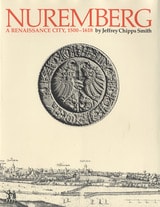
Nuremberg, a Renaissance City, 1500-1618
By Jeffrey Chipps Smith
University of Texas Press, 1983
Although renowned for the excellence of its medieval art, the German city of Nuremberg reached the height of its artistic brilliance during the Renaissance. Beginning its ascendancy during the late fifteenth century, by 1500 the city had blossomed into both Germany's preeminent artistic center and one of the foremost cultural centers in all of Europe. Nuremberg was the home of Albrecht Dürer, the greatest Northern Renaissance master, whose creative genius inspired two generations of German artists. However, Dürer was only one of a host of extraordinary painters, printmakers, sculptors, and goldsmiths working in the city. Georg Pencz, Hans and Barthel Beham, Hans Schäufelein, Jost Amman, and Hans Lautensack were among the most accomplished printmakers of the day. Veit Stoss, Adam Kraft, Peter Flötner, and the Vischer family dominated early sixteenth-century German sculpture. Goldsmith Wenzel Jamnitzer was rivaled only by Florentine master Benvenuto Cellini in his inventiveness and technical virtuosity.
This remarkably comprehensive volume is the first English-language examination of Nuremberg at its creative peak. Following a mapping of the city's principal landmarks, Guy Fitch Lytle provides a compact historical background for Jeffrey Chipps Smith's detailed discussions of the city's social and artistic history. Smith examines the religious function of art before and during the Reformation to demonstrate the magnitude of the cultural transformations that resulted from the adoption of Lutheranism in 1525. He considers the early manifestations of humanism in Nuremberg and its influence on the art of Dürer and his contemporaries, and he reviews the central role of Dürer's pedagogical ideas and his workshop in the dissemination of Renaissance artistic concepts. Finally, Smith surveys the principal artists and stylistic trends in Nuremberg from 1500 to the outbreak of the Thirty Years War in 1618.
Nuremberg: A Renaissance City, 1500-1618 is the permanent record of an exhibition organized by the Archer M. Huntington Art Gallery as part of the centennial celebration of the University of Texas at Austin. As such, it represents not only a thorough introduction to the cultural heritage of Nuremberg during its period of greatest glory but also a catalogue of the more than two hundred objects borrowed for the exhibition from public and private collections in the United States, Canada, and Germany. The catalogue contains biographical sketches of forty-five major artists of the period. Over three hundred illustrations depict the city and its most magnificent artistic treasures.

Peasants, Warriors, and Wives
Popular Imagery in the ReformationKeith Moxey
University of Chicago Press, 2004

The Apocalypse in Reformation Nuremberg
Jews and Turks in Andreas Osiander’s WorldAndrew L. Thomas
University of Michigan Press, 2022
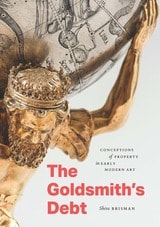
The Goldsmith's Debt
Conceptions of Property in Early Modern ArtShira Brisman
University of Chicago Press, 2026
In the sixteenth century, German goldsmiths played a unique role in articulating property claims and social values. These artisans shaped precious metals into visible expressions of domination, subordination, and obligation. The objects they crafted played a major role in the practices of exchange and inheritance that were reconfiguring a tumultuous economic landscape. Cities commissioned goldsmiths to transform revenue into goblets that could be given as diplomatic gifts or reconverted into currency in times of war, and courts used serving implements as promises of credit.
With The Goldsmith’s Debt, art historian Shira Brisman offers the first book-length study of the Nuremberg goldsmith Christoph Jamnitzer (1563–1618), who created elaborate gilded silver drinking cups that he crafted into unexpected forms, with designs ranging from racialized heads to mining scenes. Considering how works of art can shape a social order, Brisman explores what Jamnitzer’s etchings and goblets reveal about how goldsmiths shared ideas and how their patrons used commissioned works to legitimize their claims over land and the rights of others. Drawing on a range of textual and material evidence—including commentaries on Roman and customary laws, wills and civic statutes, printed designs, and firsthand study of lidded cups in dozens of major European institutions—this unprecedented study places the goldsmith at the heart of the era’s arguments about how people and lands should be subjugated. Brisman reveals the insidious side of these objects that were often used to advance socially conservative agendas, and she presents radical proposals for addressing inequity in the world of ornament prints.

The Unwanted Child
The Fate of Foundlings, Orphans, and Juvenile Criminals in Early Modern GermanyJoel F. Harrington
University of Chicago Press, 2009
The baby abandoned on the doorstep is a phenomenon that has virtually disappeared from our experience, but in the early modern world, unwanted children were a very real problem for parents, government officials, and society. The Unwanted Child skillfully recreates sixteenth-century Nuremberg to explore what befell abandoned, neglected, abused, or delinquent children in this critical period.
Joel F. Harrington tackles this question by focusing on the stories of five individuals. In vivid and poignant detail, he recounts the experiences of an unmarried mother-to-be, a roaming mercenary who drifts in and out of his children’s lives, a civic leader handling the government’s response to problems arising from unwanted children, a homeless teenager turned prolific thief, and orphaned twins who enter state care at the age of nine. Braiding together these compelling portraits, Harrington uncovers and analyzes the key elements that link them, including the impact of war and the vital importance of informal networks among women. From the harrowing to the inspiring, The Unwanted Child paints a gripping picture of life on the streets five centuries ago.
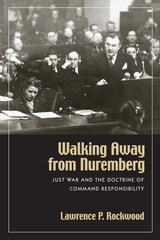
Walking Away from Nuremberg
Just War and the Doctrine of Command ResponsibilityLawrence P. Rockwood
University of Massachusetts Press, 2007
In September 1994, Lawrence P. Rockwood, then a counterintelligence officer with the U.S. Army's Tenth Mountain Division, was deployed to Haiti as part of Operation Restore Democracy, the American-led mission to oust the regime of Raoul Cedras and reinstall President Jean-Bertrand Aristide. Shortly after arriving in-country, Captain Rockwood began receiving reports of human rights abuses at the local jails, including the murder of political prisoners. He appealed to his superiors for permission to take action but was repeatedly turned down. Eventually, after filing a formal complaint with an army inspector general, he set off to inspect the jails on his own. The next day, Captain Rockwood found himself on a plane headed back to the United States, where he was tried by court-martial, convicted on several counts, and discharged from military service.
In this book, Rockwood places his own experience within the broader context of the American military doctrine of “command responsibility”—the set of rules that holds individual officers directly responsible for the commission of war crimes under their authority. He traces the evolution of this doctrine from the Civil War, where its principles were first articulated as the “Lieber Code,” through the Nuremberg trials following World War II, where they were reaffirmed and applied, to the present. Rockwood shows how in the past half-century the United States has gradually abandoned its commitment to these standards, culminating in recent Bush administration initiatives that in effect would shield American commanders and officials from prosecution for many war crimes. The Abu Ghraib and Guantánamo prison abuse scandals, the recently disclosed illegal CIA detention centers, the unprecedented policy of tolerating acts considered as torture by both international standards and U.S. military doctrine, and the recent cover-ups of such combat-related war crimes as the Haditha massacre of November 2005, all reflect an “official anti-humanitarian” trend, Rockwood argues, that is at odds with our nation's traditions and principles.