Results by title
16 books match the query 'Nancy, Jean-Luc'
Didactic Poetries
Philippe Beck
University of Minnesota Press, 2016
Complex, haunting, imaginative and profoundly literary, Didactic Poetries is Beck’s response to Schiller’s statement: “We are still waiting for a didactic poem where thought itself would be and would remain poetic,” and Hegel’s claim that, “strictly speaking, didactic poetry isn’t poetry.”
For the acclaimed French poet, Philippe Beck, Schiller’s task of attempting a didactic poetry remains as vital today as it was for Schiller’s time. Is there a way to construct a poetry built and chiseled, hammered and stitched, from out of past narratives and poetries, condensed in such a manner as to make new poetic verses sing new truths? Forging a singular attempt to echo the poets and tales of a bygone age, Beck’s didactic poetries perhaps carve out the path for renewing a poetic thought as a quasi-musical atmosphere where the reader can glimpse “A small country “sculpted” as spiritual, supposed to be so at home in the Bygone Country. Alluvial layers so light, that weather disappeared, weary of variety a priori.” Beck’s deftly textured poems interweave contemporary commentary with cultural, historical, literary, and philosophical allusions, drawing the reader into a world of lived poetic experience.
Dies Irae
Jean-Luc Nancy
University of Westminster Press, 2019
Edited by Angela Condello, Carlo Grassi and Andreas Philippopoulos-Mihalopoulos
With an introduction by Carlo Grassi
Translated by Cadenza Academic Translations and Angela Condello
What does it mean to judge when there is no general and universal norm to define what is right and what is wrong? Can laws be absent and is law always necessary?
This is the first English translation published of Jean- Luc Nancy’s acclaimed consideration of the law’s most pervasive principles in the context of actual systems and contemporary institutions, power, norms, laws. In a world where it is impossible to imagine the realisation of an ideal of justice that corresponds to every person’s ideal of justice, Nancy probes the limits of legal normativity. Moreover, the question is asked: how can legal normativity be legitimised? A legal order based on performativity and formal validity is questionable and other forces than juridical normativity are at the heart of Dies Irae. Such leads inevitably to the processes of inclusion and exclusion that characterise contemporary juridical systems and those issues of identity, hostility and self-representation central to contemporary political and legal debates
Doing
Jean-Luc Nancy
Seagull Books, 2020
Fortino Sámano
The Overflowing of the PoemVirginie Lalucq and Jean-Luc Nancy
Omnidawn, 2012
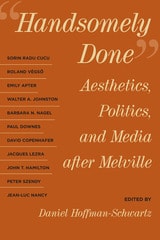
Handsomely Done
Aesthetics, Politics, and Media after MelvilleEdited by Daniel Hoffman-Schwartz
Northwestern University Press, 2019
The volume thus engages not only Melville reception across media (Jorge Luis Borges, John Huston, Jean-Luc Godard, Led Zeppelin, Claire Denis) but also the Melvillean resonances and echoes of various political events and movements, such as the Attica uprising, the Red Army Faction, Occupy Wall Street, and Black Lives Matter. This consideration of Melville’s afterlife opens onto theorizations of intermediality, un/translatability, and material intensity even as it also continually faces the most concrete and pressing questions of history and politics.
Hegel
The Restlessness Of The NegativeJean-Luc Nancy
University of Minnesota Press, 2002
Inoperative Community
Jean-Luc Nancy
University of Minnesota Press, 1991
L’Écologique de l’Histoire
Valentin Husson
Diaphanes, 2020
Il y a plaisir à saluer l‘arrivée d’un philosophe tout neuf qui soudain bondit dans le cortège dionysiaque. Plus on est de fous, plus on pense, le proverbe dit vrai et notre temps de misère a plus que besoin de se refaire – s’il se peut – une vigueur spéculative. Il y a plus que du plaisir, une vraie jubilation lorsque le tout neuf philosophe affirme une pensée de la jouissance, de l’abondance et de la dépense au sens de Bataille (ici toujours discrètement mais efficacement présent). Une pensée énergique au sens le plus – oserais-je dire « vitalisant » du terme. L’energeia n’a-t-elle de sens que depuis l’être ? N’y a-t-il pas une autre énergie à penser ? Une énergie non pas de l’être, ni relative à celle extraite de la nature pour des fins productives et économiques, mais une énergie excédentaire, une sorte de « dépense improductive » (Bataille) de la vie ? Une énergie qui serait le luxe biologique du vivant. Ce luxe biologique, Valentin Husson le pense comme – on ne peut plus dire « ontologique » – comme existence en un sens qui se dérobe à Heidegger et à son « sens de l’être » pour affirmer un avoir à être selon lequel l’être se dissipe au-delà de toute consistance tandis que l’avoir à prend toute l’énergie d’une vie en débordante envie d’elle-même. Jean-Luc Nancy
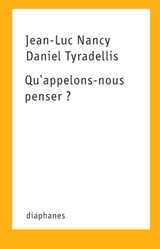
Qu'appelons-nous penser?
Jean-Luc Nancy and Daniel Tyradellis
Diaphanes, 2013
Cet échange rare et singulier traite de la précarité de toute pensée, qu’elle s’établisse dans la langue, dans l’image, dans le corps ou dans l’espace ; du nous et de la pensée partagée qui ouvre les possibilités du sens. Il dessine une pensée qui s’épuise, mais qui aime aussi, et nous redonne foi en l’existence.
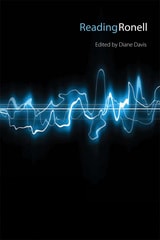
Reading Ronell
Edited by Diane Davis
University of Illinois Press, 2008
Avital Ronell has won worldwide acclaim for her work across literature and philosophy, psychoanalysis and popular culture, political theory and feminism, art and rhetoric, drugs and deconstruction. In works such as The Test Drive, Stupidity, Crack Wars, and The Telephone Book, she has perpetually raised new and powerful questions about how we think, what thinking does, and how we fool ourselves about the troubled space between thought and action.
In this collection, some of today's most distinguished and innovative thinkers turn their attention to Ronell's teaching, writing, and provocations, observing how Ronell reads and what comes from reading her. By reading Ronell, and reading Ronell reading, contributors examine the ethico-political implications of her radical dislocations and carefully explicate, extend, and explore the paraconcepts addressed in her works.
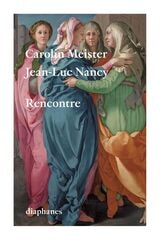
Rencontre
Carolin Meister and Jean-Luc Nancy
Diaphanes, 2021
Hasard, providence, intrication quantique, rituel, animisme, étreinte ou porosité, pensée ou art sont autant de tentatives de tourner autour de ce qui nous échappe quand nous nous rencontrons. Et autant de façons de se rencontrer là où la philosophie reconnait que l’art lui échappe.
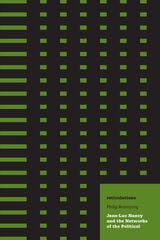
Reticulations
Jean-Luc Nancy and the Networks of the PoliticalPhilip Armstrong
University of Minnesota Press, 2009
Revealing how networks reopen our understanding of political discourse today
Significantly advancing our notion of what constitutes a network, Philip Armstrong proposes a rethinking of political public space that specifically separates networks from the current popular discussion of globalization and information technology.
Analyzing a wide range of Jean-Luc Nancy’s works, Reticulations shows how his project of articulating the political in terms of singularities, pluralities, and multiplicities can deepen our understanding of networks and how they influence community and politics. Even more striking is the way Armstrong associates this general complex in Nancy’s writing with his concern for what Nancy calls the retreat of the political. Armstrong highlights what Nancy’s perspective on networks reveals about movement politics as seen in the 1999 protests in Seattle against the World Trade Organization, the impact of technology on citizenship, and finally how this perspective critiques the model of networked communism constructed by Hardt and Negri. Contesting the exclusive link between technology and networks, Reticulations ultimately demonstrates how network society creates an entirely new politics, one surprisingly rooted in community.
The Deconstruction of Sex
Jean-Luc Nancy and Irving Goh
Duke University Press, 2021
The Sense of the World
Nancy, Jean-Luc
University of Minnesota Press, 1998
Is there a “world” anymore, let alone any “sense” to it? Acknowledging the lack of meaning in our time, and the lack of a world at the center of meanings we try to impose, Jean-Luc Nancy presents a rigorous critique of the many discourses-from philosophy and political science to psychoanalysis and art history-that talk and write their way around these gaping absences in our lives.
In an original style befitting his search for a new mode of thought, Nancy offers fragmentary readings of writers such as Nietzsche, Hegel, Marx, Lévinas, Lacan, Derrida, and Deleuze insofar as their work reflects his concern with sense and the world. Rather than celebrate or bemoan the loss of meaning or attempt to install a new one, his book seeks to reposition both sense and the world between the presence and absence of meaning, between objectivity and subjectivity. Nancy’s project entails a reconception of the field of philosophy itself, a rearticulation of philosophical practice. Neither recondite nor abstract, it is concerned with the existence and experience of freedom-the actuality of existence as experienced by contemporary communities of citizens, readers, and writers.
Combining aesthetic, political, and philosophical considerations to convey a sense of the world between meaning and reality, ideal content and material form, this book offers a new way of understanding-and responding to-“the end of the world.”
Jean-Luc Nancy teaches at the University of Human Sciences in Strasbourg. His books in English include The Literary Absolute (with Philip Lacoue-Labarthe, 1988), The Inoperative Community (Minnesota, 1991), The Birth to Presence (1993), The Experience of Freedom (1993), and The Muses (1996).
Jeffrey S. Librett is associate professor of modern languages and literatures at Loyola University of Chicago.
The Technique of Thought
Nancy, Laruelle, Malabou, and Stiegler after NaturalismIan James
University of Minnesota Press, 2019
Interrogating the work of four contemporary French philosophers to rethink philosophy’s relationship to science and science’s relationship to reality
The Technique of Thought explores the relationship between philosophy and science as articulated in the work of four contemporary French thinkers—Jean-Luc Nancy, François Laruelle, Catherine Malabou, and Bernard Stiegler. Situating their writings within both contemporary scientific debates and the philosophy of science, Ian James elaborates a philosophical naturalism that is notably distinct from the Anglo-American tradition. The naturalism James proposes also diverges decisively from the ways in which continental philosophy has previously engaged with the sciences. He explores the technical procedures and discursive methods used by each of the four thinkers as distinct “techniques of thought” that approach scientific understanding and knowledge experimentally.
Moving beyond debates about the constructed nature of scientific knowledge, The Technique of Thought argues for a strong, variably configured, and entirely novel scientific realism. By bringing together post-phenomenological perspectives concerning individual or collective consciousness and first-person qualitative experience with science’s focus on objective and third-person quantitative knowledge, James tracks the emergence of a new image of the sciences and of scientific practice.
Stripped of aspirations toward total mastery of the universe or a “grand theory of everything,” this renewed scientific worldview, along with the simultaneous reconfiguration of philosophy’s relationship to science, opens up new ways of interrogating immanent reality.
Thinking With—Jean-Luc Nancy
Edited by Susanna Lindberg, Artemy Magun, and Marita Tatari
Diaphanes, 2023
This book continues passionate conversation that Jean-Luc Nancy (1940–2021) was engaged in throughout his life with philosophers and artists from all over the world. The contributors take up Nancy’s philosophical question of truth as a praxis of a “with”—understanding truth without any given measure or comparison as an articulation of a with. It is a thinking responsible for the world from within the world, a language that seeks to respond to the ongoing mutation of our civilization. Contributors include Jean-Christophe Bailly, Rodolphe Burger, Marcia Sá Calvacante Schuback, Marcus Coelen, Alexander García Düttmann, Juan-Manuel Garrido, Martta Heikkilä, Erich Hörl, Valentin Husson, Sandrine Israel-Jost, Ian James, Apostolos Lampropoulos, Nidesh Lawtoo, Jérôme Lèbre, Susanna Lindberg, Michael Marder, Artemy Magun, Boyan Manchev, Dieter Mersch, Hélène Nancy, Jean-Luc Nancy, Aïcha Liviana Messina, Ginette Michaud, Helen Petrovsky, Jacob Rogozinski, Philipp Stoellger, Peter Szendy, Georgios Tsagdis, Marita Tatari, Gert-Jan van der Heiden, and Aukje van Rooden.