Results by title
4 books match the query 'National Security State'
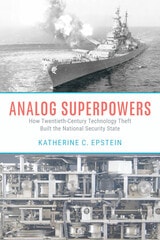
Analog Superpowers
How Twentieth-Century Technology Theft Built the National Security StateKatherine C. Epstein
University of Chicago Press, 2024
At the beginning of the twentieth century, two British inventors, Arthur Pollen and Harold Isherwood, became fascinated by a major military question: how to aim the big guns of battleships. These warships—of enormous geopolitical import before the advent of intercontinental missiles or drones—had to shoot in poor light and choppy seas at distant moving targets, conditions that impeded accurate gunfire. Seeing the need to account for a plethora of variables, Pollen and Isherwood built an integrated system for gathering data, calculating predictions, and transmitting the results to the gunners. At the heart of their invention was the most advanced analog computer of the day, a technological breakthrough that anticipated the famous Norden bombsight of World War II, the inertial guidance systems of nuclear missiles, and the networked “smart” systems that dominate combat today. Recognizing the value of Pollen and Isherwood’s invention, the British Royal Navy and the United States Navy pirated it, one after the other. When the inventors sued, both the British and US governments invoked secrecy, citing national security concerns.
Drawing on a wealth of archival evidence, Analog Superpowers analyzes these and related legal battles over naval technology, exploring how national defense tested the two countries’ commitment to individual rights and the free market. Katherine C. Epstein deftly sets out Pollen’s and Isherwood’s pioneering achievements, the patent questions raised, the geopolitical rivalry between Britain and the United States, and the legal precedents each country developed to control military tools built by private contractors.
Epstein’s account reveals that long before the US national security state sought to restrict information about atomic energy, it was already embroiled in another contest between innovation and secrecy. The America portrayed in this sweeping and accessible history isn’t yet a global hegemon but a rising superpower ready to acquire foreign technology by fair means or foul—much as it accuses China of doing today.

Analog Superpowers
How Twentieth-Century Technology Theft Built the National Security StateKatherine C. Epstein
University of Chicago Press, 2024
A gripping history that spans law, international affairs, and top-secret technology to unmask the tension between intellectual property rights and national security.
At the beginning of the twentieth century, two British inventors, Arthur Pollen and Harold Isherwood, became fascinated by a major military question: how to aim the big guns of battleships. These warships—of enormous geopolitical import before the advent of intercontinental missiles or drones—had to shoot in poor light and choppy seas at distant moving targets, conditions that impeded accurate gunfire. Seeing the need to account for a plethora of variables, Pollen and Isherwood built an integrated system for gathering data, calculating predictions, and transmitting the results to the gunners. At the heart of their invention was the most advanced analog computer of the day, a technological breakthrough that anticipated the famous Norden bombsight of World War II, the inertial guidance systems of nuclear missiles, and the networked “smart” systems that dominate combat today. Recognizing the value of Pollen and Isherwood’s invention, the British Royal Navy and the United States Navy pirated it, one after the other. When the inventors sued, both the British and US governments invoked secrecy, citing national security concerns.
Drawing on a wealth of archival evidence, Analog Superpowers analyzes these and related legal battles over naval technology, exploring how national defense tested the two countries’ commitment to individual rights and the free market. Katherine C. Epstein deftly sets out Pollen’s and Isherwood’s pioneering achievements, the patent questions raised, the geopolitical rivalry between Britain and the United States, and the legal precedents each country developed to control military tools built by private contractors.
Epstein’s account reveals that long before the US national security state sought to restrict information about atomic energy, it was already embroiled in another contest between innovation and secrecy. The America portrayed in this sweeping and accessible history isn’t yet a global hegemon but a rising superpower ready to acquire foreign technology by fair means or foul—much as it accuses China of doing today.

Citizenship in Cold War America
The National Security State and the Possibilities of DissentAndrea Friedman
University of Massachusetts Press, 2014
The stories told here capture a wide-ranging debate about the workings of the national security state and the meaning of American citizenship. Some of the participants in this debate—women like war bride Ellen Knauff and Pentagon employee Annie Lee Moss—were able to make their own experiences compelling examples of the threats posed by the national security regime. Others, such as Ruth Reynolds and Lolita Lebrón, who advocated an end to American empire in Puerto Rico, or the psychiatrist Fredric Wertham, who sought to change the very definition of national security, were less successful. Together, however, they exposed the gap between democratic ideals and government policies.
Friedman traverses immigration law and loyalty boards, popular culture and theoretical treatises, U.S. court-rooms and Puerto Rican jails, to demonstrate how Cold War repression made visible in new ways the unevenness and limitations of American citizenship. Highlighting the ways that race and gender shaped critiques and defenses of the national security regime, she offers new insight into the contradictions of Cold War political culture.
Redefining Science
Scientists, the National Security State, and Nuclear Weapons in Cold War AmericaPaul Rubinson
University of Massachusetts Press, 2016
The Cold War forced scientists to reconcile their values of internationalism and objectivity with the increasingly militaristic uses of scientific knowledge. For decades, antinuclear scientists pursued nuclear disarmament in a variety of ways, from grassroots activism to transnational diplomacy and government science advising. The U.S. government ultimately withstood these efforts, redefining science as a strictly technical endeavor that enhanced national security and deeming science that challenged nuclear weapons on moral grounds “emotional” and patently unscientific. In response, many activist scientists restricted themselves to purely technical arguments for arms control. When antinuclear protest erupted in the 1980s, grassroots activists had moved beyond scientific and technical arguments for disarmament. Grounding their stance in the idea that nuclear weapons were immoral, they used the “emotional” arguments that most scientists had abandoned.
Redefining Science shows that the government achieved its Cold War “consensus” only by active opposition to powerful dissenters and helps explain the current and uneasy relationship between scientists, the public, and government in debates over issues such as security, energy, and climate change.