Results by title

3 books match the query 'National characteristics, Japanese'

cover of Discourses of the Vanishing: Modernity, Phantasm, Japan

Discourses of the Vanishing

Modernity, Phantasm, Japan

Marilyn Ivy

University of Chicago Press, 1995

Japan today is haunted by the ghosts its spectacular modernity has generated. Deep anxieties about the potential loss of national identity and continuity disturb many in Japan, despite widespread insistence that it has remained culturally intact. In this provocative conjoining of ethnography, history, and cultural criticism, Marilyn Ivy discloses these anxieties—and the attempts to contain them—as she tracks what she calls the vanishing: marginalized events, sites, and cultural practices suspended at moments of impending disappearance.

Ivy shows how a fascination with cultural margins accompanied the emergence of Japan as a modern nation-state. This fascination culminated in the early twentieth-century establishment of Japanese folklore studies and its attempts to record the spectral, sometimes violent, narratives of those margins. She then traces the obsession with the vanishing through a range of contemporary reconfigurations: efforts by remote communities to promote themselves as nostalgic sites of authenticity, storytelling practices as signs of premodern presence, mass travel campaigns, recallings of the dead by blind mediums, and itinerant, kabuki-inspired populist theater.

[more]
cover of Home Away from Home: Japanese Corporate Wives in the United States

Home Away from Home

Japanese Corporate Wives in the United States

Sawa Kurotani

Duke University Press, 2005

Drawing attention to domestic space as the critical juncture between the global and the local, Home Away from Home is an innovative ethnography of the daily lives of middle-class Japanese housewives who accompany their husbands on temporary corporate job assignments in the United States. These women are charged with the task of creating and maintaining restful Japanese homes in a foreign environment so that their husbands are able to remain productive, loyal workers for Japanese multinationals and their children are properly socialized and educated as Japanese citizens abroad. Arguing that the homemaking components of transnational communities have not received adequate attention, Sawa Kurotani demonstrates how gender dynamics and the politics of the domestic sphere are integral to understanding national identity and transnational mobility.

Kurotani interviewed and spent time with more than 120 women in three U.S. locations with sizable expatriate Japanese communities: Centerville, a pseudonymous Midwestern town; the New York metropolitan area; and North Carolina’s Research Triangle area. She highlights the contradictory situations faced by the transient wives. Their husbands’ assignments in the United States typically last from three to five years, and they frequently emphasize the temporariness of their situation, referring to it as a “long vacation.” Yet they are responsible for creating comfortable homes for their families, which necessitates producing a familiar and permanent environment. Kurotani looks at the dynamic friendships that develop among the wives and describes their feelings about returning to Japan. She conveys how their sense of themselves as Japanese women, of home, and of their relationships with family members are altered by their personal experiences of transnational homemaking.
[more]
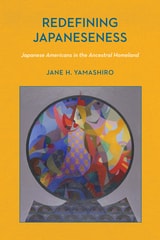
cover of Redefining Japaneseness: Japanese Americans in the Ancestral Homeland

Redefining Japaneseness

Japanese Americans in the Ancestral Homeland

Yamashiro, Jane H

Rutgers University Press, 2017

There is a rich body of literature on the experience of Japanese immigrants in the United States, and there are also numerous accounts of the cultural dislocation felt by American expats in Japan. But what happens when Japanese Americans, born and raised in the United States, are the ones living abroad in Japan? 
 
Redefining Japaneseness chronicles how Japanese American migrants to Japan navigate and complicate the categories of Japanese and “foreigner.” Drawing from extensive interviews and fieldwork in the Tokyo area, Jane H. Yamashiro tracks the multiple ways these migrants strategically negotiate and interpret their daily interactions. Following a diverse group of subjects—some of only Japanese ancestry and others of mixed heritage, some fluent in Japanese and others struggling with the language, some from Hawaii and others from the US continent—her study reveals wide variations in how Japanese Americans perceive both Japaneseness and Americanness. 
 
Making an important contribution to both Asian American studies and scholarship on transnational migration, Redefining Japaneseness critically interrogates the common assumption that people of Japanese ancestry identify as members of a global diaspora. Furthermore, through its close examination of subjects who migrate from one highly-industrialized nation to another, it dramatically expands our picture of the migrant experience.  
 
[more]