Results by title
10 books match the query 'National characteristics, Mexican'
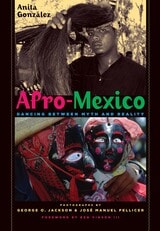
Afro-Mexico
Dancing between Myth and RealityBy Anita González
University of Texas Press, 2010
While Africans and their descendants have lived in Mexico for centuries, many Afro-Mexicans do not consider themselves to be either black or African. For almost a century, Mexico has promoted an ideal of its citizens as having a combination of indigenous and European ancestry. This obscures the presence of African, Asian, and other populations that have contributed to the growth of the nation. However, performance studies—of dance, music, and theatrical events—reveal the influence of African people and their cultural productions on Mexican society.
In this work, Anita González articulates African ethnicity and artistry within the broader panorama of Mexican culture by featuring dance events that are performed either by Afro-Mexicans or by other ethnic Mexican groups about Afro-Mexicans. She illustrates how dance reflects upon social histories and relationships and documents how residents of some sectors of Mexico construct their histories through performance. Festival dances and, sometimes, professional staged dances point to a continuing negotiation among Native American, Spanish, African, and other ethnic identities within the evolving nation of Mexico. These performances embody the mobile histories of ethnic encounters because each dance includes a spectrum of characters based upon local situations and historical memories.
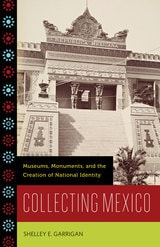
Collecting Mexico
Museums, Monuments, and the Creation of National IdentityShelley E. Garrigan
University of Minnesota Press, 2012
Collecting Mexico centers on the ways in which aesthetics and commercialism intersected in officially sanctioned public collections and displays in late nineteenth-century Mexico. Shelley E. Garrigan approaches questions of origin, citizenry, membership, and difference by reconstructing the lineage of institutionally collected objects around which a modern Mexican identity was negotiated. In doing so, she arrives at a deeper understanding of the ways in which displayed objects become linked with nationalistic meaning and why they exert such persuasive force.
Spanning the Porfiriato period from 1867 to 1910, Collecting Mexico illuminates the creation and institutionalization of a Mexican cultural inheritance. Employing a wide range of examples—including the erection of public monuments, the culture of fine arts, and the representation of Mexico at the Paris World’s Fair of 1889—Garrigan pursues two strands of thought that weave together in surprising ways: national heritage as a transcendental value and patrimony as potential commercial interest.
Collecting Mexico shows that the patterns of institutional collecting reveal how Mexican public collections engendered social meaning. Using extensive archival materials, Garrigan’s close readings of the processes of collection building offer a new vantage point for viewing larger issues of identity, social position, and cultural/capital exchange.
Cosmopolitanism in Mexican Visual Culture
By María Fernández
University of Texas Press, 2014
Since the colonial era, Mexican art has emerged from an ongoing process of negotiation between the local and the global, which frequently involves invention, synthesis, and transformation of diverse discursive and artistic traditions. In this pathfinding book, María Fernández uses the concept of cosmopolitanism to explore this important aspect of Mexican art, in which visual culture and power relations unite the local and the global, the national and the international, the universal and the particular. She argues that in Mexico, as in other colonized regions, colonization constructed power dynamics and forms of violence that persisted in the independent nation-state. Accordingly, Fernández presents not only the visual qualities of objects, but also the discourses, ideas, desires, and practices that are fundamental to the very existence of visual objects.
Fernández organizes episodes in the history of Mexican art and architecture, ranging from the seventeenth century to the end of the twentieth century, around the consistent but unacknowledged historical theme of cosmopolitanism, allowing readers to discern relationships among various historical periods and works that are new and yet simultaneously dependent on their predecessors. She uses case studies of art and architecture produced in response to government commissions to demonstrate that established visual forms and meanings in Mexican art reflect and inform desires, expectations, memories, and ways of being in the world—in short, that visual culture and cosmopolitanism are fundamental to processes of subjectification and identity.
Crafting Mexico
Intellectuals, Artisans, and the State after the RevolutionRick A. López
Duke University Press, 2010
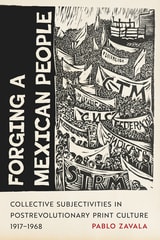
Forging a Mexican People
Collective Subjectivities in Postrevolutionary Print Culture, 1917–1968Pablo Zavala
University of Arizona Press, 2026
Forging a Mexican People shows how illustrated print culture helped to construct and deconstruct versions of “a people” in postrevolutionary Mexico.
Through meticulous research, Pablo Zavala uncovers the ways photographers, graphic artists, writers, and activists used print culture to challenge hegemonic conceptions of state-guided narratives and forge alternative collective subjectivities. This book offers a fresh perspective on the sociopolitical landscape of postrevolutionary Mexico, revealing how cultural artifacts simultaneously crafted and reflected the people vis-à-vis different political and social categories. By examining print culture, editorial practices, and related processes such as the creation, consumption, and distribution of said culture, Zavala’s research contributes to scholarship that has recently reexamined the construction of nationalism by moving away from the focus on state formation and addressing the horizontal and aesthetic dimensions in products by cultural producers from nonstate and grassroots political sectors.
Zavala examines the conceptual parameters of el pueblo by analyzing El Universal Ilustrado, El Machete, the Taller de Gráfica Popular, the protest graphic art used in Mexico City’s 1968 popular student movement, and graphic art used in California’s Chicano farmworkers’ struggle. Based on in-depth archival research, the work includes primary sources that have never been digitized, offering readers unique insights into the visual manifestations of Mexico’s postrevolutionary identity and their enduring significance.
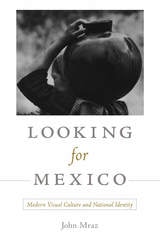
Looking for Mexico
Modern Visual Culture and National IdentityJohn Mraz
Duke University Press, 2009
Turning to film, Mraz compares portrayals of the Mexican Revolution by Fernando de Fuentes to the later movies of Emilio Fernández and Gabriel Figueroa. He considers major stars of Golden Age cinema as gender archetypes for mexicanidad, juxtaposing the charros (hacienda cowboys) embodied by Pedro Infante, Pedro Armendáriz, and Jorge Negrete with the effacing women: the mother, Indian, and shrew as played by Sara García, Dolores del Río, and María Félix. Mraz also analyzes the leading comedians of the Mexican screen, representations of the 1968 student revolt, and depictions of Frida Kahlo in films made by Paul Leduc and Julie Taymor. Filled with more than fifty illustrations, Looking for Mexico is an exuberant plunge into Mexico’s national identity, its visual culture, and the connections between the two.
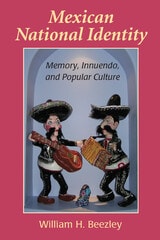
Mexican National Identity
Memory, Innuendo, and Popular CultureWilliam H. Beezley
University of Arizona Press, 2008
In the century that followed Mexico’s independence from Spain in 1821, Beezley maintains, sentiments of nationality were promulgated by people who were concerned not with the promotion of nationalism but with something far more immediate—the need to earn a living. These peddlers, vendors, actors, artisans, writers, publishers, and puppeteers sought widespread popular appeal so that they could earn money. According to Beezley, they constantly refined their performances, as well as the symbols and images they employed, in order to secure larger revenues.
Gradually they discovered the stories, acts, and products that attracted the largest numbers of paying customers. As Beezley convincingly asserts, out of “what sold to the masses” a collective national identity slowly emerged. Mexican National Identity makes an important contribution to the growing body of literature that explores the influences of popular culture on issues of national identity. By looking at identity as it was fashioned “in the streets,” it opens new avenues for exploring identity formation more generally, not just in Mexico and Latin American countries but in every nation.
Check out the New Books in History Interview with Bill Beezley!
Mexico Unveiled
Resisting Colonial Vices and Other ComplaintsCarlos Pereda; Translated by Noell Birondo with Andres Bonilla
Vanderbilt University Press, 2025
In three engaging essays written in a peerless prose style, Pereda considers the persistent influence of European colonialism on Mexican intellectual life, the politics of inclusion, and the changing ideas of what it means to be Mexican. He identifies three “vices”—social habits, customs, and beliefs inherited from European colonialism—that have influenced the development of Mexican national identity: subaltern fervor, craving for novelty, and nationalist zeal. Pereda demonstrates that these three tendencies have led Mexican intellectuals, and Mexican society more generally, to uncritically adopt a politics of exclusion and destructive nationalist attitudes.
Using a strategy he calls “nomadic” thinking—the act of moving beyond our cultural preconceptions and habits of thinking—Pereda guides readers through a number of examples drawn from Mexican philosophy and culture that illustrate these tendencies. At its core, Mexico Unveiled is an accessible and entertaining introduction to the philosophical themes that have long occupied Pereda’s life and work and Mexican philosophy more generally.
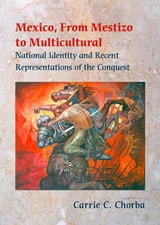
Mexico, From Mestizo to Multicultural
National Identity and Recent Representations of the ConquestCarrie C. Chorba
Vanderbilt University Press, 2006
Throughout the twentieth century, the post-revolutionary Mexican State had used mestizaje as a symbol of national unity and social integration. By the end of the millennium, however, Mexico had gone from a PRI-dominated, economically protectionist nation to a more democratic, economically globalizing one. More importantly, the homogenizing, mestizophile national identity that pervaded Mexico throughout the past century had given way to official admission of Mexico's ethnic and linguistic diversity--or 'pluriculture' according to President Salinas's 1992 constitutional revision.
This book is the first interdisciplinary study of literary, cinematic, and graphic images of Mexican national identity in the 1980s and '90s. Discussing, in depth, writings, films, and cartoons from a vast array of contemporary sources, Carrie C. Chorba creates a social history of this important shift.
The Borders Within
Encounters Between Mexico and the U.S.Douglas Monroy
University of Arizona Press, 2008
Douglas Monroy, a noted Mexican American historian, has for many years pondered the historical and cultural intertwinings of the two nations. Here, in beautifully crafted essays, he reflects on some of the many ways in which the citizens of the two countries have misunderstood each other.
Putting himself— and his own quest for understanding—directly into his work, he contemplates the missions of California; the differences between “liberal” and “traditional” societies; the meanings of words like Mexican, Chicano, and Latino; and even the significance of avocados and bathing suits. In thought-provoking chapters, he considers why Native Americans didn’t embrace Catholicism, why NAFTA isn’t working the way it was supposed to, and why Mexicans and their neighbors to the north tell themselves different versions of the same historical events.
In his own thoughtful way, Monroy is an explorer. Rather than trying to conquer new lands, however, his goal is to gain new insights. He wants to comprehend two cultures that are bound to each other without fully recognizing their bonds. Along with Monroy, readers will discover that borders, when we stop and really think about it, are drawn more deeply in our minds than on any maps.