Results by title
2 books match the query 'National characteristics, Peruvian'
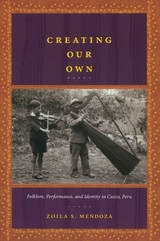
Creating Our Own
Folklore, Performance, and Identity in Cuzco, PeruZoila S. Mendoza
Duke University Press, 2007
Mendoza draws on early-twentieth-century newspapers and other archival documents as well as interviews with key artistic and intellectual figures and their descendants. She offers vivid descriptions of the Peruvian Mission of Incaic Art, a tour undertaken by a group of artists from Cuzco, at their own expense, to represent Peru to Bolivia, Argentina, and Uruguay in 1923–24, as well as of the origins in the 1920s of the Qosqo Center of Native Art, the first cultural institution dedicated to regional and national folkloric art. She highlights other landmarks, including both The Charango Hour, a radio show that contributed to the broad acceptance of rural Andean music from its debut in 1937, and the rise in that same year of another major cultural institution, the American Art Institute of Cuzco. Throughout, she emphasizes the intricate local, regional, national, and international pressures that combined to produce folkloric art, especially the growing importance of national and international tourism in Cuzco.
Please visit the Web site http://nas.ucdavis.edu/creatingbook for samples of the images and music discussed in this book.
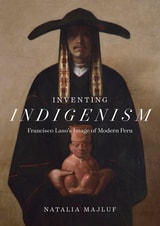
Inventing Indigenism
Francisco Laso's Image of Modern PeruNatalia Majluf
University of Texas Press, 2021
2023 ALAA Book Award, Association for Latin American Art/Arvey Foundation
A fascinating account of the modern reinvention of the image of the Indian in nineteenth-century literature and visual culture, seen through the work of Peruvian painter Francisco Laso.
One of the outstanding painters of the nineteenth century, Francisco Laso (1823–1869) set out to give visual form to modern Peru. His solemn and still paintings of indigenous subjects were part of a larger project, spurred by writers and intellectuals actively crafting a nation in the aftermath of independence from Spain. In this book, at once an innovative account of modern indigenism and the first major monograph on Laso, Natalia Majluf explores the rise of the image of the Indian in literature and visual culture. Reading Laso’s works through a broad range of sources, Majluf traces a decisive break in a long history of representations of indigenous peoples that began with the Spanish conquest. She ties this transformation to the modern concept of culture, which redefined both the artistic field and the notion of indigeneity. As an abstraction produced through indigenist discourse, an icon of authenticity, and a densely racialized cultural construct, the Indian would emerge as a central symbol of modern Andean nationalisms.
Inventing Indigenism brings the work and influence of this extraordinary painter to the forefront as it offers a broad perspective on the dynamics of art and visual culture in nineteenth-century Latin America.