Results by title
3 books match the query 'National geographic'
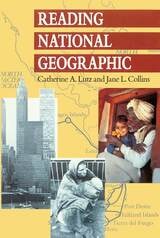
Reading National Geographic
Catherine A. Lutz and Jane L. Collins
University of Chicago Press, 1993
Lutz and Collins take us inside the National Geographic Society to investigate how its photographers, editors, and designers select images and text to produce representations of Third World cultures. Through interviews with the editors, they describe the process as one of negotiating standards of "balance" and "objectivity," informational content and visual beauty. Then, in a close reading of some six hundred photographs, they examine issues of race, gender, privilege, progress, and modernity through an analysis of the way such things as color, pose, framing, and vantage point are used in representations of non-Western peoples. Finally, through extensive interviews with readers, the authors assess how the cultural narratives of the magazine are received and interpreted, and identify a tension between the desire to know about other peoples and their ways and the wish to validate middle-class American values.
The result is a complex portrait of an institution and its role in promoting a kind of conservative humanism that acknowledges universal values and celebrates diversity while it allows readers to relegate non-Western peoples to an earlier stage of progress. We see the magazine and the Society as a key middlebrow arbiter of taste, wealth, and power in America, and we get a telling glimpse into middle-class American culture and all the wishes, assumptions, and fears it brings to bear on our armchair explorations of the world.
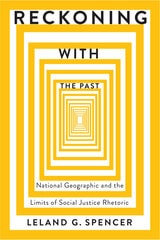
Reckoning with the Past
National Geographic and the Limits of Social Justice RhetoricLeland G. Spencer
Michigan State University Press, 2026
For over a century, National Geographic has shaped American visual culture, captivating audiences with stunning photography and compelling storytelling. Yet behind its iconic yellow border lies a fraught legacy of gender bias, racial misrepresentation, and colonialist narratives.In this incisive study, Leland G. Spencer examines the brand's recent attempts to reckon with that legacy across its magazine and television platforms. From special issues spotlighting transgender lives, to a public acknowledgment of past racism, to a magazine edition created entirely by women, these efforts signal a move toward inclusivity. But as Spencer reveals through rigorous rhetorical analysis, these gestures often fall short. The texts themselves frequently echo the same systemic inequalities they seek to redress. National Geographic's progressive rebranding, he argues, remains tangled in the very histories it aims to transcend.
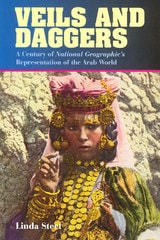
Veils And Daggers
Linda Steet
Temple University Press, 2000
In Veils and Daggers, Linda Steet provides a critically insightful and alternative interpretation of National Geographic. Through an analysis of the journal's discourses in Orientalism, patriarchy, and primitivism in the Arab world as well as textual and visual constructions of Arab men and women, Islam, and Arab culture, Veils and Daggers unpacks the ideological perspectives that have guided National Geographic throughout its history. Drawing on cultural, feminist, and postcolonial criticism, Steet generates alternative readings that challenge the magazine's claims to objectivity. In this fascinating journey, it becomes clear that neither text nor image in the magazine can be regarded as natural or self-evident and she artfully demonstrates that the act of representing others "inevitably involves some degree of violence, decontextualization, minaturization, etc." The subject area known as Orientalism, she shows, is a manmade concept that as such must be studied as an integral component of the social, rather than the natural or divine world.
Veils and Daggers repositions and redefines National Geographic as an educational journal. Steet's work is an important and groundbreaking contribution in the area of social construction of knowledge, social foundations of education, popular educational media, and social studies as well as racial identity, ethnicity, gender. Once encountered, readers of National Geographic will never regard it in the same manner again.