Results by title
37 books match the query 'National socialism'
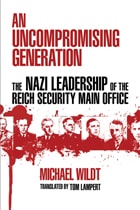
An Uncompromising Generation
The Nazi Leadership of the Reich Security Main OfficeMichael Wildt
University of Wisconsin Press, 2009
Wildt’s study traces the intellectual evolution of key members of the Reich Security Main Office (RSHA) from their days as students until the end of World War II. Established in 1939, this office fused together the Gestapo, the Criminal Police, and the Sicherheitsdienst (Security Service) of the SS. Far from being small cogs in a big bureaucratic machine, Wildt finds that the people who made up the RSHA constructed the concepts and operated the apparatus that carried out the Holocaust.
At the center of both theory and practice of persecution and genocide in Nazi-occupied Europe, these young men of the RSHA—none of whom envisioned the systematic annihilation of the European Jews—became radicalized. How this occurred is the central question of Wildt’s book. Wildt also discusses the postwar careers of the members of the RSHA. Strikingly, he shows how the leaders of the RSHA evaded the consequences of their actions under the Nazi regime and went on to have important careers in the rebuilt West Germany.
An alternate selection of the History Book Club and Military Book Club
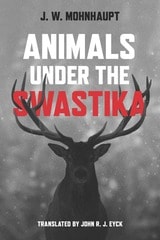
Animals under the Swastika
J. W. Mohnhaupt, translated by John R. J. Eyck
University of Wisconsin Press, 2022
Drawing from diaries, journals, school textbooks, and printed propaganda, J.W. Mohnhaupt tells these animals’ stories vividly and with an eye for everyday detail, focusing each chapter on a different facet of Nazism by way of a specific animal species: red deer, horses, cats, and more. Animals under the Swastika illustrates the complicated, thought-provoking relationship between Nazis and animals.
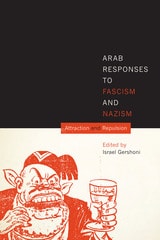
Arab Responses to Fascism and Nazism
Attraction and RepulsionBy Israel Gershoni
University of Texas Press, 2014
The first book to present an analysis of Arab response to fascism and Nazism from the perspectives of both individual countries and the Arab world at large, this collection problematizes and ultimately deconstructs the established narratives that assume most Arabs supported fascism and Nazism leading up to and during World War II. Using new source materials taken largely from Arab memoirs, archives, and print media, the articles reexamine Egyptian, Syrian, Lebanese, Palestinian, and Iraqi responses in the 1930s and throughout the war.
While acknowledging the individuals, forces, and organizations that did support and collaborate with Nazi Germany and fascist Italy, Arab Responses to Fascism and Nazism focuses on the many other Arab voices that identified with Britain and France and with the Allied cause during the war. The authors argue that many groups within Arab societies—elites and non-elites, governing forces, and civilians—rejected Nazism and fascism as totalitarian, racist, and, most important, as new, more oppressive forms of European imperialism. The essays in this volume argue that, in contrast to prevailing beliefs that Arabs were de facto supporters of Italy and Germany—since “the enemy of my enemy is my friend”—mainstream Arab forces and currents opposed the Axis powers and supported the Allies during the war. They played a significant role in the battles for control over the Middle East.
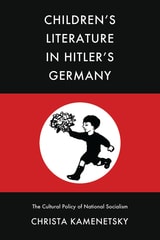
Children’s Literature in Hitler’s Germany
The Cultural Policy of National SocialismChrista Kamenetsky
Ohio University Press, 1984
Between 1933 and 1945, National Socialists enacted a focused effort to propagandize children’s literature by distorting existing German values and traditions with the aim of creating a homogenous “folk community.” A vast censorship committee in Berlin oversaw the publication, revision, and distribution of books and textbooks for young readers, exercising its control over library and bookstore content as well as over new manuscripts, so as to redirect the cultural consumption of the nation’s children. In particular, the Nazis emphasized Nordic myths and legends with a focus on the fighting spirit of the saga heroes, their community loyalty, and a fierce spirit of revenge—elements that were then applied to the concepts of loyalty to and sacrifice for the Führer and the fatherland. They also tolerated select popular series, even though these were meant to be replaced by modern Hitler Youth camping stories.
In this important book, first published in 1984 and now back in print, Christa Kamenetsky demonstrates how Nazis used children’s literature to selectively shape a “Nordic Germanic” worldview that was intended to strengthen the German folk community, the Führer, and the fatherland by imposing a racial perspective on mankind. Their efforts corroded the last remnants of the Weimar Republic’s liberal education, while promoting an enthusiastic following for Hitler.

Conjuring Hitler
How Britain and America Made the Third ReichGuido Giacomo Preparata
Pluto Press, 2005
Contested City
Municipal Politics and the Rise of Nazism in Altona, 1917-1937Anthony McElligott
University of Michigan Press, 1998
Eros and Inwardness in Vienna
Weininger, Musil, DodererDavid S. Luft
University of Chicago Press, 2003
According to Luft, Otto Weininger viewed human beings as bisexual and applied this theme to issues of creativity and morality. Robert Musil developed a creative ethics that was closely related to his open, flexible view of sexuality and gender. And Heimito von Doderer portrayed his own sexual obsessions as a way of understanding the power of total ideologies, including his own attraction to National Socialism. For Luft, the significance of these three writers lies in their understandings of eros and inwardness and in the roles that both play in ethical experience and the formation of meaningful relations to the world-a process that continues to engage artists, writers, and thinkers today.
Eros and Inwardness in Vienna will profoundly reshape our understanding of Vienna's intellectual history. It will be important for anyone interested in Austrian or German history, literature, or philosophy.

From Racism to Genocide
Anthropology in the Third ReichGretchen E. Schafft
University of Illinois Press, 2007
In paperback for the first time, From Racism to Genocide is an explosive, richly detailed account of how Nazi anthropologists justified racism, developed practical applications of racist theory, and eventually participated in every phase of the Holocaust.
Using original sources and previously unpublished documentation, Gretchen E. Schafft shows the total range of anti-human activity from within the confines of a particular discipline. Based on seven years of archival research in the United States and abroad, the work includes many original photos and documents, most of which have never before been published. It uses primary data and original texts whenever possible, including correspondence written by perpetrators. The book also reveals that the United States was not merely a bystander in this research, but instead contributed professional and financial support to early racial research that continued through the first five years of Hitler’s regime.
Grand Illusion
The Third Reich, the Paris Exposition, and the Cultural Seduction of FranceKaren Fiss
University of Chicago Press, 2009
Franco-German cultural exchange reached its height at the 1937 Paris World’s Fair, where the Third Reich worked to promote an illusion of friendship between the two countries. Through the prism of this decisive event, Grand Illusion examines the overlooked relationships among Nazi elites and French intellectuals. Their interaction, Karen Fiss argues, profoundly influenced cultural production and normalized aspects of fascist ideology in 1930s France, laying the groundwork for the country’s eventual collaboration with its German occupiers.
Tracing related developments across fine arts, film, architecture, and mass pageantry, Fiss illuminates the role of National Socialist propaganda in the French decision to ignore Hitler’s war preparations and pursue an untenable policy of appeasement. France’s receptiveness toward Nazi culture, Fiss contends, was rooted in its troubled identity and deep-seated insecurities. With their government in crisis, French intellectuals from both the left and the right demanded a new national culture that could rival those of the totalitarian states. By examining how this cultural exchange shifted toward political collaboration, Grand Illusion casts new light on the power of art to influence history.
Growing Up Female in Nazi Germany
Dagmar Reese, Translated by William Templer
University of Michigan Press, 2010
Dagmar Reese, however, depicts another picture of life in the BDM. She explores how and in what way the National Socialists were successful in linking up with the interests of contemporary girls and young women and providing them a social life of their own. The girls in the BDM found latitude for their own development while taking on responsibilities that integrated them within the folds of the National Socialist state.
"At last available in English, this pioneering study provides fresh insights into the ways in which the Nazi regime changed young 'Aryan' women's lives through appeals to female self-esteem that were not obviously defined by Nazi ideology, but drove a wedge between parents and children. Thoughtful analysis of detailed interviews reveals the day-to-day functioning of the Third Reich in different social milieus and its impact on women's lives beyond 1945. A must-read for anyone interested in the gendered dynamics of Nazi modernity and the lack of sustained opposition to National Socialism."
--Uta Poiger, University of Washington
"In this highly readable translation, Reese provocatively identifies Nazi girls league members' surprisingly positive memories and reveals significant implications for the functioning of Nazi society. Reaching across disciplines, this work is for experts and for the classroom alike."
--Belinda Davis, Rutgers University
Dagmar Reese is The Moses Mendelssohn Zentrum Potsdam researcher on the DFG-project "Georg Simmels Geschlechtertheorien im ‚fin de siecle' Berlin", 2004
William Templer is a widely published translator from German and Hebrew and is on the staff of Rajamangala University of Technology Srivijaya.

Haunted by Hitler
Liberals, the Left, and the Fight against Fascism in the United StatesChristopher Vials
University of Massachusetts Press, 2014
Although fascism is typically associated with Europe, the threat of fascism in the United States haunted the imaginations of activists, writers, and artists, spurring them to create a rich, elaborate body of cultural and political work. Traversing the Popular Front of the 1930s, the struggle against McCarthyism in the 1950s, the Black Power movement of the 1960s, and the AIDS activism of the 1980s, Haunted by Hitler highlights the value of “antifascist” cultural politics, showing how it helped to frame the national discourse.
Christopher Vials examines the ways in which anxieties about fascism in the United States have been expressed in the public sphere, through American television shows, Off-Broadway theater, party newspapers, bestselling works of history, journalism, popular sociology, political theory, and other media. He argues that twentieth-century liberals and leftists were more deeply unsettled by the problem of fascism than those at the center or the right and that they tirelessly and often successfully worked to counter America's fascist equivalents.
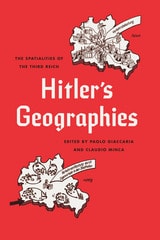
Hitler's Geographies
The Spatialities of the Third ReichEdited by Paolo Giaccaria and Claudio Minca
University of Chicago Press, 2016
With Hitler’s Geographies, editors Paolo Giaccaria and Claudio Minca examine the variety of ways in which spatial theory evolved and was translated into real-world action under the Third Reich. They have gathered an outstanding collection by leading scholars, presenting key concepts and figures as well exploring the undeniable link between biopolitical power and spatial expansion and exclusion.
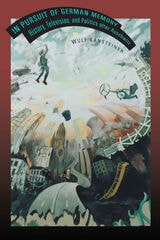
In Pursuit of German Memory
History, Television, and Politics after AuschwitzWulf Kansteiner
Ohio University Press, 2006
The collective memories of Nazism that developed in postwar Germany have helped define a new paradigm of memory politics. From Europe to South Africa and from Latin America to Iraq, scholars have studied the German case to learn how to overcome internal division and regain international recognition.
In Pursuit of German Memory: History, Television, and Politics after Auschwitz examines three arenas of German memory politics—professional historiography, national politics, and national public television—that have played key roles in the reinvention of the Nazi past in the last sixty years. Wulf Kansteiner shows that the interpretations of the past proposed by historians, politicians, and television producers reflect political and generational divisions and an extraordinary concern for Germany's image abroad. At the same time, each of these theaters of memory has developed its own dynamics and formats of historical reflection.
Kansteiner’s analysis of the German scene reveals a complex social geography of collective memory. In Pursuit of German Memory underscores the fact that German memories of Nazism, like many other collective memories, combine two seemingly contradictory qualities: They are highly mediated and part of a global exchange of images and story fragments but, at the same time, they can be reproduced only locally, in narrowly circumscribed networks of communication.
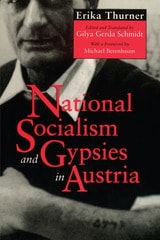
National Socialism and Gypsies in Austria
Erika Thurner
University of Alabama Press, 1998
In this first English translation of Erika Thurner's National Socialism and Gypsies in Austria, Gilya Gerda Schmidt makes available Thurner’s investigation of Camps Salzburg and Lackenbach, the two central areas of Gypsy persecution in Austria. Two factors made Thurner’s research especially difficult: the Roma and Sinti have more an oral tradition than a written one, and scholarship on the plight of the Gypsies is sparse. Through painstaking research, Thurner has been able to piece together fragments from Nazi documents, recollections of victims, accounts of bystanders and other eyewitnesses, and formal records to present her account. The result is a volume that truly enhances our understanding of the Gypsies’ experiences during this period.
The volume also focuses on broader aspects of the Gypsies’ ordeals: the ideological foundations and legal ordinances regarding Gypsies, the discrimination and persecution in Burgenland as a whole, the transports from Austria to Lodz and Chelmo, and the medical experimentation. The book has also been expanded, with a new study of Camp Salzburg, an updated bibliography, and numerous photographs, which were not included in the German edition.
The recent upsurge of anti-Gypsy violence in Austria illustrates both the horror of the treatment of Gypsy tribes and the timeliness of the subject of this volume.
Nazi Ideology before 1933
A DocumentationIntroduced and translated by Barbara Miller Lane and Leila J. Rupp
University of Texas Press, 1978
This volume brings together a hitherto scattered and inaccessible body of material crucial to the understanding of the evolution of Nazi political thought. Before the publication of this volume, scholars had virtually ignored the extensive writings and programs published by leading Nazi ideologues before 1933. Barbara Miller Lane and Leila J. Rupp have collected the political writings of Nazi theorists—Dietrich Eckart, Alfred Rosenberg, Gottfried Feder, Joseph Goebbels, Gregor and Otto Strasser, Heinrich Himmler, and Richard Walther Darré—during the period before the National Socialists came to power. The Strassers are given considerable space because of their great intellectual importance within the party before 1933. In commentary by the editors, the significance of each Nazi theorist is weighed and evaluated at each stage of the history of the party.
Lane and Rupp conclude that Nazi ideology, before 1933 at least, was not a consistent whole but a doctrine in the process of rapid development to which new ideas were continually introduced. By the time the Nazis came to power, however, a group of interrelated assertions and official promises had been made to party followers and to the public. Hitler and the Third Reich had to accommodate this ideology, even when not implementing it. Hitler’s role in the development of Nazi ideology, interpreted here as a very permissive one, is thoroughly assessed. His own writings, however, have been omitted since they are readily available elsewhere.
The twenty-eight documents included in this book illustrate themes and phases in Nazi ideology which are discussed in the introduction and the detailed prefatory notes. Long selections, as often as possible full-length, are provided to allow the reader to follow the arguments. Each selection is accompanied by an introductory note and annotations which clarify its relationship to other works of the author and other writings of the period. Also included are original translations of the “Twenty-Five Points” and a number of little-known official party statements.

On European Ground
Alan Cohen
University of Chicago Press, 2001
Cohen's images achieve a solemn beauty even as they engage history at its most topical. Pictures of trenches and bunkers at the battlefields of Somme and Verdun explore the tension between the violence of the past and the inscrutability of its remnants. Photographs from the grounds of Dachau and Auschwitz solicit a provocative dialogue between the ordinariness of these sites today and their haunting memory. They teach us, as the New Art Examiner notes, "that the living perceptual connection to the Holocaust is vanishing." Images of the Berlin Wall show only the footprint of the barricade that once separated two hostile ideologies. They record the physical erosion and looming disappearance of the Wall while capturing its reappearance as a memorialized abstraction.
Accompanying the photographs in On European Ground are essays by Sander Gilman and Jonathan Bordo, as well as an interview with Cohen by critic Roberta Smith of the New York Times. The essays present both an introduction to and aesthetic analysis of Cohen's work, while the interview discusses the intractable problems of history and memory that his photographs so uniquely capture.
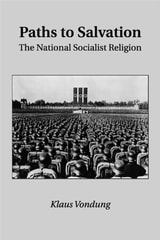
Paths to Salvation
The National Socialist ReligionKlaus Vondung
St. Augustine's Press, 2017
In order to understand National Socialism one must recognize its religious nature. Many Germans were attracted to the party by its pledge to re-establish a true community of the people, a goal that was celebrated as “holy”.
Not only did Hitler promise to solve political, social, and economic problems, he also responded to a widely felt need for salvation. The prospect of salvation elevated politics into the realm of religion and lent meaning to the lives of those who embraced it.
In this work Klaus Vondung explores the various forms in which the elevation of politics into the sphere of religion was expressed in the Third Reich: in the faith of committed National Socialists, in the party’s cult events which celebrated the “community of the people” as a “community of faith” and the Fuhrer as “savior”, and in the persecution of the Jews that was ‘justified’ in religious terms by demonizing Jews as the “evil enemies of humanity” responsible for the world’s ills. This apocalyptic worldview was the extreme manifestation of the religious nature of National Socialism and, in the final analysis, the only plausible explanation for the intention of exterminating the Jews that led to the holocaust.

Readings on Fascism and National Socialism
University of Colorado, Dept. of Philosophy
Ohio University Press, 1952
The catastrophe and holocaust brought about by the two powerful movements of fascism and national socialism will mark human life always. Now, as we feel our hatred for them, we find it difficult to understand how they could have been so powerful, how they could have appealed so strongly to millions of people of a modern age.
To understand our own times, it is necessary to understand these movements. And to understand them, we must read the basic philosophical and political documents which show the force of the ideas which moved a world to the brink of disaster.
This collection of readings has been selected to encourage students to clarify their thinking on social philosophy. They will accordingly need to determine whether the readings contain more or less coherent body of ideas which constitutes a social philosophy. They will also need to raise the more far-reaching question of whether the ideas are acceptable. To arrive at any satisfactory answer to this latter question, they will necessarily have to compare the ideas of fascism and their practical meanings with the alternatives, real and ideal, that are the substance of live philosophical issues.

Redeeming Objects
A West German MythologyNatalie Scholz
University of Wisconsin Press, 2023
Postwar advertising, film, and print culture sought to divest mass-produced goods—such as the Volkswagen and modern interiors—of their fascist legacies. But Scholz demonstrates that postwar representations were saturated with unacknowledged references to the Nazi past. Drawing on a vast array of popular and highbrow publications and films, Redeeming Objects adds a new perspective to debates about postwar reconstruction, memory, and consumerism.

Requiem for a German Past
A Boyhood among the NazisJurgen Herbst
University of Wisconsin Press, 2002
Jurgen Herbst’s account of growing up in Nazi Germany from 1928 to 1948 is a boy’s experience of anti-Semitism and militarism from the inside. Herbst was a middle-class boy in a Lutheran family that saw value in Prussian military ideals and a mythic German past. His memoir is a compelling, understated tale of moral awakening.
Sacrifice in the Modern World
On the Particularity and Generality of Nazi MythDavid Pan
Northwestern University Press, 2012
A landmark book, David Pan’s Sacrifice in the Modern World seeks to explain the continuing emphasis, in modern times, on sacrifice. Pan specifically turns to the culture of sacrifice—ritualized and sanctified death—in Nazi Germany, showing how that regime co-opted an existing discussion of sacrifice and infused it with its own mythology. Pan suggests that sacrifice is a key value in every society but that there is a preponderance of association of sacrifice with Nazi culture and therefore a largely pejorative treatment of sacrifice.
Surveying the arguments of philosopher Alfred Baeumler and other symptomatic Nazi texts, Pan shows how the Nazis’ reactionary intellectual culture unraveled much of the Enlightenment project. In so doing, he is able to offer a compelling new perspective on basic theoretical concepts in the work of Kant, Nietzsche, Adorno, Bataille, Girard, and others. He posits that it is only by clearing our way through the Nazis’ misuse of sacrifice that we can understand the durability of sacrificial structures that—following several of the theorists he discusses— establish the fundamental values by which we live our lives.
Rather than condemning the Nazi appeal to sacrifice itself, this book looks at the particular ways in which sacrifice was distributed and structured within that society. All cultures must grapple with the existential violence of the human condition, and they frequently do so through aesthetic treatments of sacrifice, rooted in myths and traditions. Pan argues that our task is not to eradicate these traditions but to engage them by carefully evaluating the commitments and values that they imply.
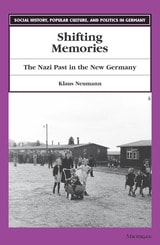
Shifting Memories
The Nazi Past in the New GermanyKlaus Neumann
University of Michigan Press, 2000
The case studies address, for example, the legacy of the so-called Celler Hasenjagd (the hunting down of concentration camp prisoners who survived an Allied air raid in April 1945 in a town in Lower Saxony); efforts by the City of Hildesheim to memorialize the Kristallnacht pogrom; attempts by Italian, Jewish, and Sinti survivors to commemorate their suffering in two West German towns; the posthumous reputation of a German communist imprisoned in Buchenwald and credited with having saved the lives of 159 Jewish children; and the public memories of the Ravensbrück and Buchenwald concentration camps in East Germany.
Directed at an audience curious about contemporary Germany, this book will appeal to those interested in issues of public and social memory, and in the legacy of Auschwitz.
Klaus Neumann is a historian who has taught in universities in Germany and Australia and written about social memories in the Pacific Islands, Australia, and Germany. Previous books include Not the Way It Really Was and Rabaul Yu Swit Moa Yet. He lives in Richmond, Australia.
The "Goldhagen Effect"
History, Memory, Nazism--Facing the German PastGeoff Eley, Editor
University of Michigan Press, 2000

The Brown Plague
Travels in Late Weimar and Early Nazi GermanyDaniel Guérin
Duke University Press, 1994
Guérin’s travels took him across the countryside and into the cities of Germany. He describes with extraordinary clarity, for example, his encounters with large groups of unemployed workers in Berlin and the spectacle of Goering presiding over the Reichstag. Staying in youth hostels, Guérin met individuals representing a range of various groups and movements, including the Wandervögel, leftist brigades, Hitler Youth, and the strange, semicriminal sexual underground of the Wild-frei. Devoting particular attention to the cultural politics of fascism and the lure of Nazism for Germany’s disaffected youth, he describes the seductive rituals by which the Nazis were able to win over much of the population. As Robert Schwartzwald makes clear in his introduction, Guérin’s interest in Germany at this time was driven, in part, by a homoerotic component that could not be stated explicitly in his published material. This excellent companion essay also places The Brown Plague within a broad historical and literary context while drawing connections between fascism, aesthetics, and sexuality.
Informed by an epic view of class struggle and an admiration for German culture, The Brown Plague, a notable primary source in the literature of modern Europe, provides a unique view onto the rise of Nazism.
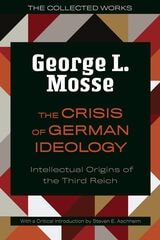
The Crisis of German Ideology
Intellectual Origins of the Third ReichGeorge L. Mosse
University of Wisconsin Press, 2021
George L. Mosse (1918–99) was a legendary scholar, teacher, and mentor. A refugee from Nazi Germany, in 1955 he joined the Department of History at the University of Wisconsin–Madison, where he was both influential and popular. Mosse was an early leader in the study of modern European cultural and intellectual history, fascism, and the history of sexuality and masculinity. Over his career he authored more than two dozen books.
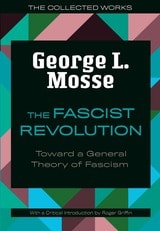
The Fascist Revolution
Toward a General Theory of FascismGeorge L. Mosse, with a critical introduction by Roger Griffin
University of Wisconsin Press, 2021
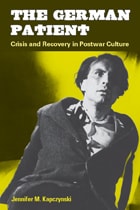
The German Patient
Crisis and Recovery in Postwar CultureJennifer M. Kapczynski
University of Michigan Press, 2010
The German Patient takes an original look at fascist constructions of health and illness, arguing that the idea of a healthy "national body"---propagated by the Nazis as justification for the brutal elimination of various unwanted populations---continued to shape post-1945 discussions about the state of national culture. Through an examination of literature, film, and popular media of the era, Jennifer M. Kapczynski demonstrates the ways in which postwar German thinkers inverted the illness metaphor, portraying fascism as a national malady and the nation as a body struggling to recover. Yet, in working to heal the German wounds of war and restore national vigor through the excising of "sick" elements, artists and writers often betrayed a troubling affinity for the very biopolitical rhetoric they were struggling against. Through its exploration of the discourse of collective illness, The German Patient tells a larger story about ideological continuities in pre- and post-1945 German culture.
Jennifer M. Kapczynski is Assistant Professor of Germanic Languages and Literatures at Washington University in St. Louis. She is the coeditor of the anthology A New History of German Cinema.
Cover art: From The Murderers Are Among Us (1946). Reprinted courtesy of the Deutsche Kinemathek.
"A highly evocative work of meticulous scholarship, Kapczynski's deftly argued German Patient advances the current revaluation of Germany's postwar reconstruction in wholly original and even exciting ways: its insights into discussions of collective sickness and health resonate well beyond postwar Germany."
---Jaimey Fischer, University of California, Davis
"The German Patient provides an important historical backdrop and a richly specific cultural context for thinking about German guilt and responsibility after Hitler. An eminently readable and engaging text."
---Johannes von Moltke, University of Michigan
"This is a polished, eloquently written, and highly informative study speaking to the most pressing debates in contemporary Germany. The German Patient will be essential reading for anyone interested in mass death, genocide, and memory."
---Paul Lerner, University of Southern California
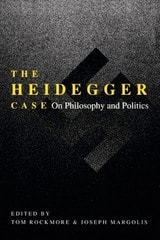
The Heidegger Case
On Philosophy and Politicsedited by Tom Rockmore and Joseph Margolis
Temple University Press, 1992
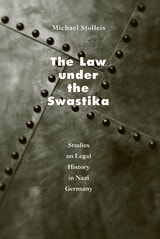
The Law under the Swastika
Studies on Legal History in Nazi GermanyMichael Stolleis
University of Chicago Press, 1997
Stolleis studies a wide range of legal fields—constitutional, judicial, agrarian, administrative, civil, and business—arguing that all types of law were affected by the political realities of National Socialism. Moreover, he shows that legal traditions were not relinquished immediately with the onset of a new regime. For the first time we can see clearly the continuities between the Nazi period and the postwar period. The law under National Socialism did not make a complete break with the law during the Weimar Republic, nor did the law of the Federal Republic nullify all of the laws under National Socialism. Through a rich and subtle investigation, Stolleis shows how the legal profession and the political regime both reacted to the conditions of the period and molded the judicial system accordingly.
Breaking the conspiracy of silence held by the justices in the postwar period, Stolleis stresses the importance of researching Nazi law in order to confront ethical problems in today's legal profession.
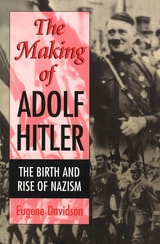
The Making of Adolf Hitler
The Birth and Rise of NazismEugene Davidson
University of Missouri Press, 1997
The harsh Armistice terms of 1918, the short-lived Weimar Republic, Hindenburg's senile vacillations, and behind-the-scene power plays form the backbone of this excellent study covering German history during the first three-and-a-half decades of the century.
The Science of the Swastika
Bernard Mees
Central European University Press, 2008
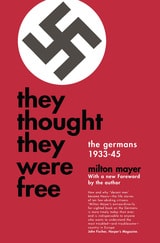
They Thought They Were Free
The Germans, 1933-45Milton Mayer
University of Chicago Press, 1966
“What happened here was the gradual habituation of the people, little by little, to being governed by surprise; to receiving decisions deliberated in secret; to believing that the situation was so complicated that the government had to act on information which the people could not understand, or so dangerous that, even if the people could not understand it, it could not be released because of national security. And their sense of identification with Hitler, their trust in him, made it easier to widen this gap and reassured those who would otherwise have worried about it.”--from Chapter 13, “But Then It Was Too Late”
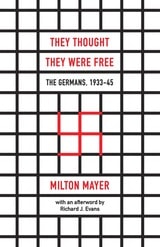
They Thought They Were Free
The Germans, 1933–45Milton Mayer
University of Chicago Press, 2017
“When this book was first published it received some attention from the critics but none at all from the public. Nazism was finished in the bunker in Berlin and its death warrant signed on the bench at Nuremberg.”
That’s Milton Mayer, writing in a foreword to the 1966 edition of They Thought They Were Free. He’s right about the critics: the book was a finalist for the National Book Award in 1956. General readers may have been slower to take notice, but over time they did—what we’ve seen over decades is that any time people, across the political spectrum, start to feel that freedom is threatened, the book experiences a ripple of word-of-mouth interest.
They Thought They Were Free is an eloquent and provocative examination of the development of fascism in Germany. Mayer’s book is a study of ten Germans and their lives from 1933-45, based on interviews he conducted after the war when he lived in Germany. Mayer had a position as a research professor at the University of Frankfurt and lived in a nearby small Hessian town which he disguised with the name “Kronenberg.” “These ten men were not men of distinction,” Mayer noted, but they had been members of the Nazi Party; Mayer wanted to discover what had made them Nazis. His discussions with them of Nazism, the rise of the Reich, and mass complicity with evil became the backbone of this book, an indictment of the ordinary German that is all the more powerful for its refusal to let the rest of us pretend that our moment, our society, our country are fundamentally immune.
A new foreword to this edition by eminent historian of the Reich Richard J. Evans puts the book in historical and contemporary context. We live in an age of fervid politics and hyperbolic rhetoric. They Thought They Were Free cuts through that, revealing instead the slow, quiet accretions of change, complicity, and abdication of moral authority that quietly mark the rise of evil.

Tomorrow Will Be Better
Surviving Nazi GermanyWalter Meyer with the assistance of Matt Valentine
University of Missouri Press, 1999
How does a young German who has been a member of the Hitler Youth and has competed in Nazi-organized athletic competitions become, over the span of two years, an eighty-pound, tuberculosis-stricken concentration camp escapee?
In this larger-than-life memoir, Walter Meyer leads readers from one harrowing moment to the next as he recounts his experiences during and after Hitler's reign. As a teenager, Meyer refused to conform to institutional rules. While serving in the Hitler Youth, he rebelled by joining a subversive group that focused its efforts on pranks against the youth organization. During World War II, Meyer was arrested, interrogated, and beaten for stealing shoes, but he received a sentence of one to four years, as opposed to the standard penalty for looting—death.
The sixteen-year-old Meyer's refusal to conform to prison regulations and his foiled escape attempts resulted in solitary confinement on several occasions. His fiery spirit eventually landed him in a Nazi work camp. Unbeknownst to his family, Meyer became a concentration camp prisoner. Transported to Ravensbrueck, he was forced to work under grueling conditions in a quarry. He struggled to reach his daily work quota so he could dine on watery broth and bits of bread. In these subhuman conditions, Meyer developed tuberculosis. Knowing he would soon die in the camp, he again plotted his escape. This time he succeeded.
Upon returning home to Duesseldorf, Meyer despaired at the destruction of his hometown. He lamented the pallor that had spread throughout the town and the country itself. After recovering his health, he regained his youthful lust for adventure. His postwar travels began with his infiltration of the Russian-occupied zone of Germany to retrieve his family's possessions. Meyer then began a whirlwind odyssey, ducking into train cars and stowing away on ships, occasionally landing in jail for traveling without a passport—from France to Spain, Belgium to Holland, and finally to South America--in pursuit of something other than the aftermath of war.
Meyer's memoir gives insight into the climate in Germany during World War II and in the defeated nation after the war. His experience as a non-Jewish survivor of the Nazi concentration camps provides an enlightening and varied perspective to the Holocaust dialogue.

Unwilling Germans
The Goldhagen DebateRobert R. Shandley
University of Minnesota Press, 1998
A comprehensive overview of the controversy surrounding Hitler’s Willing Executioners.
Few if any books of the past fifty years have moved a broad section of the German public to think about their country’s Nazi past as has Daniel Jonah Goldhagen’s Hitler’s Willing Executioners. The main argument of his book is that Germans committed the unthinkable acts of the Holocaust not because they were forced to but out of a deeply held conviction that killing Jews was morally just. Unwilling Germans? traces the intense and varied reception of a book that has created more heated debate than any other treatment of Germany’s genocidal past.
When Goldhagen’s book first appeared, it was almost universally dismissed by journalists and historians alike. However, following a book tour in Germany, Goldhagen started winning over many of his ardent detractors and finding a young, receptive audience. Although German scholars reacted to Goldhagen and his argument with outrage and dismissal, ironically the German public was mesmerized by both the book and Goldhagen himself.Unwilling Germans? reprints articles that originally appeared in German newspapers, the popular press, and journals, as well as offering original essays. Among the writers whose work is represented are historians, journalists, political scientists, and literary critics, including Jürgen Habermas and Klaus Theweleit. The book traces the initial reactions in Germany to the debate surrounding the U.S. publication of the book, the subsequent reviews and reactions upon the publication of the German translation, and recent commentary by Goldhagen and the American historian Christopher Browning. A unique and fascinating collection, Unwilling Germans? will help to sort out the confusing nature of the response to the “Goldhagen Debate,” and shed light on both Germany’s continuing process of coming to terms with its Nazi past and the resonances of that debate in the United States.ISBN 0-8166-3100-X Cloth $44.95xxISBN 0-8166-3101-8 Paper $17.95224 pages 5 7/8 x 9 JuneTranslation inquiries: University of Minnesota Press
Vesna Pavlovic
StagecraftVesna Pavlovic
Vanderbilt University Press, 2021
The book includes critical essays that contextualize and expound on Pavlović's unique treatment of the photographic medium, in which a photographic moment is expanded to include the conditions of image making, production, documentation, and representation.
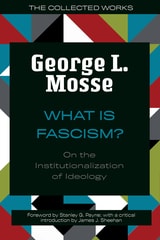
What Is Fascism?
On the Institutionalization of IdeologyGeorge L. Mosse
University of Wisconsin Press, 2026
In 1963, nearly two decades after the end of the most destructive war in human history, George L. Mosse assembled a group of interdisciplinary scholars from diverse backgrounds to answer a seemingly simple question: What is fascism? The landmark seminar that followed, held at Stanford University, came to define the intellectual conversation about European fascism throughout the postwar era. Mosse strove to better understand the legacy of fascism by debating its origins—often contentiously—with the sharpest minds of his generation.
In this volume, which collects Mosse’s lectures as well as his peers’ responses, Mosse and his colleagues wrestle with fascism’s origins and impact. The straightforward question that launched the seminar quickly expands to deeper debates: What are the intellectual foundations of right-wing populist political movements? How had these particular movements risen to power so quickly and then left so much devastation in their wakes? Were charismatic leaders like Hitler and Mussolini driving forces or did the various incarnations of fascism throughout Europe and beyond constitute a broader “revolution”? What was the relationship of religious and cultural institutions to fascism’s rise and cataclysmic fall?
As the word “fascism” takes on new meaning in the twenty-first century, it is more urgent than ever to revisit the work of scholars who witnessed its birth—and its defeat. In the foreword, Stanley G. Payne situates the lively debate in its historical context, and in the critical introduction, James J. Sheehan shares his own memories of the seminar and reflects on how the experience drove Mosse’s later work.