Results by title
8 books match the query 'Nationalists'
Gandhi in India
In His Own WordsMahatma Gandhi and Martin Green
Brandeis University Press, 1987
Mozambique’s Samora Machel
A Life Cut ShortAllen F. Isaacman
Ohio University Press, 2020
The precipitous rise and controversial fall of a formidable African leader.
Samora Machel (1933–1986), the son of small-town farmers, led his people through a war against their Portuguese colonists and became the first president of the People’s Republic of Mozambique.
Machel’s military successes against a colonial regime backed by South Africa, Rhodesia, the United States, and its NATO allies enhanced his reputation as a revolutionary hero to the oppressed people of Southern Africa. In 1986, during the country’s civil war, Machel died in a plane crash under circumstances that remain uncertain.
Allen and Barbara Isaacman lived through many of these changes in Mozambique and bring personal recollections together with archival research and interviews with others who knew Machel or participated in events of the revolutionary or post-revolutionary years.
Nationalists and Nomads
Essays on Francophone African Literature and CultureChristopher L. Miller
University of Chicago Press, 1999
Miller ranges from the beginnings of francophone African literature—which he traces not to the 1930s Negritude movement but to the largely unknown, virulently radical writings of Africans in Paris in the 1920s—to the evolving relations between African literature and nationalism in the 1980s and 1990s. Throughout he aims to offset the contemporary emphasis on the postcolonial at the expense of the colonial, arguing that both are equally complex, with powerful ambiguities. Arguing against blanket advocacy of any one model (such as nationalism or hybridity) to explain these ambiguities, Miller instead seeks a form of thought that can read and recognize the realities of both identity and difference.
Nationalists, Cosmopolitans, and Popular Music in Zimbabwe
Thomas Turino
University of Chicago Press, 2000
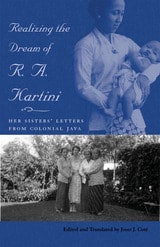
Realizing the Dream of R. A. Kartini
Her Sisters’ Letters from Colonial JavaJoost J. Coté
Ohio University Press, 2008
Realizing the Dream of R. A. Kartini: Her Sisters’ Letters from Colonial Java presents a unique collection of documents reflecting the lives, attitudes, and politics of four Javanese women in the early twentieth century. Joost J. Coté translates the correspondence between Raden Ajeng Kartini, Indonesia’s first feminist, and her sisters, revealing for the first time her sisters’ contributions in defining and carrying out her ideals. With this collection, Coté aims to situate Kartini’s sisters within the more famous Kartini narrative–and indirectly to situate Kartini herself within a broader narrative.
The letters reveal the emotional lives of these modern women and their concerns for the welfare of their husbands and the success of their children in rapidly changing times. While by no means radical nationalists, and not yet extending their horizons to the possibility of an Indonesian nation, these members of a new middle class nevertheless confidently express their belief in their own national identity.
Realizing the Dream of R. A. Kartini is essential reading for scholars of Indonesian history, providing documentary evidence of the culture of modern, urban Java in the late colonial era and an insight into the ferment of the Indonesian nationalist movement in which these women and their husbands played representative roles.
The Phenomenology of Pain
Saulius Geniusas
Ohio University Press, 2020
The Phenomenology of Pain is the first book-length investigation of its topic to appear in English. Groundbreaking, systematic, and illuminating, it opens a dialogue between phenomenology and such disciplines as cognitive science and cultural anthropology to argue that science alone cannot clarify the nature of pain experience without incorporating a phenomenological approach. Building on this premise, Saulius Geniusas develops a novel conception of pain grounded in phenomenological principles: pain is an aversive bodily feeling with a distinct experiential quality, which can only be given in original first-hand experience, either as a feeling-sensation or as an emotion.
Geniusas crystallizes the fundamental methodological principles that underlie phenomenological research. On the basis of those principles, he offers a phenomenological clarification of the fundamental structures of pain experience and contests the common conflation of phenomenology with introspectionism. Geniusas analyzes numerous pain dissociation syndromes, brings into focus the de-personalizing and re-personalizing nature of chronic pain experience, and demonstrates what role somatization and psychologization play in pain experience. In the process, he advances Husserlian phenomenology in a direction that is not explicitly worked out in Husserl’s own writings.
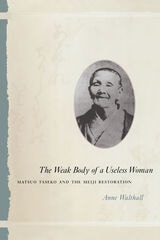
The Weak Body of a Useless Woman
Matsuo Taseko and the Meiji RestorationAnne Walthall
University of Chicago Press, 1998
In telling Taseko's story, Anne Walthall gives us not just the first full biography in English of a peasant woman of the Tokugawa period (1603-1868), but also fresh perspectives on the practices and intellectual concerns of rural entrepreneurs and their role in the Meiji Restoration. Writing about Taseko with a depth and complexity that has thus far been accorded only to men of that time, Walthall has uncovered a tale that will captivate anyone concerned with women's lives and with Japan's dramatic transition to modernity.
Waiting for Mahatma
R. K. Narayan
University of Chicago Press, 1955
"The experience of reading one of his novels is . . . comparable to one's first reaction to the great Russian novels: the fresh realization of the common humanity of all peoples, underlain by a simultaneous sense of strangeness—like one's own reflection seen in a green twilight."—Margaret Parton, New Herald Tribune Book Review
"The hardest of all things for a novelist to communicate is the extraordinary ordinariness of most human happiness. . . . Jane Austen, Soseki, Chekhov: a few bring it off. Narayan is one of them."—Francis King, Spectator
"The novels of R.K. Narayan are the best I have read in any language for a long time."—Amit Roy, Daily Telegraph