Results by title
2 books match the query 'Natsume, Sōseki'
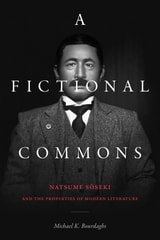
A Fictional Commons
Natsume Soseki and the Properties of Modern LiteratureMichael K. Bourdaghs
Duke University Press, 2021
Modernity arrived in Japan, as elsewhere, through new forms of ownership. In A Fictional Commons, Michael K. Bourdaghs explores how the literary and theoretical works of Natsume Sōseki (1867–1916), widely celebrated as Japan's greatest modern novelist, exploited the contradictions and ambiguities that haunted this new system. Many of his works feature narratives about inheritance, thievery, and the struggle to obtain or preserve material wealth while also imagining alternative ways of owning and sharing. For Sōseki, literature was a means for thinking through—and beyond—private property. Bourdaghs puts Sōseki into dialogue with thinkers from his own era (including William James and Mizuno Rentarō, author of Japan’s first copyright law) and discusses how his work anticipates such theorists as Karatani Kōjin and Franco Moretti. As Bourdaghs shows, Sōseki both appropriated and rejected concepts of ownership and subjectivity in ways that theorized literature as a critical response to the emergence of global capitalism.
[more]
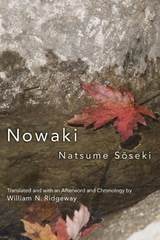
Nowaki
Natsume Soseki; Translated and with an Afterword and Chronology by William N. Ridgeway
University of Michigan Press, 2011
Shirai Dōya is a man of letters, a man of principles. His principles sometimes stand in the way of his teaching career, but his writing allows him to openly address “today’s youth” with stern conviction—although he is still unable to make a comfortable living from his writing. Two youths in particular show interest in his ideas: the tubercular impoverished Takayanagi, an aspiring writer himself (and former student of Dōya’s, as it turns out), and his rich friend, the dandy Nakano. The lives and minds of the three men come together in ways that are both commonplace and surprising. The setting—mainly Tokyo of one hundred years ago—and the preoccupations of these characters will appear distinctly familiar, even today.
[more]