Results by title
2 books match the query 'Natural Sciences'
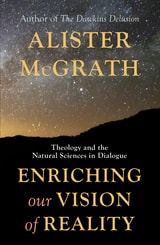
Enriching Our Vision of Reality
Theology and the Natural Sciences in DialogueAlister McGrath
Templeton Press, 2017
“Enriching our Vision of Reality is elegant, erudite, and animated by a constant enthusiasm for its subject. There is everything here—science, theology, philosophy, biography, even some poetry—all enlisted to help us to see the world as it is, both more clearly and with greater delight.” —Reverend Doctor Andrew Davison, Starbridge Lecturer in theology and natural sciences, University of Cambridge, and fellow in theology at Corpus Christi College
“It’s a pleasure to read an introduction to science and Christian belief that is both erudite and accessible. McGrath’s new book is rich with personal examples, biographies of famous scientists and theologians, and effective refutations of their detractors. This invitation to move forward from a bifurcated to an expansive view of reality is recommended for all who seek an ‘integrated understanding’ of science and Christian faith.” —Philip Clayton, editor of The Oxford Handbook of Religion and Science
In this exceptional volume, leading theologian Alister McGrath writes for scientists with an interest in theology, and Christians and theologians who are aware of the importance of the natural sciences. A scene-setting chapter explores the importance of the human quest for intelligibility. The focus then moves to three leading figures who have stimulated discussion about the relationship between science and theology in recent years: Charles Coulson, an Oxford professor of theoretical chemistry who was also a prominent Methodist lay preacher; Thomas F. Torrance, perhaps the finest British theologian of the twentieth-century; and John Polkinghorne, a theoretical physicist and theologian.
The final section of the book features six “parallel conversations” between science and theology, which lay the groundwork for the kind of enriched vision of reality the author hopes to encourage. Here, we are inspired to enjoy individual aspects of nature while seeking to interpret them in the light of deeper revelations about our gloriously strange universe.
[more]
On Knowing--The Natural Sciences
Richard P. McKeon
University of Chicago Press, 1994
Well before the current age of discourse, deconstruction, and multiculturalism, Richard McKeon propounded a philosophy of pluralism showing how "facts" and "values" are dependent on diverse ways of reading texts. This book is a transcription of an entire course, including both lectures and student discussions, taught by McKeon. As such, it provides an exciting introduction to McKeon's conception of pluralism, a central aspect of neo-Pragmatism, while demonstrating how pluralism works in a classroom setting.
In his lectures, McKeon outlines the entire history of Western thinking on the sciences. Treating the central concepts of motion, space, time, and cause, he traces modern intellectual debates back to the ancient Greeks, notably Plato, Aristotle, Democritus, and the Sophists. As he brings the story of Western science up to the twentieth century, he uses his fabled semantic schema (reproduced here for the first time) to uncover new ideas and observations about cosmology, mechanics, dynamics, and other aspects of physical science.
Illustrating the broad historical sweep of the lectures are a series of discussions which give detail to the course's intellectual framework. These discussions of Plato, Aristotle, Galileo, Newton, and Maxwell are perhaps the first published rendition of a philosopher in literal dialogue with his students. Led by McKeon's pointed questioning, the discussions reveal the difficulties and possibilities of learning to engage in serious intellectual communication.
[more]