Results by title
13 books match the query 'Natural World'
A Place for Humility
Whitman, Dickinson, and the Natural WorldChristine Gerhardt
University of Iowa Press, 2014
Dickinson and Whitman developed their environmentally suggestive poetics at roughly the same historical moment, at a time when a major shift was occurring in American culture’s view and understanding of the natural world. Just as they were achieving poetic maturity, the dominant view of wilderness was beginning to shift from obstacle or exploitable resource to an endangered treasure in need of conservation and preservation.
A Place for Humility examines Dickinson’s and Whitman’s poetry in conjunction with this important change in American environmental perception, exploring the links between their poetic projects within the context of developing nineteenth-century environmental thought. Christine Gerhardt argues that each author's poetry participates in this shift in different but related ways, and that their involvement with their culture’s growing environmental sensibilities constitutes an important connection between their disparate poetic projects. There may be few direct links between Dickinson’s “letter to the World” and Whitman’s “language experiment,” but via a web of environmentally-oriented discourses, their poetry engages in a cultural conversation about the natural world and the possibilities and limitations of writing about it—a conversation in which their thematic and formal choices meet on a surprising number of levels.

Against Ecological Sovereignty
Ethics, Biopolitics, and Saving the Natural WorldMick Smith
University of Minnesota Press, 2011
Against Ecological Sovereignty is a passionate defense of radical ecology that speaks directly to current debates concerning the nature, and dangers, of sovereign power. Engaging the work of Bataille, Arendt, Levinas, Nancy, and Agamben, among others, Mick Smith reconnects the political critique of sovereign power with ecological considerations, arguing that ethical and political responsibilities for the consequences of our actions do not end with those defined as human.
Against Ecological Sovereignty is the first book to turn Agamben’s analysis of sovereignty and biopolitics toward an investigation of ecological concerns. In doing so it exposes limits to that thought, maintaining that the increasingly widespread biopolitical management of human populations has an unrecognized ecological analogue—reducing nature to a “resource” for human projects. Smith contends that a radical ecological politics must resist both the depoliticizing exercise of sovereign power and the pervasive spread of biopolitics in order to reveal new possibilities for creating healthy human and nonhuman communities.
Presenting a stinging critique of human claims to sovereignty over the natural world, Smith proposes an alternative way to conceive of posthumanist ecological communities—one that recognizes the utter singularity of the beings in them.
Atomic Environments
Nuclear Technologies, the Natural World, and Policymaking, 1945–1960Neil S. Oatsvall
University of Alabama Press, 2023
Demonstrates how policymakers influenced environmental science during the early nuclear age
In Atomic Environments: Nuclear Technologies, the Natural World, and Policymaking, 1945–1960, Neil S. Oatsvall examines how top officials in the Truman and Eisenhower administrations used environmental science to develop nuclear strategy at the beginning of the Cold War. While many people were involved in research and analysis during the period in question, it was at highest levels of executive decision-making where environmental science and nuclear science most clearly combined to shape the nation’s policies.
Oatsvall clearly demonstrates how the natural world and the scientific disciplines that study it became integral parts of nuclear science rather than adversarial fields of knowledge. But while nuclear technologies heavily depended on environmental science to develop, those same technologies frequently caused great harm to the natural world. Moreover, while some individuals expressed real anxieties about the damage wrought by nuclear technologies, policymakers as a class consistently made choices that privileged nuclear boosterism and secrecy, prioritizing institutional values over the lives and living systems that they were ostensibly charged to protect.
By scrutinizing institutional policymaking practices and agendas at the birth of the nuclear age, a constant set of values becomes clear. Oatsvall reveals an emerging technocratic class that routinely valued knowledge about the environment to help create and maintain a nuclear arsenal, despite its existential threat to life on earth and the negative effects many nuclear technologies had on ecosystems and the American people alike. Although policymakers took their charge to protect and advance the welfare of the United States and its people seriously, Atomic Environments demonstrates how they often failed to do so because their allegiance to the US nuclear hierarchy blinded them to the real risks and dangers of the nuclear age.
Curious Encounters with the Natural World
From Grumpy Spiders to Hidden TigersMichael Jeffords
University of Illinois Press, 2017
Everyday Nature
Knowledge of the Natural World in Colonial New YorkGronim, Sara S
Rutgers University Press, 2007
In the modern world, the public looks to scientists and scholars for their expertise on issues ranging from the effectiveness of vaccines to the causes of natural disasters. But for early Americans, whose relationship to nature was more intimate and perilous than our own, personal experience, political allegiances, and faith in God took precedence over the experiments of the learned.
In Everyday Nature, Sara Gronim shows how scientific advances were received in the early modern world, from the time Europeans settled in America until just before the American Revolution. Settlers approached a wide range of innovations, such as smallpox inoculation, maps and surveys, Copernican cosmology, and Ben Franklin’s experiments with electricity, with great skepticism. New Yorkers in particular were distrustful because of the chronic political and religious factionalism in the colony. Those discoveries that could be easily reconciled with existing beliefs about healing the sick, agricultural practices, and the revolution of the planets were more readily embraced.
A fascinating portrait of colonial life, this book traces a series of innovations that were disseminated throughout the Atlantic world during the Enlightenment, and shows how colonial New Yorkers integrated new knowledge into their lives.

Father Nature
Fathers as Guides to the Natural WorldPaul S. & Stan Piper & Tag
University of Iowa Press, 2003
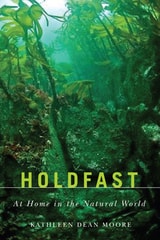
Holdfast
At Home in the Natural WorldKathleen Dean Moore
Oregon State University Press, 2013
Naturalist and philosopher Kathleen Dean Moore meditates on connection and separation in these twenty-one elegant, probing essays. Using the metaphor of holdfasts—the structures that attach seaweed to rocks with a grip strong enough to withstand winter gales—she examines our connections to our own bedrock.
“When people lock themselves in their houses at night and seal the windows shut to keep out storms, it is possible to forget, sometimes for years and years, that human beings are part of the natural world,” she writes. Holdfast passionately reclaims an awareness of the natural world, exploring the sense of belonging fostered by the communal howls of wolves; the inevitability of losing children to their own lives; the fear of bears and love of storms; the sublimity of life and longing in the creatures of the sea; her agonizing decision when facing her father’s bone-deep pain. As Moore travels philosophically and geographically—from Oregon’s shores to Alaska’s islands—she leaves no doubt of her virtuosity and range.
The new afterword is an important statement on the new responsibilities of nature writers as the world faces the consequences of climate change.
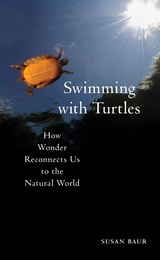
Swimming with Turtles
How Wonder Reconnects Us to the Natural WorldSusan Baur
University of Massachusetts Press, 2026
A memoir of discovery, loss, and wonder that shows us how to slow down
When psychologist and author Susan Baur first slipped into a Cape Cod pond with a snorkel, she wasn’t looking for transformation, just a swim. But beneath the surface, she discovered something extraordinary: minnows hiding among water lilies; fresh-water jellies like jewels and—most striking of all—painted, musk, and snapping turtles. Whether the turtles were buried in mud, teetering on a submerged branch, or drifting like ancient astronauts, they pulled her into a mysterious happiness she could not explain.
Learning to move slowly enough to see them became both her new discipline and her greatest joy. Each dive required patience, curiosity, and humility, and she learned to read the water, follow a subtle shadow, and anticipate the turtles’ rhythms without disturbing their world. As she mastered the art of swimming with turtles, Baur also fell in love with an older man whose companionship deepened her connection to the natural world. When he passed away, grief drove her deeper into the water. There, among the turtles, she found solace and purpose: a reason to keep diving, looking, and learning.
Over nearly two decades, Baur became a self-taught naturalist, children’s author (of The Turtle Sisters series), and unlikely environmental advocate, founding Old Ladies Against Underwater Garbage to protect the ponds she had grown to love. With humor, heart, and vivid observation, Baur shows that wonder isn’t reserved for the young or the lucky—it waits beneath the surface for anyone willing to slow down, look closely, and stay a while.
Swimming with Turtles
How Wonder Reconnects Us to the Natural WorldWritten by Susan Baur. Narrated by Moe Egan
University of Massachusetts Press, 2026
A memoir of discovery, loss, and wonder that shows us how to slow down
When psychologist and author Susan Baur first slipped into a Cape Cod pond with a snorkel, she wasn’t looking for transformation, just a swim. But beneath the surface, she discovered something extraordinary: minnows hiding among water lilies; fresh-water jellies like jewels and—most striking of all—painted, musk, and snapping turtles. Whether the turtles were buried in mud, teetering on a submerged branch, or drifting like ancient astronauts, they pulled her into a mysterious happiness she could not explain.
Learning to move slowly enough to see them became both her new discipline and her greatest joy. Each dive required patience, curiosity, and humility, and she learned to read the water, follow a subtle shadow, and anticipate the turtles’ rhythms without disturbing their world. As she mastered the art of swimming with turtles, Baur also fell in love with an older man whose companionship deepened her connection to the natural world. When he passed away, grief drove her deeper into the water. There, among the turtles, she found solace and purpose: a reason to keep diving, looking, and learning.
Over nearly two decades, Baur became a self-taught naturalist, children’s author (of The Turtle Sisters series), and unlikely environmental advocate, founding Old Ladies Against Underwater Garbage to protect the ponds she had grown to love. With humor, heart, and vivid observation, Baur shows that wonder isn’t reserved for the young or the lucky—it waits beneath the surface for anyone willing to slow down, look closely, and stay a while.

The Natural World as a Philosophical Problem
Jan Patocka, edited by Ivan Chvatík and Lubica Ucnik, translated by Erika Abrams, foreword by Ludwig Landgrebe
Northwestern University Press, 2016
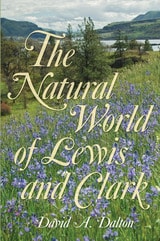
The Natural World of Lewis and Clark
David A. Dalton
University of Missouri Press, 2007
On their journey westward, Lewis and Clark demonstrated an amazing ability to identify the new plants and animals they encountered, and their observations enriched science’s understanding of the trans-Mississippi West. Others have written about their discoveries and have faithfully cataloged their findings; now a twenty-first-century biologist reexamines some of those discoveries in the light of modern science to show for the first time their lasting biological significance.
The Natural World of Lewis and Clark interprets the expedition’s findings from a modern perspective to show how advances such as DNA research, modern understanding of proteins, and the latest laboratory methods shed new light on them. David Dalton recounts the expedition’s observations and, in clear, readily accessible terms, relates them to principles of ecology, genetics, physiology, and even animal behavior.
Writing in informal language with a bit of wry humor, Dalton invites readers to imagine the West that Lewis and Clark found, revealing the dynamic features of nature and the dramatic changes that earlier peoples brought about. He explains surprising facts, ranging from why Indians used cottonwood bark as winter feed for horses to why the explorers experienced gastric distress with some foods, and even why the Expedition’s dog would have been well-advised to avoid a diet of salmon.
Dalton introduces the tools and techniques of today’s science in a way that won’t intimidate nonspecialist readers. Throughout the book he expertly balances botanical and zoological information, with coverage ranging from the extinction of large animals in North America a few thousand years ago to the expected effects of invasive species and climate change in the coming centuries.
Enhanced with unusual and informative illustrations—not only nature photography but also historical images—this book will fascinate any reader with an interest in the natural history of the American West as well as broader issues in conservation and ecology. The Natural World of Lewis and Clark tells the story behind the story of this remarkable expedition and shows that its legacy extended not only across a continent but also into our own time.
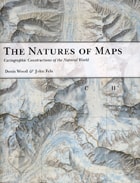
The Natures of Maps
Cartographic Constructions of the Natural WorldDenis Wood and John Fels
University of Chicago Press, 2008
To answer that question, the authors turn to a category of maps with a particularly strong reputation for objectivity: maps of nature. From depictions of species habitats and bird migrations to portrayals of the wilds of the Grand Canyon and the reaches of the Milky Way, such maps are usually presumed—even by users who should know better—to be strictly scientific. Yet by drawing our attention to every aspect of these maps’ self-presentation, from place names to titles and legends, the authors reveal the way that each piece of information collaborates in a disguised effort to mount an argument about reality. Without our realizing it, those arguments can then come to define our very relationship to the natural world—determining whether we see ourselves as humble hikers or rampaging despoilers, participants or observers, consumers or stewards.
Richly illustrated, and crafted in vivid and witty prose, The Natures of Maps will enlighten and entertain map aficionados, scholars, and armchair navigators alike. You’ll never be able to look at Google Maps quite the same way again.
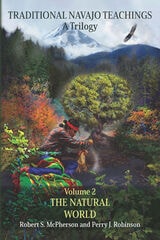
Traditional Navajo Teachings
The Natural WorldRobert S. McPherson
University Press of Colorado, 2020
"Navajo teachings provide a classic study of a land-based religion that involves every aspect of the physical world in a spiritual universe. Nothing is too big or small—everything holds a power, provides a teaching, and responds through an inner form. Beyond the material life of daily existence, there lies a world of interconnected relations made apparent in Volume II, The Natural World. This book graphically describes elements of life rooted in the Navajo philosophy of hózhǫ́. A unified harmony results. I highly recommend this book as a study in understanding the power of relationships that populate the Diné worldview."
—Clayton Long, a participant/creator of the Navajo Rosetta Stone; Bilingual Education Director (retired), San Juan School District, Utah; and curriculum developer for the Navajo Nation.
"For days after reading The Natural World, I found myself looking at my surroundings in a different way. The vibrant spirit of the earth and every plant or animal I encountered seemed to glow through a translucent shell. I have always been a nature-lover and gotten a sense of peace from being outdoors, but since reading these beautiful Navajo teachings I am filled with a profound sense of joy and gratitude every time I walk outside."
—Cindy Yurth, The Navajo Times